9DEG | pdb_00009deg

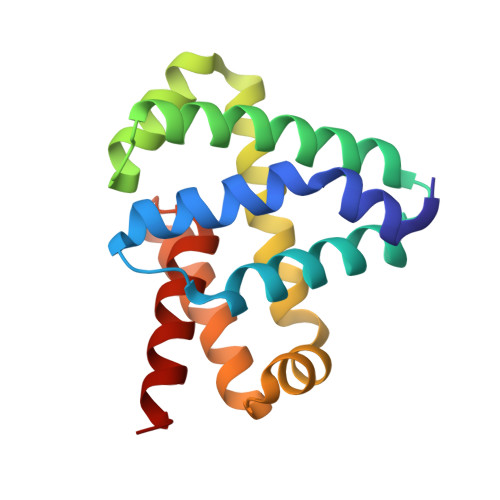
The designed serine hydrolase known as win1

  • Classification: HYDROLASE
  • Organism(s): synthetic construct
  • Expression System: Escherichia coli
  • Mutation(s): No 

  • Deposited: 2024-08-28 Released: 2025-02-19 
  • Deposition Author(s): Lauko, A., Pellock, S.J., Bera, A.K.
  • Funding Organization(s): Howard Hughes Medical Institute (HHMI), National Institutes of Health/National Institute of General Medical Sciences (NIH/NIGMS), Defense Advanced Research Projects Agency (DARPA), Defense Threat Reduction Agency (DTRA), Other private

Experimental Data Snapshot

  • Method: X-RAY DIFFRACTION
  • Resolution: 2.11 Å
  • R-Value Free: 
    0.262 (Depositor), 0.259 (DCC) 
  • R-Value Work: 
    0.194 (Depositor), 0.195 (DCC) 
  • R-Value Observed: 
    0.201 (Depositor) 

Starting Model: in silico
View more details

wwPDB Validation   3D Report Full Report


Ligand Structure Quality Assessment 


This is version 1.2 of the entry. See complete history


Literature

Computational design of serine hydrolases.

Lauko, A.Pellock, S.J.Sumida, K.H.Anishchenko, I.Juergens, D.Ahern, W.Jeung, J.Shida, A.F.Hunt, A.Kalvet, I.Norn, C.Humphreys, I.R.Jamieson, C.Krishna, R.Kipnis, Y.Kang, A.Brackenbrough, E.Bera, A.K.Sankaran, B.Houk, K.N.Baker, D.

(2025) Science 388: eadu2454-eadu2454

  • DOI: https://doi.org/10.1126/science.adu2454
  • Primary Citation of Related Structures:  
    9DED, 9DEE, 9DEF, 9DEG, 9DEH, 9MRB

  • PubMed Abstract: 

    The design of enzymes with complex active sites that mediate multistep reactions remains an outstanding challenge. With serine hydrolases as a model system, we combined the generative capabilities of RFdiffusion with an ensemble generation method for assessing active site preorganization to design enzymes starting from minimal active site descriptions. Experimental characterization revealed catalytic efficiencies ( k cat / K m ) up to 2.2x10 5 M -1 s -1 and crystal structures that closely match the design models (Cα RMSDs < 1 Å). Selection for structural compatibility across the reaction coordinate enabled identification of new catalysts in low-throughput screens with five different folds distinct from those of natural serine hydrolases. Our de novo approach provides insight into the geometric basis of catalysis and a roadmap for designing enzymes that catalyze multistep transformations.


  • Organizational Affiliation
    • Department of Biochemistry, University of Washington, Seattle, WA, USA.

Macromolecules
Find similar proteins by:  (by identity cutoff)  |  3D Structure
Entity ID: 1
MoleculeChains Sequence LengthOrganismDetailsImage
Win1
A, B
158synthetic constructMutation(s): 0 
Entity Groups  
Sequence Clusters30% Identity50% Identity70% Identity90% Identity95% Identity100% Identity
Sequence Annotations
Expand
  • Reference Sequence
Experimental Data & Validation

Experimental Data

  • Method: X-RAY DIFFRACTION
  • Resolution: 2.11 Å
  • R-Value Free:  0.262 (Depositor), 0.259 (DCC) 
  • R-Value Work:  0.194 (Depositor), 0.195 (DCC) 
  • R-Value Observed: 0.201 (Depositor) 
Space Group: P 21 21 21
Unit Cell:
Length ( Å )Angle ( ˚ )
a = 35.811α = 90
b = 82.032β = 90
c = 101.875γ = 90
Software Package:
Software NamePurpose
PHENIXrefinement
XDSdata reduction
Aimlessdata scaling
PHENIXphasing

Structure Validation

View Full Validation Report


Ligand Structure Quality Assessment 


Entry History & Funding Information

Deposition Data


Funding OrganizationLocationGrant Number
Howard Hughes Medical Institute (HHMI)United States--
National Institutes of Health/National Institute of General Medical Sciences (NIH/NIGMS)United States--
Defense Advanced Research Projects Agency (DARPA)United States--
Defense Threat Reduction Agency (DTRA)United States--
Other private--

Revision History  (Full details and data files)

  • Version 1.0: 2025-02-19
    Type: Initial release
  • Version 1.1: 2025-02-26
    Changes: Database references
  • Version 1.2: 2025-04-30
    Changes: Database references