9D30 | pdb_00009d30

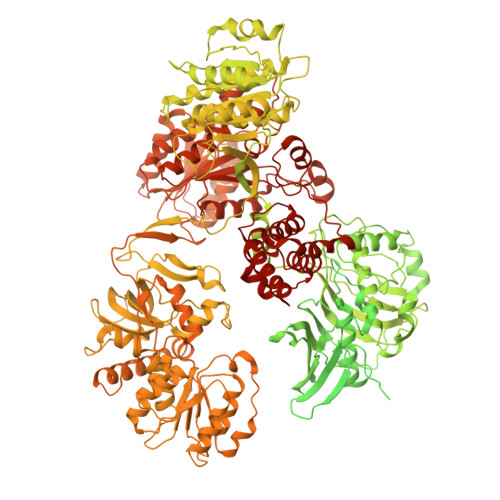
Cryo-EM structure of mycocerosic acid synthase with a single DH-ACP crosslink using C16 alpha-bromoamide. Complex C

  • Classification: BIOSYNTHETIC PROTEIN
  • Organism(s): Mycobacterium tuberculosis
  • Expression System: Escherichia coli
  • Mutation(s): No 

  • Deposited: 2024-08-09 Released: 2025-08-13 
  • Deposition Author(s): Heberlig, G.W., Jiang, Z., Burkart, M.D.
  • Funding Organization(s): National Institutes of Health/National Institute of General Medical Sciences (NIH/NIGMS), National Institutes of Health/National Heart, Lung, and Blood Institute (NIH/NHLBI), National Science Foundation (NSF, United States)

Experimental Data Snapshot

  • Method: ELECTRON MICROSCOPY
  • Resolution: 3.74 Å
  • Aggregation State: PARTICLE 
  • Reconstruction Method: SINGLE PARTICLE 

Starting Model: in silico
View more details

wwPDB Validation   3D Report Full Report


This is version 1.1 of the entry. See complete history


Literature

Visualizing acyl carrier protein interactions within a crosslinked type I polyketide synthase.

Jiang, Z.Heberlig, G.W.Chen, J.A.Huynh, J.La Clair, J.J.Burkart, M.D.

(2025) Nat Commun 16: 7798-7798

  • DOI: https://doi.org/10.1038/s41467-025-63024-x
  • Primary Citation of Related Structures:  
    9D2Y, 9D2Z, 9D30

  • PubMed Abstract: 

    Using a combination of dual covalent crosslinking and cryo-EM analyses, we elucidate the structure of mycocerosic acid synthase from Mycobacterium tuberculosis trapped in two distinct catalytic states during its iterative cycle. These structures reveal domain architecture of the acyl carrier protein mediating condensation and dehydration through dual site-selective crosslinking of the acyl carrier protein with the ketosynthase and dehydratase domains. Map density was sufficient to visualize full domain architecture with active site-bound probes and elucidate key interactions of four distinct crosslinked species. Here, iterative vectorial polyketide biosynthesis arises through an overall twisting and tilting architecture, enabling positioning and entry of the cognate substrate at each enzymatic domain. These structures present valuable details for future therapeutic design against mycocerosic acid biosynthesis in M. tuberculosis.


  • Organizational Affiliation
    • Department of Chemistry and Biochemistry, University of California, San Diego, La Jolla, CA, USA.

Macromolecules
Find similar proteins by:  (by identity cutoff)  |  3D Structure
Entity ID: 1
MoleculeChains Sequence LengthOrganismDetailsImage
Mycocerosic acid synthase
A, B
2,124Mycobacterium tuberculosisMutation(s): 0 
Gene Names: masA4S10_03068ERS035788_00558ERS053720_02716SAMEA2683035_02325
EC: 2.3.1.111
UniProt
Find proteins for Q02251 (Mycobacterium bovis (strain ATCC BAA-935 / AF2122/97))
Explore Q02251 
Go to UniProtKB:  Q02251
Entity Groups  
Sequence Clusters30% Identity50% Identity70% Identity90% Identity95% Identity100% Identity
UniProt GroupQ02251
Sequence Annotations
Expand
  • Reference Sequence
Small Molecules
Ligands 1 Unique
IDChains Name / Formula / InChI Key2D Diagram3D Interactions
MU4
Query on MU4

Download Ideal Coordinates CCD File 
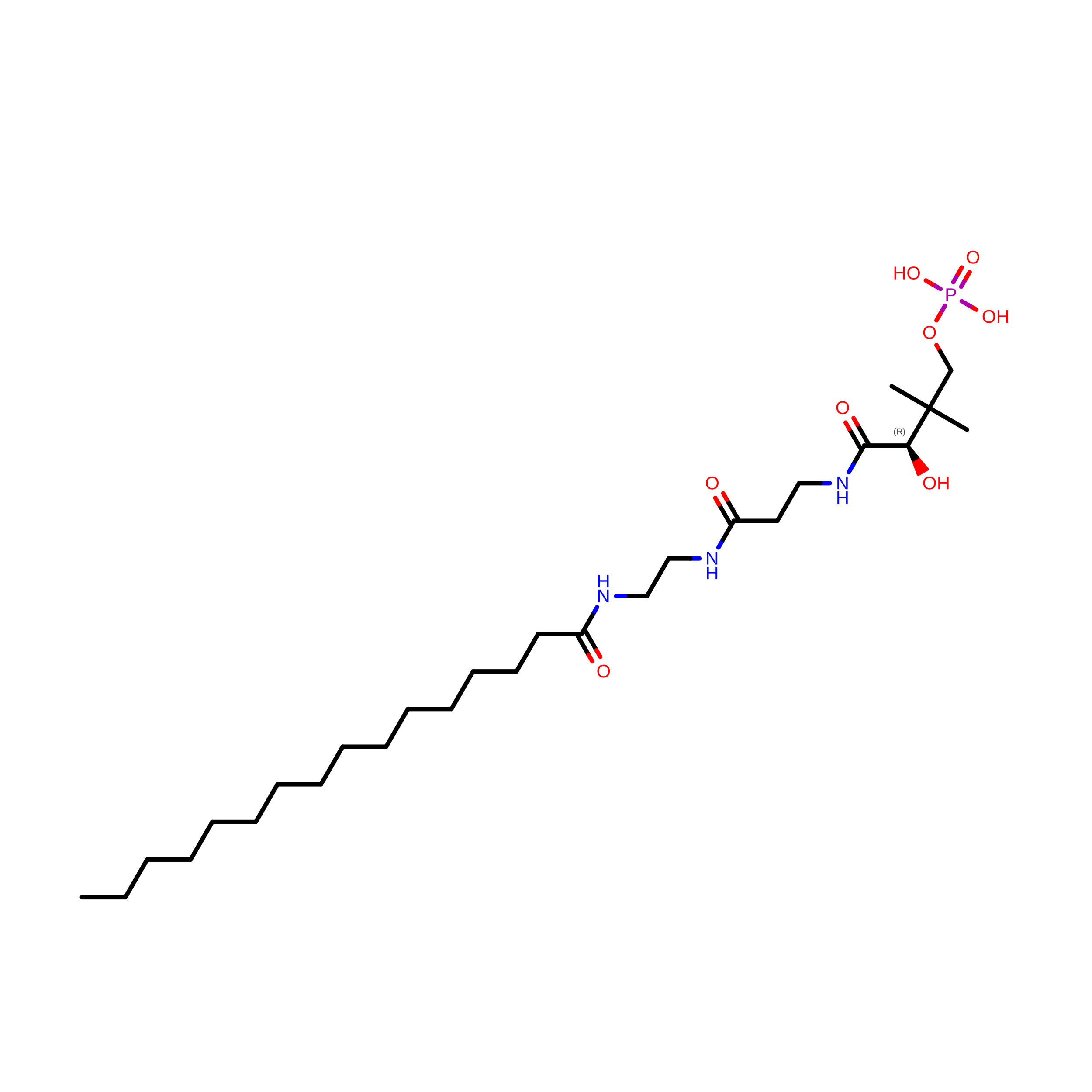
C [auth A]N-[2-(hexadecanoylamino)ethyl]-N~3~-[(2R)-2-hydroxy-3,3-dimethyl-4-(phosphonooxy)butanoyl]-beta-alaninamide
C27 H54 N3 O8 P
KCTLTWRYJGTZMN-VWLOTQADSA-N
Experimental Data & Validation

Experimental Data

  • Method: ELECTRON MICROSCOPY
  • Resolution: 3.74 Å
  • Aggregation State: PARTICLE 
  • Reconstruction Method: SINGLE PARTICLE 
EM Software:
TaskSoftware PackageVersion
MODEL REFINEMENTPHENIX
RECONSTRUCTIONcryoSPARC

Structure Validation

View Full Validation Report


Entry History & Funding Information

Deposition Data


Funding OrganizationLocationGrant Number
National Institutes of Health/National Institute of General Medical Sciences (NIH/NIGMS)United StatesR01 GM095970
National Institutes of Health/National Heart, Lung, and Blood Institute (NIH/NHLBI)United StatesK12 HL141956
National Science Foundation (NSF, United States)United StatesDMR-2011924

Revision History  (Full details and data files)

  • Version 1.0: 2025-08-13
    Type: Initial release
  • Version 1.1: 2025-09-03
    Changes: Data collection, Database references