Download Mendeley
The Role of Asparagine as a Gatekeeper Residue in the Selective Binding of Rare Earth Elements by Lanthanide-Binding Peptides.
Kt, S.S., Qiao, B., Marmorstein, J.G., Wang, Y., Favaro, D.C., Stebe, K.J., Petersson, E.J., Radhakrishnan, R., de la Fuente-Nunez, C., Tu, R.S., Maldarelli, C., Olvera de la Cruz, M., Messinger, R.J.(2025) Chemistry : e202501318-e202501318
- PubMed: 40312258 Search on PubMed
- DOI: https://doi.org/10.1002/chem.202501318
- Primary Citation Related Structures:
9CEQ - PubMed Abstract:
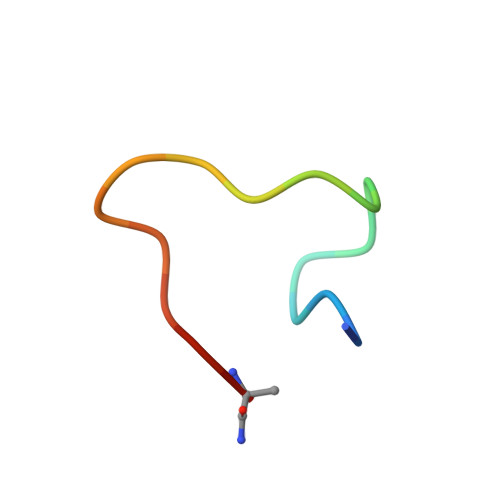
Lanthanide-binding tag (LBT) peptides selectively complex lanthanide cations (Ln 3+ ) in their binding pockets and are promising for lanthanide separation. However, designing LBTs that selectively target specific Ln 3+ cations remains a challenge due to limited molecular-level understanding and control of interactions within the lanthanide-binding pocket. In this study, we reveal that the N5 asparagine residue acts as a gatekeeper in the binding pocket, resulting in a 100-fold selectivity for smaller Lu 3+ over larger La 3+ cations. Nuclear magnetic resonance spectroscopy and molecular dynamics simulations show that the N5 residue weakly binds to the larger La 3+ cation, permitting H 2 O molecules inside the pocket. For the smaller Lu 3+ cations, the N5 residue forms an inter-arm hydrogen bond with the E14 glutamic acid residue, locking the Lu 3+ cation in the pocket and preventing H 2 O infiltration. Mutating the N5 asparagine to a D5 aspartic acid prevents such a hydrogen bond, eliminating the gatekeeping mechanism and precipitously reducing selectivity. The resulting binding affinity to Ln 3+ cations is non-monotonic but generally increases with cation size. These results suggest a molecular design paradigm: the reduced affinity for larger lanthanides is due to open pocket conformations, while the selectivity of smaller Ln 3+ cations over larger ones is due to the gatekeeping hydrogen bond.
- Department of Chemical Engineering, The City College of New York, CUNY, 160 Convent Ave, New York, NY, 10031, USA.
Organizational Affiliation: