9CD4 | pdb_00009cd4

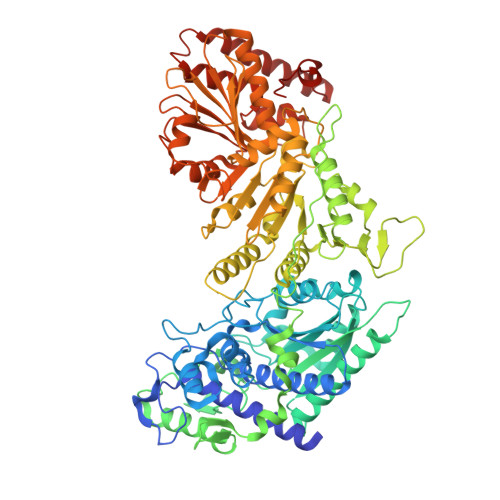
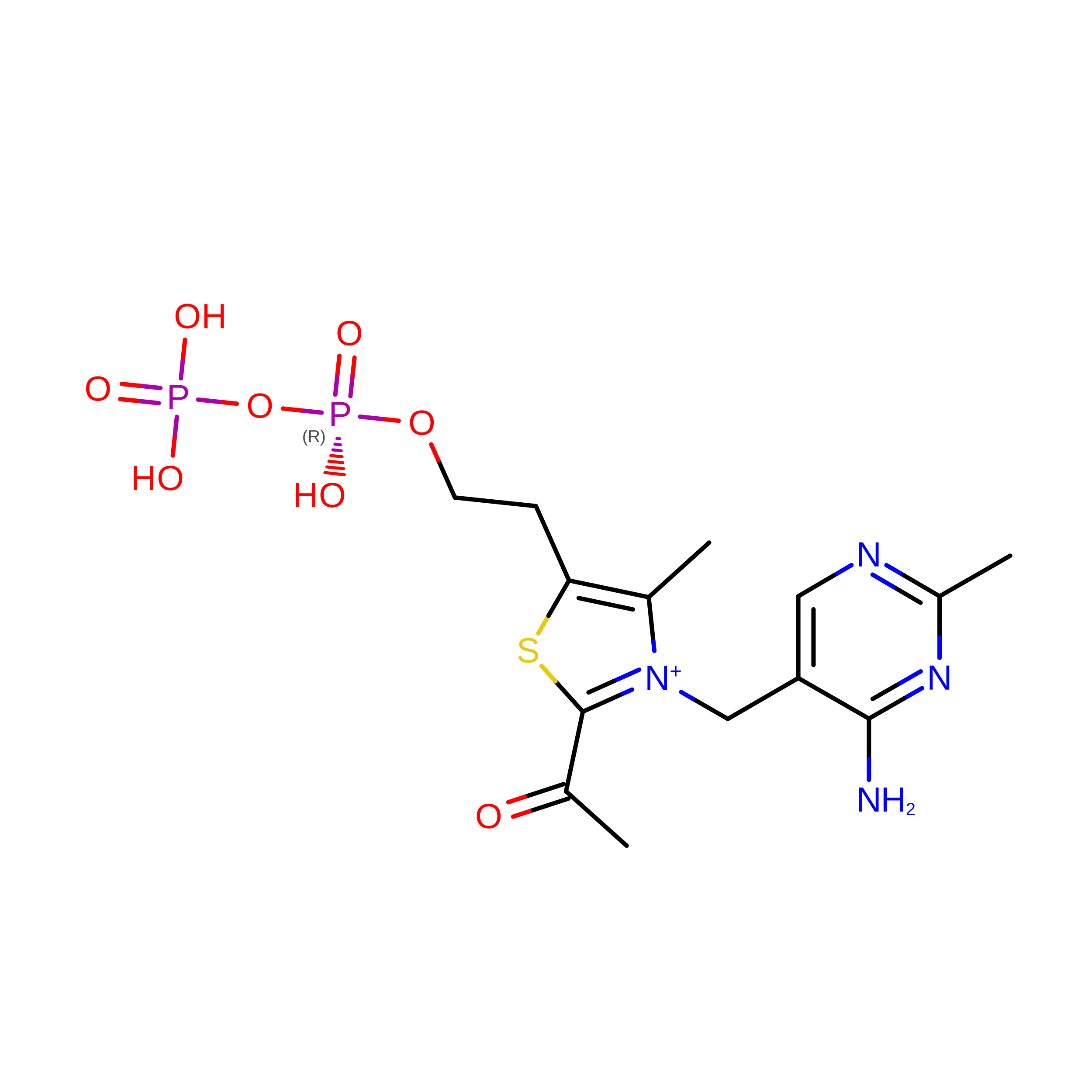
Cryo-EM structure of Candidatus Saccharibacterium phosphoketolase complexed with 2-acetyl-thiamine diphosphate


Experimental Data Snapshot

  • Method: ELECTRON MICROSCOPY
  • Resolution: 2.30 Å
  • Aggregation State: PARTICLE 
  • Reconstruction Method: SINGLE PARTICLE 

Starting Model: in silico
View more details

wwPDB Validation   3D Report Full Report


This is version 1.1 of the entry. See complete history


Literature

A synthetic cell-free pathway for biocatalytic upgrading of one-carbon substrates.

Landwehr, G.M.Vogeli, B.Tian, C.Singal, B.Gupta, A.Lion, R.Sargent, E.H.Karim, A.S.Jewett, M.C.

(2024) bioRxiv 

  • DOI: https://doi.org/10.1101/2024.08.08.607227
  • Primary Citation of Related Structures:  
    9CD3, 9CD4

  • PubMed Abstract: 

    Biotechnological processes hold tremendous potential for the efficient and sustainable conversion of one-carbon (C1) substrates into complex multi-carbon products. However, the development of robust and versatile biocatalytic systems for this purpose remains a significant challenge. In this study, we report a hybrid electrochemical-biochemical cell-free system for the conversion of C1 substrates into the universal biological building block acetyl-CoA. The synthetic reductive formate pathway (ReForm) consists of five core enzymes catalyzing non-natural reactions that were established through a cell-free enzyme engineering platform. We demonstrate that ReForm works in a plug-and-play manner to accept diverse C1 substrates including CO 2 equivalents. We anticipate that ReForm will facilitate efforts to build and improve synthetic C1 utilization pathways for a formate-based bioeconomy.


  • Organizational Affiliation
    • Department of Chemical and Biological Engineering, Northwestern University, Evanston, IL, 60208, USA.

Macromolecules
Find similar proteins by:  (by identity cutoff)  |  3D Structure
Entity ID: 1
MoleculeChains Sequence LengthOrganismDetailsImage
Phosphoketolase family proteinA [auth C],
B [auth D]
799Candidatus Saccharimonadota bacteriumMutation(s): 0 
Gene Names: HG452_002440
Entity Groups  
Sequence Clusters30% Identity50% Identity70% Identity90% Identity95% Identity100% Identity
Sequence Annotations
Expand
  • Reference Sequence
Small Molecules
Experimental Data & Validation

Experimental Data

  • Method: ELECTRON MICROSCOPY
  • Resolution: 2.30 Å
  • Aggregation State: PARTICLE 
  • Reconstruction Method: SINGLE PARTICLE 
EM Software:
TaskSoftware PackageVersion
MODEL REFINEMENTPHENIX1.21.1_5286

Structure Validation

View Full Validation Report


Entry History & Funding Information

Deposition Data


Funding OrganizationLocationGrant Number
Department of Energy (DOE, United States)United StatesDE-SC0023278

Revision History  (Full details and data files)

  • Version 1.0: 2025-08-06
    Type: Initial release
  • Version 1.1: 2025-11-26
    Changes: Data collection, Database references