9CD2 | pdb_00009cd2

Structure of E. coli ZDHYS365 multi-ubiquitin domain protein


Experimental Data Snapshot

  • Method: X-RAY DIFFRACTION
  • Resolution: 1.87 Å
  • R-Value Free: 
    0.213 (Depositor), 0.212 (DCC) 
  • R-Value Work: 
    0.182 (Depositor), 0.181 (DCC) 
  • R-Value Observed: 
    0.183 (Depositor) 

Starting Model: in silico
View more details

wwPDB Validation 3D Report Full Report

Validation slider image for 9CD2

This is version 1.1 of the entry. See complete history

Literature

Structural diversity and oligomerization of bacterial ubiquitin-like proteins.

Gong, M.Ye, Q.Gu, Y.Chambers, L.R.Bobkov, A.A.Arakawa, N.K.Matyszewski, M.Corbett, K.D.

(2025) Structure 33: 1016-1026.e4

  • DOI: https://doi.org/10.1016/j.str.2025.03.011
  • Primary Citation Related Structures: 
    8U38, 9CD2, 9D59, 9D5A, 9D5B

  • PubMed Abstract: 

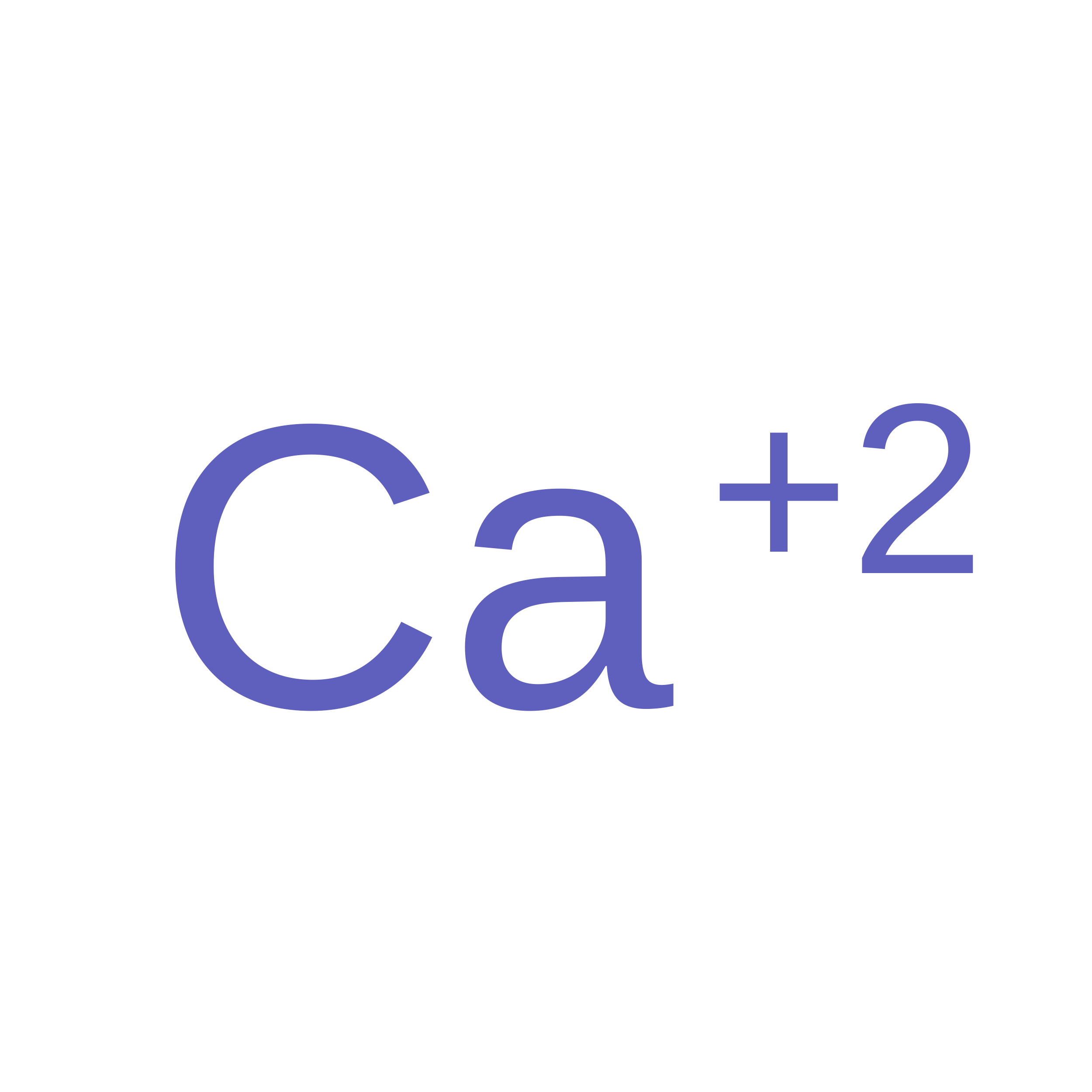
    Bacteria possess a variety of operons with homology to eukaryotic ubiquitination pathways that encode predicted E1, E2, E3, deubiquitinase, and ubiquitin-like proteins. Some of these pathways have recently been shown to function in anti-bacteriophage immunity, but the biological functions of others remain unknown. Here, we show that ubiquitin-like proteins in two bacterial operon families show surprising architectural diversity, possessing one to three β-grasp domains preceded by diverse N-terminal domains. We find that a large group of bacterial ubiquitin-like proteins possess three β-grasp domains and form homodimers and helical filaments mediated by conserved Ca 2+ ion binding sites. Our findings highlight a distinctive mode of self-assembly for ubiquitin-like proteins and suggest that Ca 2+ -mediated ubiquitin-like protein filament assembly and/or disassembly enables cells to sense and respond to stress conditions that alter intracellular metal ion concentration.


  • Organizational Affiliation
    • Department of Cellular and Molecular Medicine, University of California, San Diego, La Jolla, CA 92093, USA.

Macromolecule Content 

  • Total Structure Weight: 51.51 kDa 
  • Atom Count: 4,091 
  • Modeled Residue Count: 436 
  • Deposited Residue Count: 444 
  • Unique protein chains: 2

Macromolecules

Find similar proteins by:|  3D Structure
Entity ID: 1
MoleculeChains  Sequence LengthOrganismDetailsImage
ZDHYS365 multi-ubiquitin domain protein222Escherichia coliMutation(s): 0 
Gene Names: GQE86_25035
Find similar proteins by:|  3D Structure
Entity ID: 2
MoleculeChains  Sequence LengthOrganismDetailsImage
ZDHYS365 multi-ubiquitin domain protein222Escherichia coliMutation(s): 0 
Gene Names: GQE86_25035

Experimental Data & Validation

Experimental Data

  • Method: X-RAY DIFFRACTION
  • Resolution: 1.87 Å
  • R-Value Free:  0.213 (Depositor), 0.212 (DCC) 
  • R-Value Work:  0.182 (Depositor), 0.181 (DCC) 
  • R-Value Observed: 0.183 (Depositor) 
Space Group: P 32 2 1
Unit Cell:
Length ( Å )Angle ( ˚ )
a = 117.538α = 90
b = 117.538β = 90
c = 104.444γ = 120
Software Package:
Software NamePurpose
PHENIXrefinement
XDSdata reduction
Aimlessdata scaling
PHASERphasing

Structure Validation

View Full Validation Report


Entry History 

& Funding Information

Deposition Data


Funding OrganizationLocationGrant Number
National Institutes of Health/National Institute of General Medical Sciences (NIH/NIGMS)United StatesR35 GM144121

Revision History  (Full details and data files)

  • Version 1.0: 2025-04-02
    Type: Initial release
  • Version 1.1: 2025-10-15
    Changes: Database references