Download Mendeley
Design of intrinsically disordered region binding proteins.
Wu, K., Jiang, H., Hicks, D.R., Liu, C., Muratspahic, E., Ramelot, T.A., Liu, Y., McNally, K., Kenny, S., Mihut, A., Gaur, A., Coventry, B., Chen, W., Bera, A.K., Kang, A., Gerben, S., Lamb, M.Y., Murray, A., Li, X., Kennedy, M.A., Yang, W., Song, Z., Schober, G., Brierley, S.M., O'Neill, J., Gelb, M.H., Montelione, G.T., Derivery, E., Baker, D.(2025) Science 389: eadr8063-eadr8063
- PubMed: 40674483 Search on PubMedSearch on PubMed Central
- DOI: https://doi.org/10.1126/science.adr8063
- Primary Citation Related Structures:
9CCE, 9CCF - PubMed Abstract:
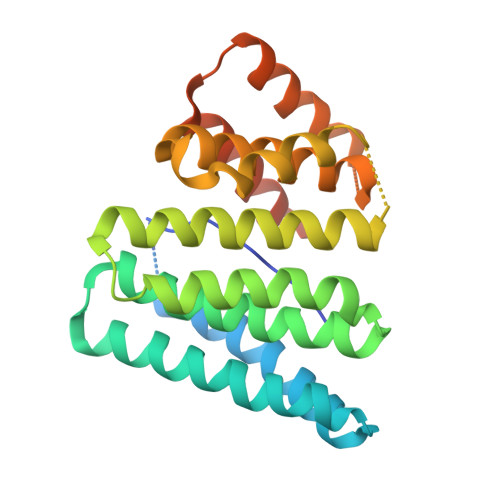
Intrinsically disordered proteins and peptides play key roles in biology, but a lack of defined structures and high variability in sequence and conformational preferences have made targeting such systems challenging. We describe a general approach for designing proteins that bind intrinsically disordered protein regions in diverse extended conformations with side chains fitting into complementary binding pockets. We used the approach to design binders for 39 highly diverse unstructured targets, including polar targets, and obtained designs with 100-picomolar to 100-nanomolar affinities in 34 cases, testing ~22 designs per target. The designs function in cells and as detection reagents and are specific for their intended targets in all-by-all binding experiments. Our approach is a major step toward a general solution to the intrinsically disordered protein and peptide recognition problem.
- Department of Biochemistry, University of Washington, Seattle, WA, USA.
Organizational Affiliation: