9CAZ | pdb_00009caz

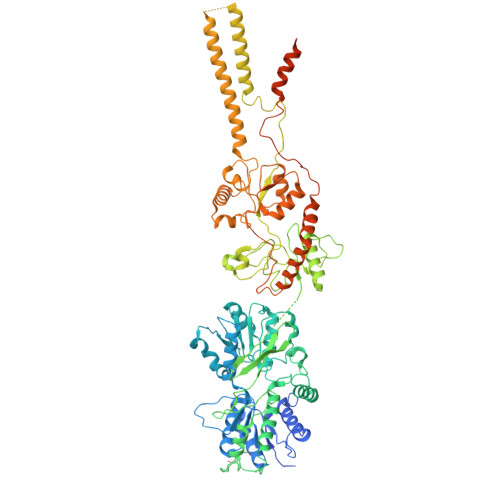
Structure of kainate receptor Gluk2 in apo state


Experimental Data Snapshot

  • Method: ELECTRON MICROSCOPY
  • Resolution: 3.88 Å
  • Aggregation State: PARTICLE 
  • Reconstruction Method: SINGLE PARTICLE 

wwPDB Validation   3D Report Full Report


This is version 1.1 of the entry. See complete history


Literature

Structural basis of GluK2 kainate receptor activation by a partial agonist.

Segura-Covarrubias, G.Zhou, C.Bogdanovic, N.Zhang, L.Tajima, N.

(2025) Nat Struct Mol Biol 32: 1456-1469

  • DOI: https://doi.org/10.1038/s41594-025-01566-w
  • Primary Citation of Related Structures:  
    8GC5, 9C5Y, 9C5Z, 9C60, 9CAZ

  • PubMed Abstract: 

    Kainate receptors (KARs) belong to the family of ionotropic glutamate receptors that regulate neurotransmitter release and excitatory synaptic transmission in the central nervous system. Despite their critical roles in synaptic signaling and disease, the detailed gating mechanisms of KARs are not completely understood. Here we present cryo-electron microscopy structures of homomeric rat GluK2 KAR in an unliganded apo state and in complexes with a partial agonist, domoate. Partial agonist-bound GluK2 populates multiple conformations, including intermediate and desensitized states. Moreover, we demonstrate that the N-glycans at the amino-terminal domain-ligand binding domain (LBD) interface modulate receptor gating properties by interfering with cation binding at the LBD dimer interface. Together, these results provide insights into the unique gating mechanisms of KARs.


  • Organizational Affiliation
    • Department of Physiology and Biophysics, Case Western Reserve University School of Medicine, Cleveland, OH, USA.

Macromolecules
Find similar proteins by:  (by identity cutoff)  |  3D Structure
Entity ID: 1
MoleculeChains Sequence LengthOrganismDetailsImage
Glutamate receptor ionotropic, kainate 2
A, B, C, D
908Rattus norvegicusMutation(s): 0 
Gene Names: Grik2Glur6
Membrane Entity: Yes 
UniProt
Find proteins for P42260 (Rattus norvegicus)
Explore P42260 
Go to UniProtKB:  P42260
Entity Groups  
Sequence Clusters30% Identity50% Identity70% Identity90% Identity95% Identity100% Identity
UniProt GroupP42260
Glycosylation
Glycosylation Sites: 4Go to GlyGen: P42260-1
Sequence Annotations
Expand
  • Reference Sequence
Small Molecules
Ligands 1 Unique
IDChains Name / Formula / InChI Key2D Diagram3D Interactions
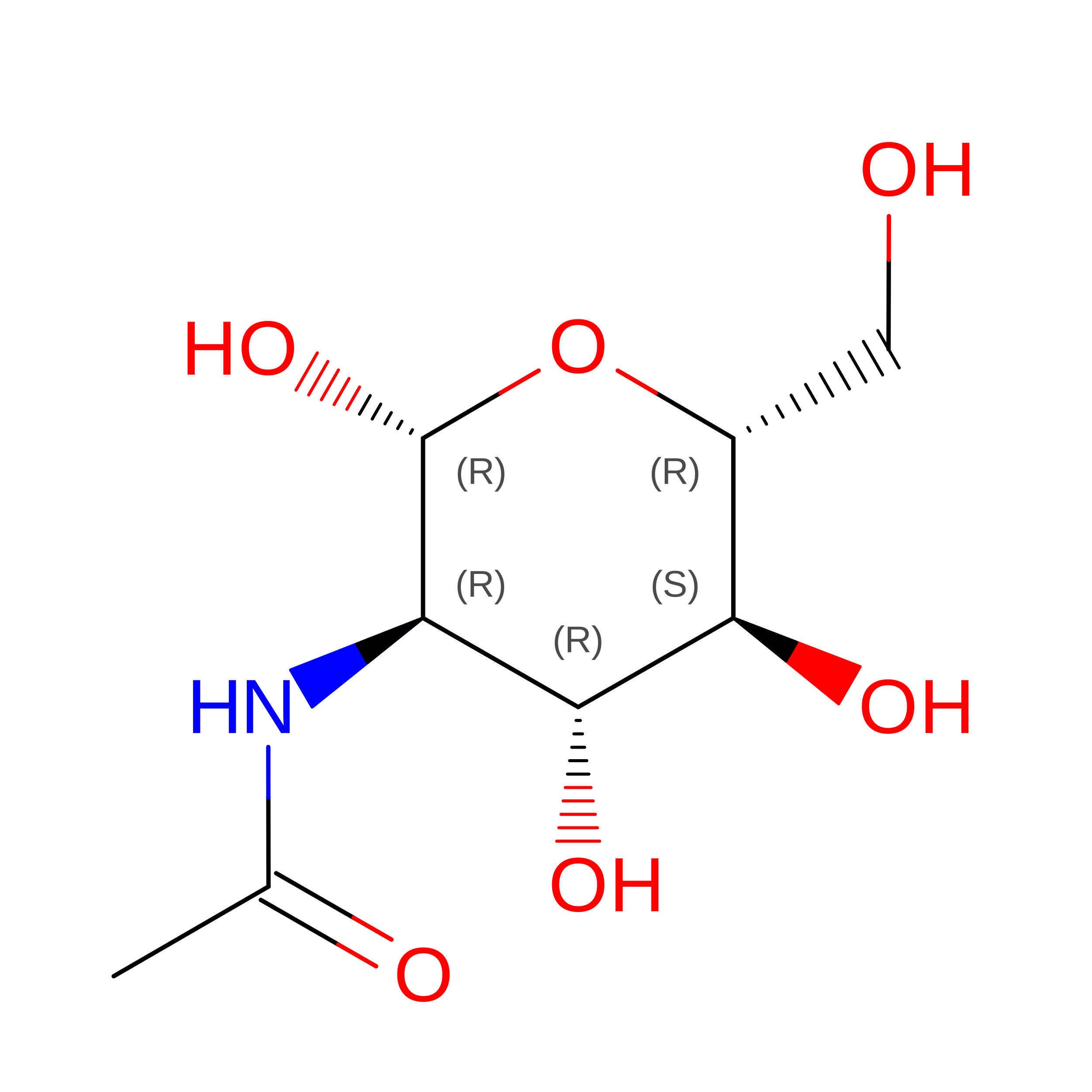
NAG (Subject of Investigation/LOI)
Query on NAG

Download Ideal Coordinates CCD File 
E [auth A]
F [auth A]
G [auth A]
H [auth B]
I [auth B]
E [auth A],
F [auth A],
G [auth A],
H [auth B],
I [auth B],
J [auth C],
K [auth C],
L [auth D],
M [auth D],
N [auth D],
O [auth D]
2-acetamido-2-deoxy-beta-D-glucopyranose
C8 H15 N O6
OVRNDRQMDRJTHS-FMDGEEDCSA-N
Experimental Data & Validation

Experimental Data

  • Method: ELECTRON MICROSCOPY
  • Resolution: 3.88 Å
  • Aggregation State: PARTICLE 
  • Reconstruction Method: SINGLE PARTICLE 
EM Software:
TaskSoftware PackageVersion
MODEL REFINEMENTPHENIX

Structure Validation

View Full Validation Report


Entry History & Funding Information

Deposition Data


Funding OrganizationLocationGrant Number
National Institutes of Health/National Institute of General Medical Sciences (NIH/NIGMS)United States1R35GM147266-01
National Institutes of Health/National Institute of General Medical Sciences (NIH/NIGMS)United States3R35GM147266-01S1

Revision History  (Full details and data files)

  • Version 1.0: 2025-07-02
    Type: Initial release
  • Version 1.1: 2026-01-14
    Changes: Data collection, Database references