Download Mendeley
The beta 2 alpha B loop determines NAD(P) cofactor specificity and kinetics in trypanosomal D-3-hydroxybutyrate dehydrogenases.
Hashimoto, H., Mawn, I.H., Escobar-Arrillaga, W., Nguyen, L., Madigan, L.A., Antuono, G., Rossy, T., Sojati, J., Mienko, A., Debler, E.W., Palenchar, J.B.(2026) J Mol Biol 438: 169946-169946
- PubMed: 42456964 Search on PubMedSearch on PubMed Central
- DOI: https://doi.org/10.1016/j.jmb.2026.169946
- Primary Citation Related Structures:
9C5H, 9C5I, 9C5J, 9C5K, 9C5L, 9C5M, 9C5N - PubMed Abstract:
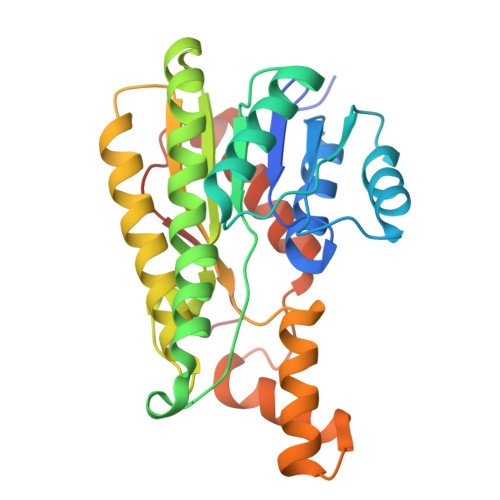
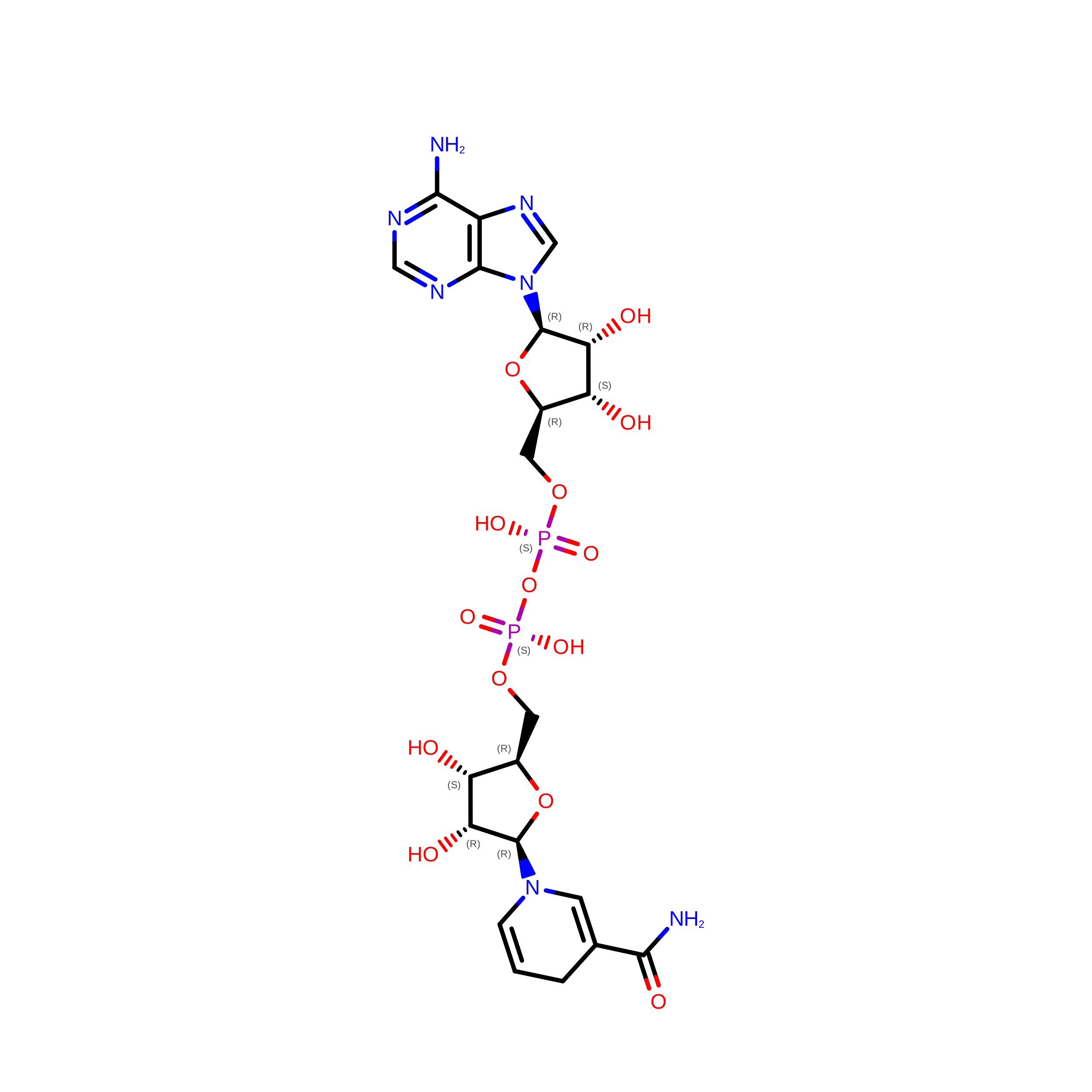
Bacterial d-3-hydroxybutyrate dehydrogenases (HBDHs) catalyze the conversion between d-3-hydroxybutyrate and acetoacetate with NAD as the cofactor but not with NAD 2'-phosphate (NADP). However, HBDHs of the early-branched eukaryotic genus Trypanosoma utilize both NAD and NADP (T. brucei) or exclusively NADP (T. cruzi). Here we reveal that NADP specificity of T. cruzi HBDH arises from stabilization of the flexible β2αB loop by the 2'-phosphate interaction. Stabilization of this loop by a nearby C64Y mutation enables T. cruzi HBDH to use NAD in addition to NADP; thus, the Cys/Tyr residue is critical for determining cofactor specificity in trypanosomal HBDHs, suggesting that most trypanosomal HBDHs use both NAD and NADP except for T. cruzi HBDH. Furthermore, Arg42 within the β2αB loop interacts with the adenine ring of NADP by ideal CH-π interactions, while the R42F mutant switches to non-ideal π-π interactions, increasing k cat ∼10-fold and K M ∼40-fold. Collectively, we identified the β2αB loop stability and sequence as key determinants of NAD(P) co-factor specificity and kinetics in HBDHs.
- Department of Biochemistry and Molecular Biology, Thomas Jefferson University, 1020 Locust Street, Philadelphia, PA 19107, USA.
Organizational Affiliation: