9BYS | pdb_00009bys

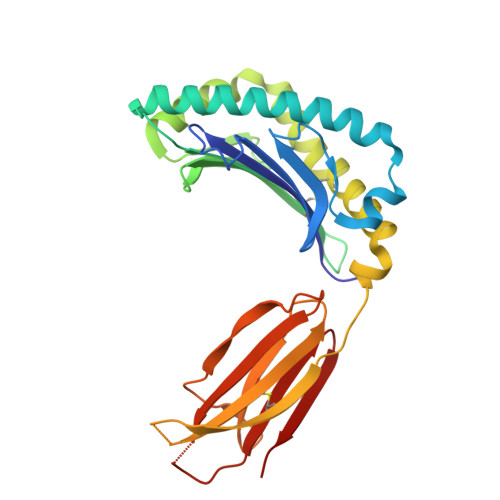
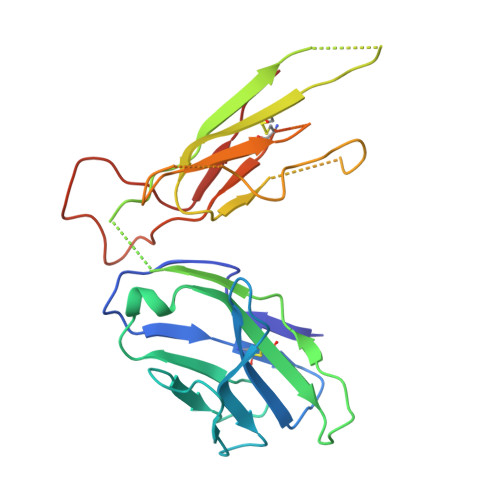
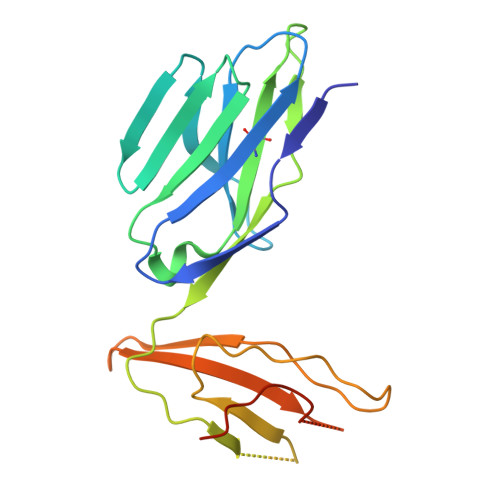
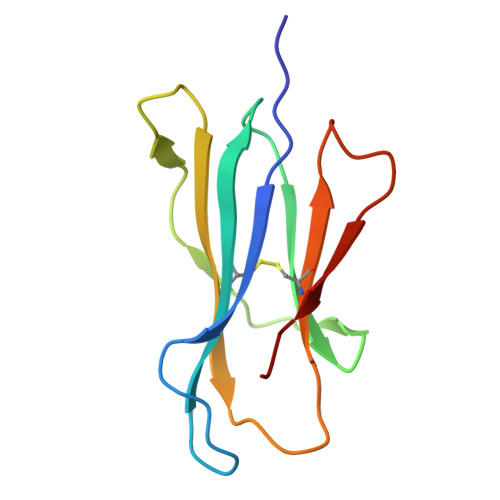
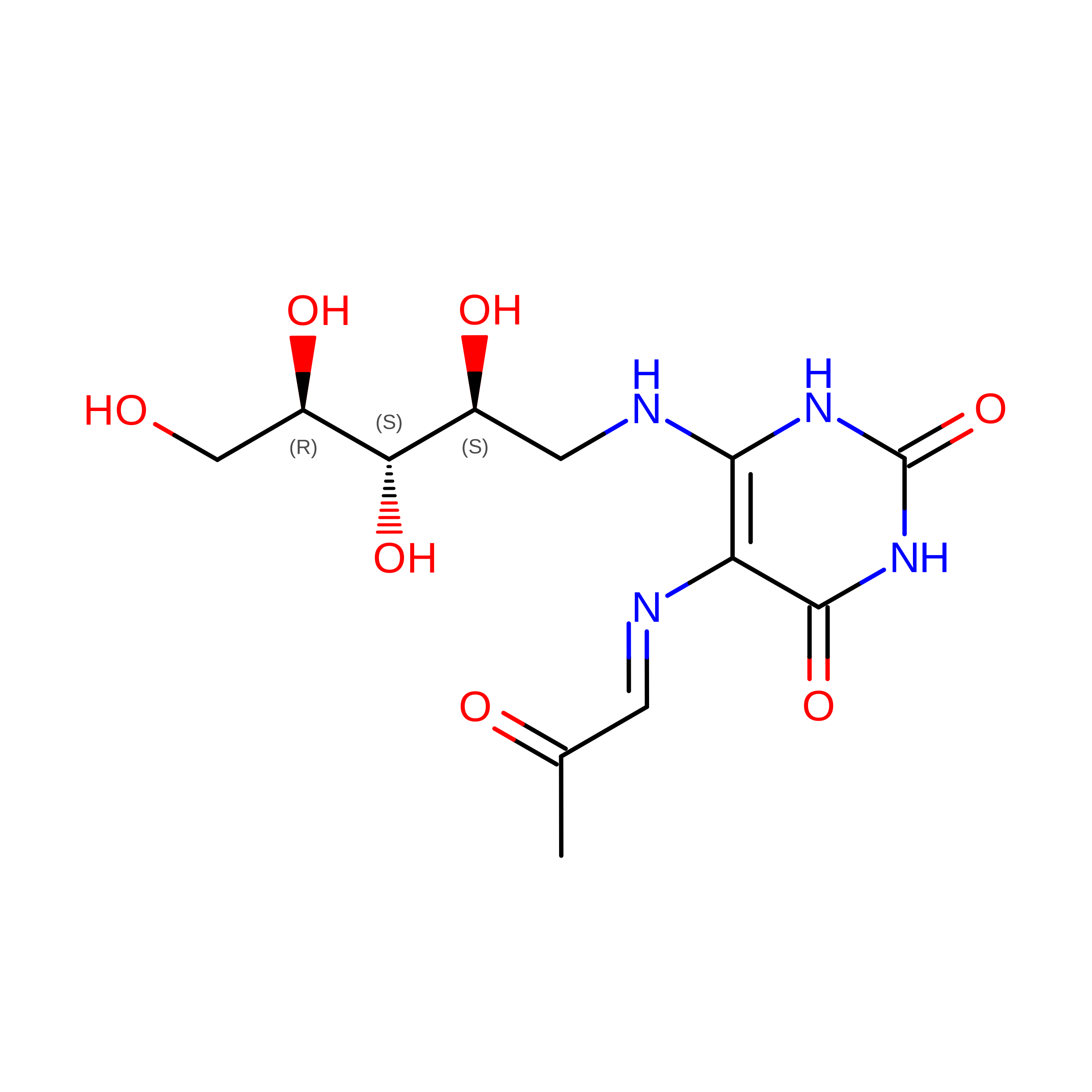
Structure of human MAIT BV28 TCR in complex with human MR1-5-OP-RU

  • Classification: IMMUNE SYSTEM
  • Organism(s): Homo sapiens
  • Expression System: Escherichia coli
  • Mutation(s): No 

  • Deposited: 2024-05-24 Released: 2025-06-11 
  • Deposition Author(s): Awad, W., Rossjohn, J.
  • Funding Organization(s): Australian Research Council (ARC), National Health and Medical Research Council (NHMRC, Australia)

Experimental Data Snapshot

  • Method: X-RAY DIFFRACTION
  • Resolution: 3.10 Å
  • R-Value Free: 
    0.252 (Depositor), 0.252 (DCC) 
  • R-Value Work: 
    0.222 (Depositor), 0.222 (DCC) 
  • R-Value Observed: 
    0.224 (Depositor) 

Starting Model: experimental
View more details

wwPDB Validation   3D Report Full Report


Ligand Structure Quality Assessment 


This is version 1.1 of the entry. See complete history


Literature

A molecular basis underpinning TRBV28 + T-cell receptor recognition of MR1-antigen.

Awad, W.Gherardin, N.A.Ciacchi, L.Keller, A.N.Liu, L.Fairlie, D.P.McCluskey, J.Godfrey, D.I.Rossjohn, J.

(2025) J Biological Chem 301: 110416-110416

  • DOI: https://doi.org/10.1016/j.jbc.2025.110416
  • Primary Citation of Related Structures:  
    9BYS

  • PubMed Abstract: 

    Mucosal-associated invariant T (MAIT) cells express a TRAV1-2 + T-cell receptor (TCR) that recognizes microbial vitamin B2 derivatives presented by the major histocompatibility complex class I-related molecule (MR1). Most MAIT TCRs incorporate a biased TCR-β repertoire, predominantly TRBV20-1 and TRBV6, but some utilize other trbv genes, including TRBV28. A second conserved, albeit less frequent TRAV36 + TRBV28 + T-cell population exhibits MAIT-like phenotypic features but use a markedly distinct mode of MR1-antigen (Ag) recognition compared with MAIT TCR-MR1 binding. Nevertheless, our understanding of how differing TCR gene usage results in altered MR1 binding modes remains incomplete. Here, binding studies demonstrated differential affinities and Ag specificities between TRBV6 + and TRBV28 + MR1-restricted TCRs. Alanine-scanning mutagenesis on the TRAV36-TRBV28 TCR revealed a strong dependence on germline-encoded residues within the highly selected complementarity-determining region 3α loop, similar to TRAV1-2-TRBV6 TCRs, and further alanine-scanning mutagenesis experiments demonstrate differential energetic footprints by these TCRs atop MR1. We determined the crystal structure of a MAIT TRAV1-2-TRBV28 + TCR-MR1-5-OP-RU ternary complex. This structure revealed a docking mode conserved amongst other TRAV1-2 + MAIT TCRs, with the trbv28-encoded TCR-β chain adopting highly distinct docking modes between the TRAV1-2 + and TRAV36 + TCRs. This indicates that the TCR-α chain dictates the positioning and role of the TCR-β chain. Taken together, these findings provide new molecular insights into MR1-Ag-driven selection of paired TCR-α and TCR-β chains.


  • Organizational Affiliation
    • Infection and Immunity Program and Department of Biochemistry and Molecular Biology, Biomedicine Discovery Institute, Monash University, Clayton, Victoria, Australia.

Macromolecules
Find similar proteins by:  (by identity cutoff)  |  3D Structure
Entity ID: 1
MoleculeChains Sequence LengthOrganismDetailsImage
Major histocompatibility complex class I-related gene protein271Homo sapiensMutation(s): 0 
Gene Names: MR1
UniProt & NIH Common Fund Data Resources
Find proteins for Q95460 (Homo sapiens)
Explore Q95460 
Go to UniProtKB:  Q95460
PHAROS:  Q95460
GTEx:  ENSG00000153029 
Entity Groups  
Sequence Clusters30% Identity50% Identity70% Identity90% Identity95% Identity100% Identity
UniProt GroupQ95460
Sequence Annotations
Expand
  • Reference Sequence
Find similar proteins by:  (by identity cutoff)  |  3D Structure
Entity ID: 2
MoleculeChains Sequence LengthOrganismDetailsImage
TCR beta chainB [auth AAAB]244Homo sapiensMutation(s): 0 
Entity Groups  
Sequence Clusters30% Identity50% Identity70% Identity90% Identity95% Identity100% Identity
Sequence Annotations
Expand
  • Reference Sequence
Find similar proteins by:  (by identity cutoff)  |  3D Structure
Entity ID: 3
MoleculeChains Sequence LengthOrganismDetailsImage
TCR alpha chainC [auth AAAC]204Homo sapiensMutation(s): 0 
Entity Groups  
Sequence Clusters30% Identity50% Identity70% Identity90% Identity95% Identity100% Identity
Sequence Annotations
Expand
  • Reference Sequence
Find similar proteins by:  (by identity cutoff)  |  3D Structure
Entity ID: 4
MoleculeChains Sequence LengthOrganismDetailsImage
Beta-2-microglobulinD [auth AAAD]100Homo sapiensMutation(s): 0 
Gene Names: B2MCDABP0092HDCMA22P
UniProt & NIH Common Fund Data Resources
Find proteins for P61769 (Homo sapiens)
Explore P61769 
Go to UniProtKB:  P61769
PHAROS:  P61769
GTEx:  ENSG00000166710 
Entity Groups  
Sequence Clusters30% Identity50% Identity70% Identity90% Identity95% Identity100% Identity
UniProt GroupP61769
Sequence Annotations
Expand
  • Reference Sequence
Experimental Data & Validation

Experimental Data

  • Method: X-RAY DIFFRACTION
  • Resolution: 3.10 Å
  • R-Value Free:  0.252 (Depositor), 0.252 (DCC) 
  • R-Value Work:  0.222 (Depositor), 0.222 (DCC) 
  • R-Value Observed: 0.224 (Depositor) 
Space Group: P 41 21 2
Unit Cell:
Length ( Å )Angle ( ˚ )
a = 111.35α = 90
b = 111.35β = 90
c = 206.46γ = 90
Software Package:
Software NamePurpose
PHENIXrefinement
PHENIXrefinement
XDSdata reduction
XDSdata scaling
PHENIXphasing

Structure Validation

View Full Validation Report


Ligand Structure Quality Assessment 


Entry History & Funding Information

Deposition Data


Funding OrganizationLocationGrant Number
Australian Research Council (ARC)AustraliaDE220101491
National Health and Medical Research Council (NHMRC, Australia)Australia--

Revision History  (Full details and data files)

  • Version 1.0: 2025-06-11
    Type: Initial release
  • Version 1.1: 2025-12-24
    Changes: Database references