Download Mendeley
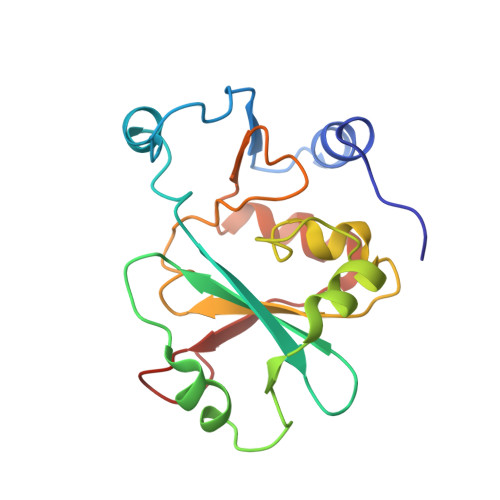
NMR-based solution structure of the Caulobacter crescentus ProXp-ala trans-editing enzyme.
Duran, A.D., Danhart, E.M., Ma, X., Nagy, A.B.K., Musier-Forsyth, K., Foster, M.P.(2024) Biomol NMR Assign 18: 233-238
- PubMed: 39214936 Search on PubMedSearch on PubMed Central
- DOI: https://doi.org/10.1007/s12104-024-10193-3
- Primary Citation Related Structures:
9BU5 - PubMed Abstract:
ProXp-ala is a key component of the translational machinery in all three Domains of life. This enzyme helps to maintain the fidelity of proline codon translation through aminoacyl-tRNA Pro proofreading. In the first step of tRNA aminoacylation, the cognate aminoacyl-tRNA synthetase (aaRS) binds and activates an amino acid in the enzyme's synthetic active site. If a non-cognate amino acid passes this first selection step and is charged onto the tRNA, a distinct aaRS editing active site may recognize the mischarged tRNA and deacylate it. Alternatively, this editing reaction may be carried out by a separate enzyme that deacylates the mischarged tRNA in trans. ProXp-ala is responsible for editing Ala mischarged onto tRNA Pro . Since trans-editing domains such as ProXp-ala bind their substrates after release from the synthetase, they must recognize not only the mischarged amino acid, but also the specific tRNA. Previous studies showed that Caulobacter crescentus (Cc) ProXp-ala distinguishes tRNA Pro from tRNA Ala , in part, based on the unique tRNA Pro acceptor stem base pair C1:G72. Previous crystallographic and NMR data also revealed a role for conformational selection by the ProXp-ala α2 helix in Ala- versus Pro-tRNA Pro substrate discrimination. The α2 helix makes lattice contacts in the crystal, which left some uncertainty as to its position in solution. We report resonance assignments for the substrate-free Cc ProXp-ala and the NMR-derived three-dimensional structure of the protein. These data reveal the position of the α2 helix in solution, with implications for substrate binding and recognition.
- Center for RNA Biology, Department of Chemistry and Biochemistry, The Ohio State University, Columbus, OH, 43210, USA.
Organizational Affiliation: