9BS1 | pdb_00009bs1

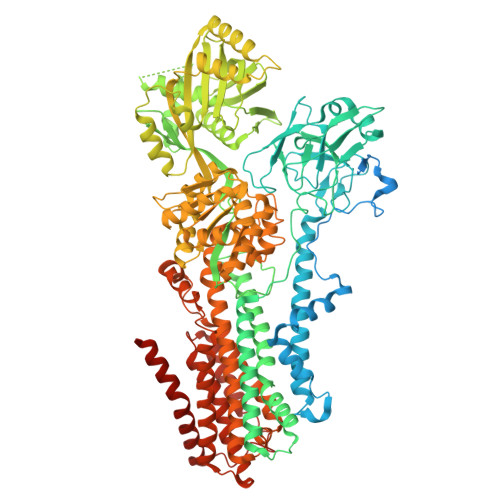
Cryo-EM structure of the S. cerevisiae lipid flippase Neo1 bound with PI4P in the E2P state


Experimental Data Snapshot

  • Method: ELECTRON MICROSCOPY
  • Resolution: 3.71 Å
  • Aggregation State: PARTICLE 
  • Reconstruction Method: SINGLE PARTICLE 

wwPDB Validation   3D Report Full Report


This is version 2.1 of the entry. See complete history


Literature

P4-ATPases control phosphoinositide membrane asymmetry and neomycin resistance.

Jain, B.K.Duan, H.D.Valentine, C.Samiha, A.Li, H.Graham, T.R.

(2025) Nat Cell Biol 27: 1114-1124

  • DOI: https://doi.org/10.1038/s41556-025-01692-z
  • Primary Citation of Related Structures:  
    9BS1

  • PubMed Abstract: 

    The aminoglycoside antibiotic neomycin has robust antibacterial properties, yet its clinical utility is curtailed by its nephrotoxicity and ototoxicity. The mechanism by which the polycationic neomycin enters specific eukaryotic cell types remains poorly understood. In budding yeast, NEO1 is required for neomycin resistance and encodes a phospholipid flippase that establishes membrane asymmetry. Here we show that mutations altering Neo1 substrate recognition cause neomycin hypersensitivity by exposing phosphatidylinositol-4-phosphate (PI4P) in the plasma membrane extracellular leaflet. Cryogenic electron microscopy reveals PI4P binding to Neo1 within the substrate translocation pathway. PI4P enters the lumen of the endoplasmic reticulum and is flipped by Neo1 at the Golgi to prevent PI4P secretion to the cell surface. Deficiency of the orthologous ATP9A in human cells also causes exposure of PI4P and neomycin sensitivity. These findings unveil conserved mechanisms of aminoglycoside sensitivity and phosphoinositide homoeostasis, with important implications for signalling by extracellular phosphoinositides.


  • Organizational Affiliation
    • Department of Biological Sciences, Vanderbilt University, Nashville, TN, USA. bhawik.kumar.k.jain@vanderbilt.edu.

Macromolecules
Find similar proteins by:  (by identity cutoff)  |  3D Structure
Entity ID: 1
MoleculeChains Sequence LengthOrganismDetailsImage
Phospholipid-transporting ATPase NEO11,159Saccharomyces cerevisiaeMutation(s): 0 
Gene Names: NEO1YIL048W
EC: 7.6.2.1
UniProt
Find proteins for P40527 (Saccharomyces cerevisiae (strain ATCC 204508 / S288c))
Explore P40527 
Go to UniProtKB:  P40527
Entity Groups  
Sequence Clusters30% Identity50% Identity70% Identity90% Identity95% Identity100% Identity
UniProt GroupP40527
Sequence Annotations
Expand
  • Reference Sequence
Small Molecules
Ligands 2 Unique
IDChains Name / Formula / InChI Key2D Diagram3D Interactions
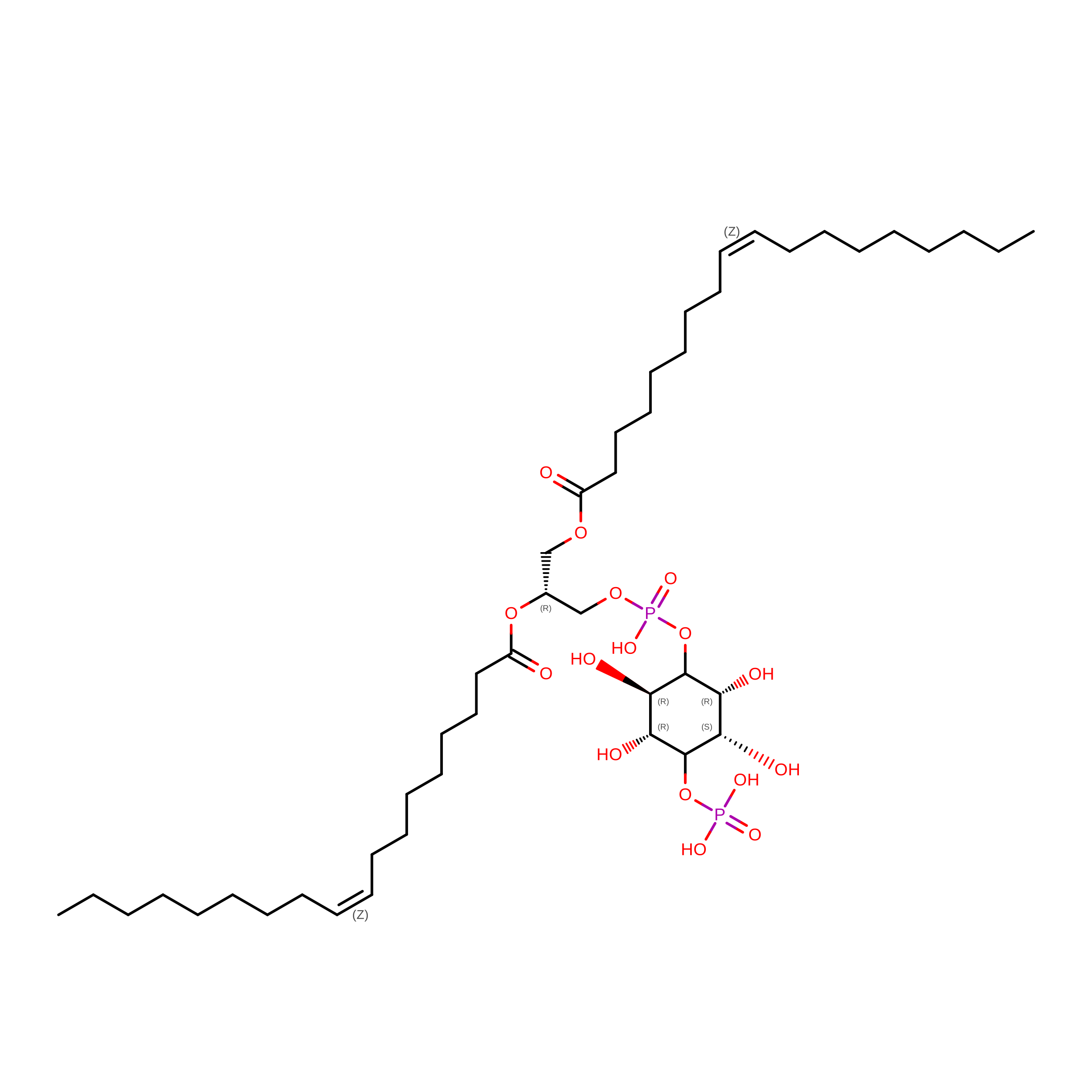
A1ARJ (Subject of Investigation/LOI)
Query on A1ARJ

Download Ideal Coordinates CCD File 
C [auth A](2R)-3-{[(S)-hydroxy{[(1R,2R,3R,4R,5S,6R)-2,3,5,6-tetrahydroxy-4-(phosphonooxy)cyclohexyl]oxy}phosphoryl]oxy}propane-1,2-diyl di[(9Z)-octadec-9-enoate]
C45 H84 O16 P2
XIBQVFRCUJZPTP-NHVDGIRCSA-N
BEF
Query on BEF

Download Ideal Coordinates CCD File 
B [auth A]BERYLLIUM TRIFLUORIDE ION
Be F3
OGIAHMCCNXDTIE-UHFFFAOYSA-K
Experimental Data & Validation

Experimental Data

  • Method: ELECTRON MICROSCOPY
  • Resolution: 3.71 Å
  • Aggregation State: PARTICLE 
  • Reconstruction Method: SINGLE PARTICLE 
EM Software:
TaskSoftware PackageVersion
MODEL REFINEMENTPHENIX1.20.1_4487:

Structure Validation

View Full Validation Report


Entry History & Funding Information

Deposition Data


Funding OrganizationLocationGrant Number
National Institutes of Health/National Cancer Institute (NIH/NCI)United StatesCA231466

Revision History  (Full details and data files)

  • Version 1.0: 2025-04-02
    Type: Initial release
  • Version 2.0: 2025-07-23
    Type: Coordinate replacement
    Reason: Model completeness
    Changes: Advisory, Atomic model, Data collection, Database references, Structure summary
  • Version 2.1: 2025-07-30
    Changes: Data collection, Database references