9BPU | pdb_00009bpu

Structure of the IFN-lambda4/IFN-lambdaR1/IL-10Rbeta receptor complex with an engineered IL-10Rbeta

  • Classification: CYTOKINE
  • Organism(s): Homo sapiens
  • Expression System: Homo sapiens
  • Mutation(s): No 

  • Deposited: 2024-05-08 Released: 2025-01-29 
  • Deposition Author(s): Zhang, B., Grubbe, W.S., Mendoza, J.L., Zhao, M.
  • Funding Organization(s): Howard Hughes Medical Institute (HHMI), National Institutes of Health/National Institute of General Medical Sciences (NIH/NIGMS)

Experimental Data Snapshot

  • Method: ELECTRON MICROSCOPY
  • Resolution: 3.26 Å
  • Aggregation State: 2D ARRAY 
  • Reconstruction Method: SINGLE PARTICLE 

wwPDB Validation   3D Report Full Report


This is version 1.2 of the entry. See complete history


Literature

Structural studies of the IFN lambda 4 receptor complex using cryoEM enabled by protein engineering.

Grubbe, W.S.Zhang, B.Kauffman, A.Bylehn, F.Padol, K.Jung, H.G.Park, S.B.Priest, J.M.Ozkan, E.de Pablo, J.J.Liang, T.J.Zhao, M.Mendoza, J.L.

(2025) Nat Commun 16: 818-818

  • DOI: https://doi.org/10.1038/s41467-025-56119-y
  • Primary Citation of Related Structures:  
    9BPU, 9BPV

  • PubMed Abstract: 

    IFNλ4 has posed a conundrum in human immunology since its discovery in 2013, with its expression linked to complications with viral clearance. While genetic and cellular studies revealed the detrimental effects of IFNλ4 expression, extensive structural and functional characterization has been limited by the inability to express and purify the protein, complicating explanations of its paradoxical behavior. In this work, we report a method for robust production of IFNλ4. We then use yeast surface display to affinity-mature IL10Rβ and solve the 72 kilodalton structures of IFNλ4 (3.26 Å) and IFNλ3 (3.00 Å) in complex with their receptors IFNλR1 and IL10Rβ using cryogenic electron microscopy. Comparison of the structures highlights differences in receptor engagement and reveals a distinct 12-degree rotation in overall receptor geometry, providing a potential mechanistic explanation for differences in cell signaling, downstream gene induction, and antiviral activities. Further, we perform a structural analysis using molecular modeling and simulation to identify a unique region of IFNλ4 that, when replaced, enables secretion of the protein from cells. These findings provide a structural and functional understanding of the IFNλ4 protein and enable future comprehensive studies towards correcting IFNλ4 dysfunction in large populations of affected patients.


  • Organizational Affiliation
    • Pritzker School of Molecular Engineering, University of Chicago, Chicago, IL, USA.

Macromolecules
Find similar proteins by:  (by identity cutoff)  |  3D Structure
Entity ID: 1
MoleculeChains Sequence LengthOrganismDetailsImage
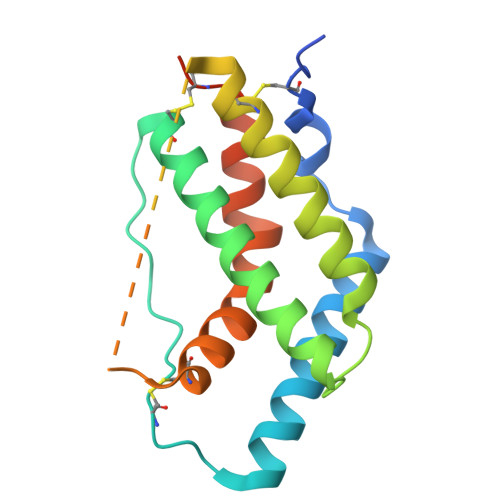
Interferon lambda-4A [auth C]175Homo sapiensMutation(s): 0 
Gene Names: IFNL4
UniProt
Find proteins for K9M1U5 (Homo sapiens)
Explore K9M1U5 
Go to UniProtKB:  K9M1U5
Entity Groups  
Sequence Clusters30% Identity50% Identity70% Identity90% Identity95% Identity100% Identity
UniProt GroupK9M1U5
Sequence Annotations
Expand
  • Reference Sequence
Find similar proteins by:  (by identity cutoff)  |  3D Structure
Entity ID: 2
MoleculeChains Sequence LengthOrganismDetailsImage
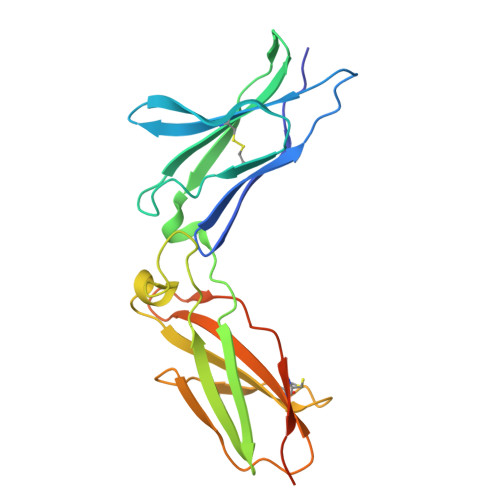
Interleukin-10 receptor subunit betaB [auth A]212Homo sapiensMutation(s): 0 
Gene Names: IL10RBCRFB4D21S58D21S66
UniProt & NIH Common Fund Data Resources
Find proteins for Q08334 (Homo sapiens)
Explore Q08334 
Go to UniProtKB:  Q08334
PHAROS:  Q08334
GTEx:  ENSG00000243646 
Entity Groups  
Sequence Clusters30% Identity50% Identity70% Identity90% Identity95% Identity100% Identity
UniProt GroupQ08334
Sequence Annotations
Expand
  • Reference Sequence
Find similar proteins by:  (by identity cutoff)  |  3D Structure
Entity ID: 3
MoleculeChains Sequence LengthOrganismDetailsImage
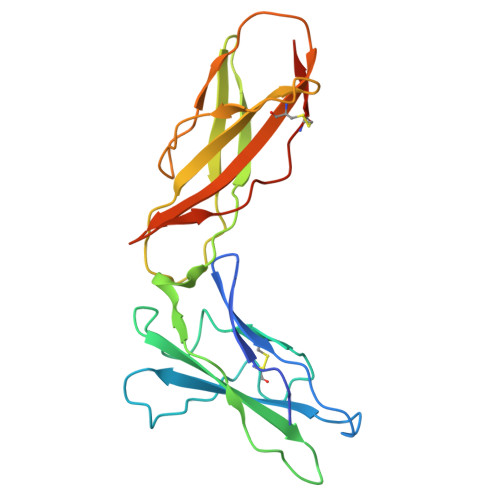
Interferon lambda receptor 1C [auth B]209Homo sapiensMutation(s): 0 
Gene Names: IFNLR1IL28RALICR2
UniProt & NIH Common Fund Data Resources
Find proteins for Q8IU57 (Homo sapiens)
Explore Q8IU57 
Go to UniProtKB:  Q8IU57
PHAROS:  Q8IU57
GTEx:  ENSG00000185436 
Entity Groups  
Sequence Clusters30% Identity50% Identity70% Identity90% Identity95% Identity100% Identity
UniProt GroupQ8IU57
Glycosylation
Glycosylation Sites: 2Go to GlyGen: Q8IU57-1
Sequence Annotations
Expand
  • Reference Sequence
Oligosaccharides

Help

Entity ID: 4
MoleculeChains Length2D Diagram Glycosylation3D Interactions
2-acetamido-2-deoxy-beta-D-glucopyranose-(1-4)-2-acetamido-2-deoxy-beta-D-glucopyranose
D
2N-Glycosylation
Glycosylation Resources
GlyTouCan:  G42666HT
GlyCosmos:  G42666HT
GlyGen:  G42666HT
Entity ID: 5
MoleculeChains Length2D Diagram Glycosylation3D Interactions
beta-D-mannopyranose-(1-4)-2-acetamido-2-deoxy-beta-D-glucopyranose-(1-4)-2-acetamido-2-deoxy-beta-D-glucopyranose
E
3N-Glycosylation
Glycosylation Resources
GlyTouCan:  G15407YE
GlyCosmos:  G15407YE
GlyGen:  G15407YE
Experimental Data & Validation

Experimental Data

  • Method: ELECTRON MICROSCOPY
  • Resolution: 3.26 Å
  • Aggregation State: 2D ARRAY 
  • Reconstruction Method: SINGLE PARTICLE 
EM Software:
TaskSoftware PackageVersion
MODEL REFINEMENTPHENIX

Structure Validation

View Full Validation Report


Entry History & Funding Information

Deposition Data


Funding OrganizationLocationGrant Number
Howard Hughes Medical Institute (HHMI)United States--
National Institutes of Health/National Institute of General Medical Sciences (NIH/NIGMS)United States1R35GM147179-01

Revision History  (Full details and data files)

  • Version 1.0: 2025-01-29
    Type: Initial release
  • Version 1.1: 2025-02-05
    Changes: Data collection, Database references
  • Version 1.2: 2025-05-28
    Changes: Data collection