Download Mendeley
Characterization of a Dual Function Peptide Cyclase in Graspetide Biosynthesis.
Rubin, G.M., Patel, K.P., Jiang, Y., Ishee, A.C., Seabra, G., Bruner, S.D., Ding, Y.(2024) ACS Chem Biol 19: 2525-2534
- PubMed: 39630567 Search on PubMedSearch on PubMed Central
- DOI: https://doi.org/10.1021/acschembio.4c00626
- Primary Citation Related Structures:
9BOU - PubMed Abstract:
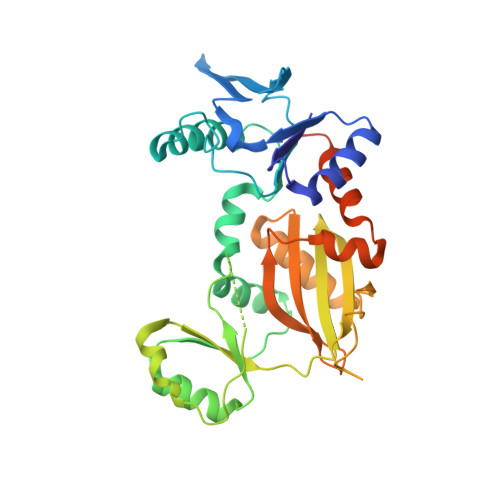
Graspetides are a diverse family of ribosomally synthesized and post-translationally modified peptides with unique macrocyclic structures formed by ATP-grasp enzymes. Group 11 graspetides, including prunipeptin, feature both macrolactone and macrolactam cross-links. Despite the known involvement of a single ATP-grasp cyclase in the dual macrocyclizations of groups 5, 7, and 11 graspetides, detailed mechanistic insights into these enzymes remain limited. Here, we reconstructed prunipeptin biosynthesis from Streptomyces coelicolor using recombinant PruA and PruB macrocyclase. PruB exhibited kinetic behavior similar to other characterized graspetide cyclases, with a notably higher k cat , likely due to utilization of an ATP-regeneration system. The X-ray crystal structure of PruB revealed distinct features as compared to groups 1 and 2 enzymes. Site-directed mutagenesis identified critical roles of key residues for the PruB reaction, including the DxR motif conserved in other graspetide cyclases. Additionally, computational modeling of the PruA/PruB cocomplex uncovered substrate interactions and suggested that PruB first catalyzes a macrolactone bond formation on PruA. This study enhances our understanding of ATP-grasp enzyme mechanisms in graspetide biosynthesis and provides insights for engineering these enzymes for future applications.
- Department of Medicinal Chemistry, Center for Natural Products, Drug Discovery and Development, University of Florida, Gainesville, Florida 31610, United States.
Organizational Affiliation: