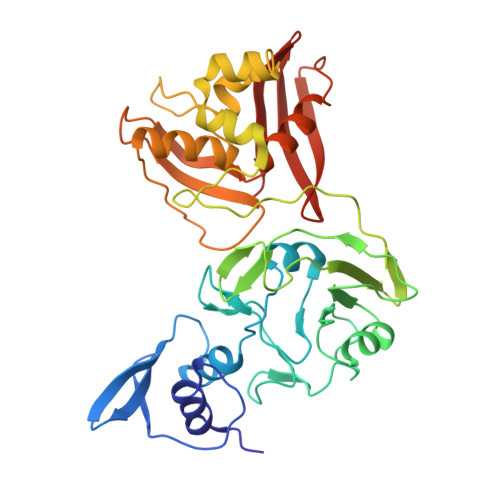
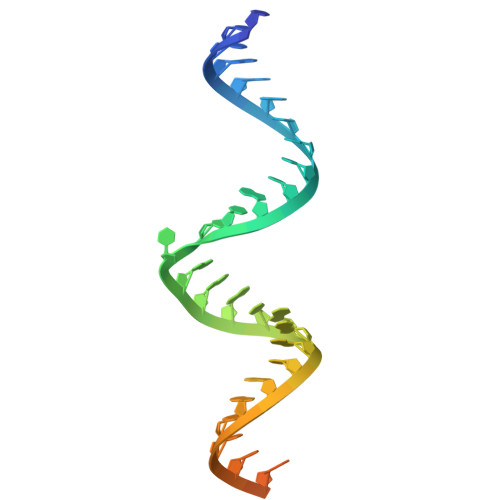
9BIH | pdb_00009bih

SARS-CoV-2 endoribonuclease Nsp15 bound to dsRNA with 1 nucleotide bulge


Experimental Data Snapshot

  • Method: ELECTRON MICROSCOPY
  • Resolution: 3.24 Å
  • Aggregation State: PARTICLE 
  • Reconstruction Method: SINGLE PARTICLE 

wwPDB Validation   3D Report Full Report


This is version 1.1 of the entry. See complete history


Literature

Spontaneous base flipping helps drive Nsp15's preferences in double stranded RNA substrates.

Wright, Z.M.Butay, K.J.Krahn, J.M.Wilson, I.M.Gabel, S.A.DeRose, E.F.Hissein, I.S.Williams, J.G.Borgnia, M.J.Frazier, M.N.Mueller, G.A.Stanley, R.E.

(2025) Nat Commun 16: 391-391

  • DOI: https://doi.org/10.1038/s41467-024-55682-0
  • Primary Citation of Related Structures:  
    9BIH

  • PubMed Abstract: 

    Coronaviruses evade detection by the host immune system with the help of the endoribonuclease Nsp15, which regulates levels of viral double stranded RNA by cleaving 3' of uridine (U). While prior structural data shows that to cleave double stranded RNA, Nsp15's target U must be flipped out of the helix, it is not yet understood whether Nsp15 initiates flipping or captures spontaneously flipped bases. We address this gap by designing fluorinated double stranded RNA substrates that allow us to directly relate a U's sequence context to both its tendency to spontaneously flip and its susceptibility to cleavage by Nsp15. Through a combination of nuclease assays, 19 F NMR spectroscopy, mass spectrometry, and single particle cryo-EM, we determine that Nsp15 acts most efficiently on unpaired Us, particularly those that are already flipped. Across sequence contexts, we find Nsp15's cleavage efficiency to be directly related to that U's tendency to spontaneously flip. Overall, our findings unify previous characterizations of Nsp15's cleavage preferences, and suggest that activity of Nsp15 during infection is partially driven by bulged or otherwise relatively accessible Us that appear at strategic positions in the viral RNA.


  • Organizational Affiliation
    • Molecular and Cellular Biology Laboratory, National Institute of Environmental Health Sciences, National Institutes of Health, Department of Health and Human Services, 111 T. W. Alexander Drive, Research Triangle Park, NC, 27709, USA. zoe.wright@nih.gov.

Macromolecules

Find similar proteins by:  (by identity cutoff)  |  3D Structure
Entity ID: 1
MoleculeChains Sequence LengthOrganismDetailsImage
Uridylate-specific endoribonuclease nsp15
A, B, C, D, E
A, B, C, D, E, F
350Severe acute respiratory syndrome coronavirus 2Mutation(s): 1 
Gene Names: rep1a-1b
EC: 4.6.1
UniProt
Find proteins for P0DTD1 (Severe acute respiratory syndrome coronavirus 2)
Explore P0DTD1 
Go to UniProtKB:  P0DTD1
Entity Groups  
Sequence Clusters30% Identity50% Identity70% Identity90% Identity95% Identity100% Identity
UniProt GroupP0DTD1
Sequence Annotations
Expand
  • Reference Sequence
Find similar nucleic acids by:  (by identity cutoff)  |  3D Structure
Entity ID: 2
MoleculeChains LengthOrganismImage
RNA (35-mer)35Severe acute respiratory syndrome coronavirus 2
Sequence Annotations
Expand
  • Reference Sequence
Find similar nucleic acids by:  (by identity cutoff)  |  3D Structure
Entity ID: 3
MoleculeChains LengthOrganismImage
RNA (34-mer)34Severe acute respiratory syndrome coronavirus 2
Sequence Annotations
Expand
  • Reference Sequence
Experimental Data & Validation

Experimental Data

  • Method: ELECTRON MICROSCOPY
  • Resolution: 3.24 Å
  • Aggregation State: PARTICLE 
  • Reconstruction Method: SINGLE PARTICLE 

Structure Validation

View Full Validation Report


Entry History & Funding Information

Deposition Data


Funding OrganizationLocationGrant Number
National Institutes of Health/National Institute of Environmental Health Sciences (NIH/NIEHS)United StatesZIA ES103247
National Institutes of Health/National Institute of Environmental Health Sciences (NIH/NIEHS)United StatesZIC ES103326
National Institutes of Health/National Institute Of Allergy and Infectious Diseases (NIH/NIAID)United States1ZIAES103340

Revision History  (Full details and data files)

  • Version 1.0: 2024-12-18
    Type: Initial release
  • Version 1.1: 2025-01-15
    Changes: Data collection, Database references