9BIC | pdb_00009bic

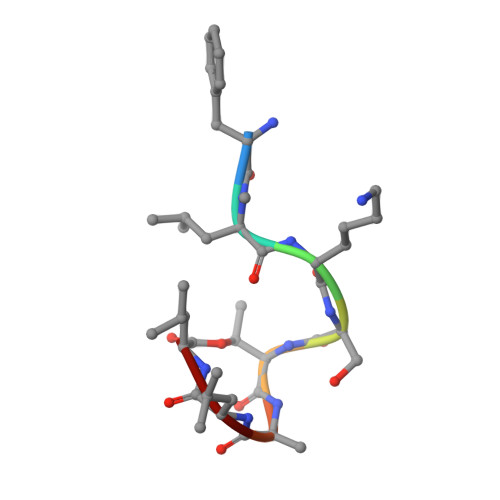
N-Me-D-Leu2,D-Thr5-clovibactin

  • Classification: ANTIBIOTIC
  • Organism(s): Eleftheria
  • Mutation(s): No 

  • Deposited: 2024-04-23 Released: 2024-09-18 
  • Deposition Author(s): Kreutzer, A.G., Griffin, J.G., Nowick, J.S.
  • Funding Organization(s): National Institutes of Health/National Institute Of Allergy and Infectious Diseases (NIH/NIAID)

Experimental Data Snapshot

  • Method: X-RAY DIFFRACTION
  • Resolution: 2.05 Å
  • R-Value Free: 
    0.204 (Depositor), 0.204 (DCC) 
  • R-Value Work: 
    0.155 (Depositor), 0.155 (DCC) 
  • R-Value Observed: 
    0.160 (Depositor) 

wwPDB Validation   3D Report Full Report


This is version 1.0 of the entry. See complete history


Literature

Structure-Activity Relationship Studies of the Peptide Antibiotic Clovibactin.

Brunicardi, J.E.H.Griffin, J.H.Ferracane, M.J.Kreutzer, A.G.Small, J.Mendoza, A.T.Ziller, J.W.Nowick, J.S.

(2024) J Org Chem 89: 12479-12484

  • DOI: https://doi.org/10.1021/acs.joc.4c01414
  • Primary Citation of Related Structures:  
    9BIC

  • PubMed Abstract: 

    Our laboratory reported the chemical synthesis and stereochemical assignment of the recently discovered peptide antibiotic clovibactin. The current paper reports an improved, gram-scale synthesis of the amino acid building block Fmoc-(2 R ,3 R )-3-hydroxyasparagine-OH that enables structure-activity relationship studies of clovibactin. An alanine scan reveals that residues Phe 1 , d-Leu 2 , Ser 4 , Leu 7 , and Leu 8 are important for antibiotic activity. The side-chain amide group of the rare d-Hyn 5 residue is not essential to activity and can be replaced with a methyl group with a moderate loss of activity. An acyclic clovibactin analogue reveals that the macrolactone ring is essential to antibiotic activity. The enantiomer of clovibactin is active, albeit somewhat less so than clovibactin. A conformationally constrained clovibactin analogue retains moderate antibiotic activity, while a backbone N -methylated analogue is almost completely inactive. X-ray crystallography of these two analogues reveals that the macrolactone ring adopts a crown-like conformation that binds anions.


  • Organizational Affiliation
    • Department of Chemistry, University of California, Irvine, Irvine, California 92697, United States.

Macromolecules

Find similar proteins by:  Sequence   |   3D Structure  

Entity ID: 1
MoleculeChains Sequence LengthOrganismDetailsImage
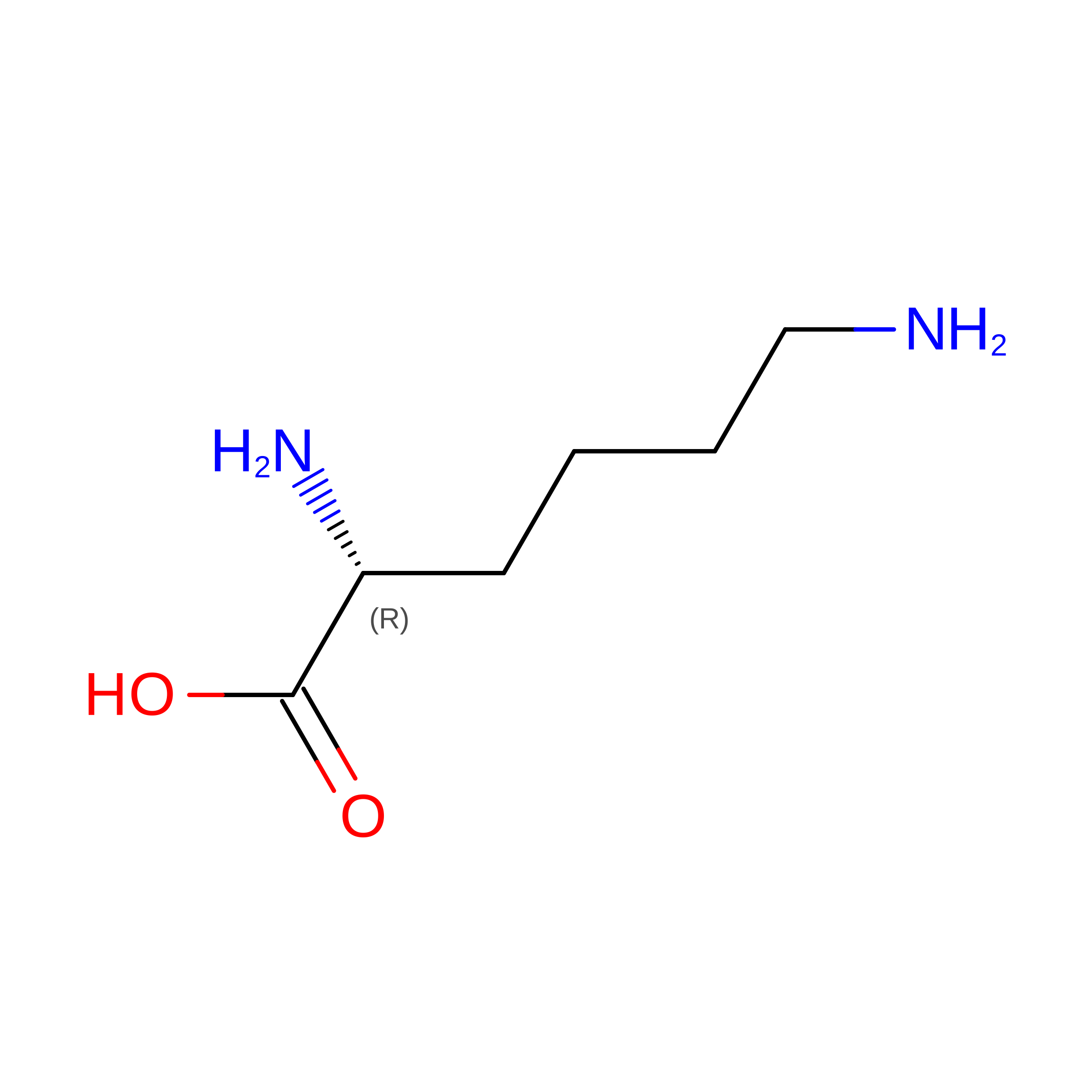
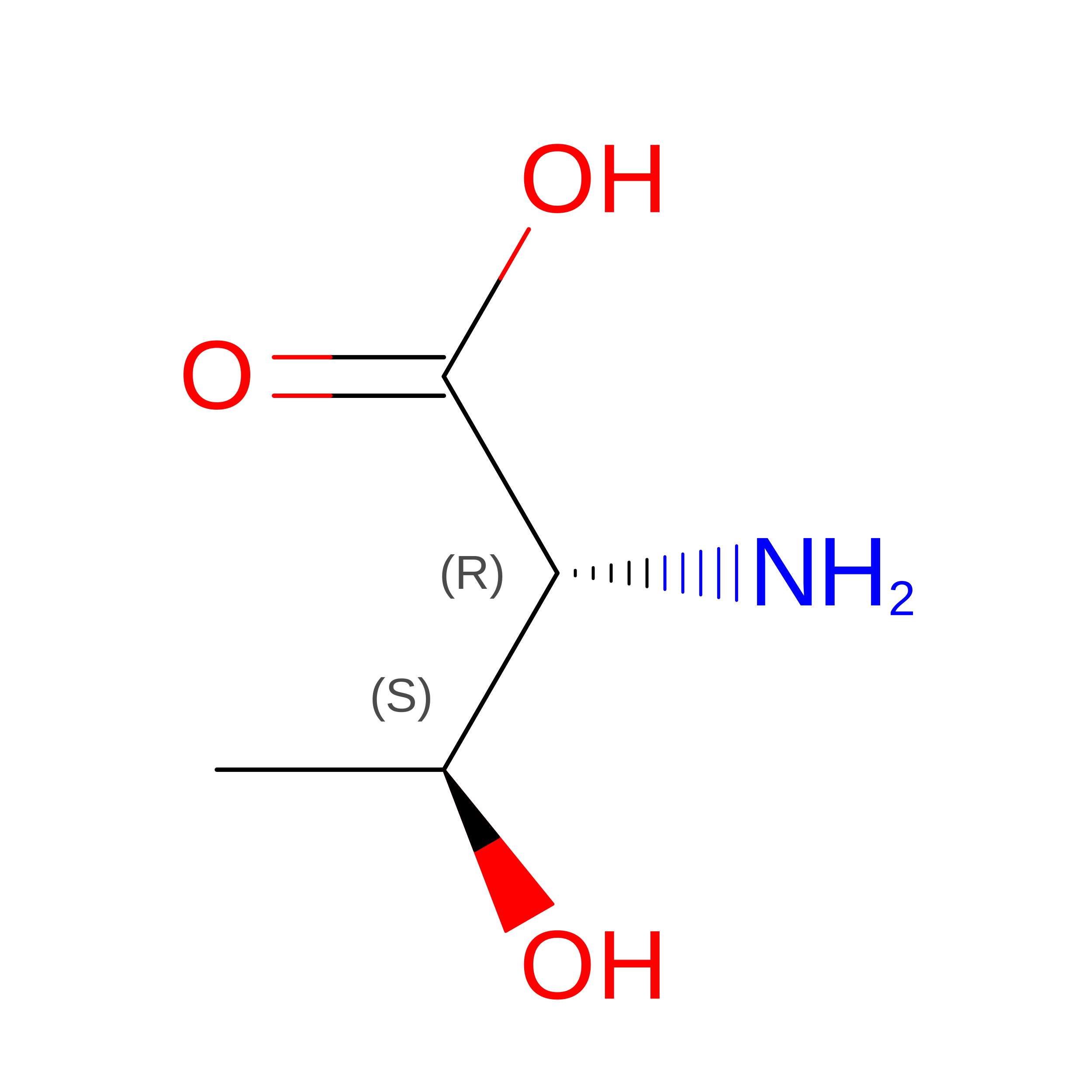
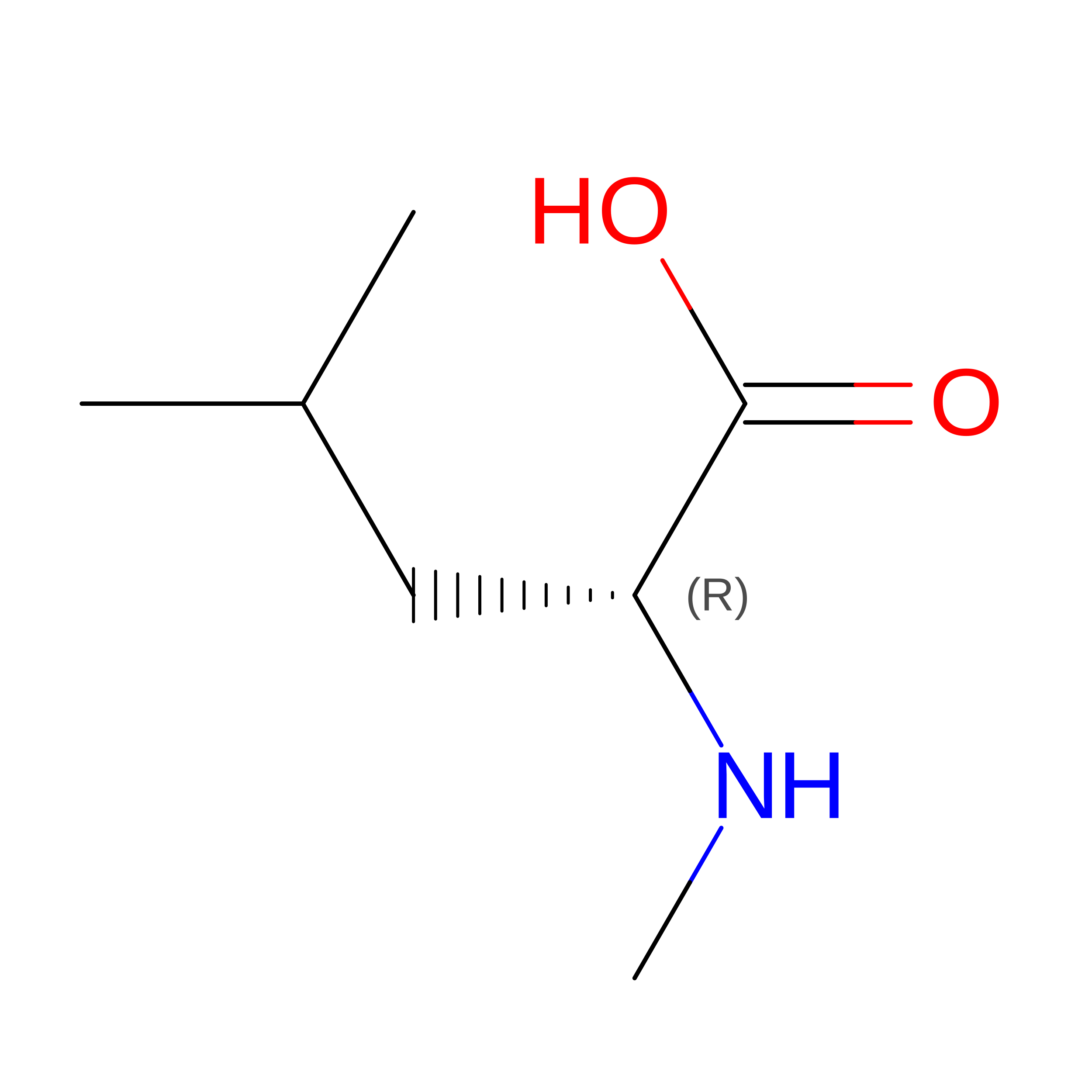
PHE-MLU-DLY-SER-DTH-ALA-LEU-LEU
A, B, C, D, E
A, B, C, D, E, F, G, H
8EleftheriaMutation(s): 0 
Sequence Annotations
Expand
  • Reference Sequence
Experimental Data & Validation

Experimental Data

  • Method: X-RAY DIFFRACTION
  • Resolution: 2.05 Å
  • R-Value Free:  0.204 (Depositor), 0.204 (DCC) 
  • R-Value Work:  0.155 (Depositor), 0.155 (DCC) 
  • R-Value Observed: 0.160 (Depositor) 
Space Group: P 2 21 21
Unit Cell:
Length ( Å )Angle ( ˚ )
a = 23.504α = 90
b = 47.773β = 90
c = 54.078γ = 90
Software Package:
Software NamePurpose
PHENIXrefinement
XDSdata reduction
Aimlessdata scaling
PHASERphasing

Structure Validation

View Full Validation Report


Entry History & Funding Information

Deposition Data


Funding OrganizationLocationGrant Number
National Institutes of Health/National Institute Of Allergy and Infectious Diseases (NIH/NIAID)United StatesAI168966

Revision History  (Full details and data files)

  • Version 1.0: 2024-09-18
    Type: Initial release