Download Mendeley
Identification and Exploration of a Series of SARS-Cov‐2 M Pro Cyano-Based Inhibitors Revealing Ortho-Substitution Effects within the P3 Biphenyl Group.
Clyde-Allen, E., Zmudzinski, M., Afsar, M., James, C., Nayak, A., Nayak, D., Dos Santos Bury, P., Jochmans, D., Neyts, J., Scott, C.J., Olsen, S.K., Drag, M., Williams, R.(2025) ACS Med Chem Lett 16: 1935-1945
- PubMed: 41089474 Search on PubMedSearch on PubMed Central
- DOI: https://doi.org/10.1021/acsmedchemlett.5c00301
- Primary Citation Related Structures:
9BBP, 9BBQ, 9BBR, 9BBS, 9BBT, 9BBU, 9BBV, 9BBW, 9BBX, 9BBY, 9BBZ, 9BC0 - PubMed Abstract:
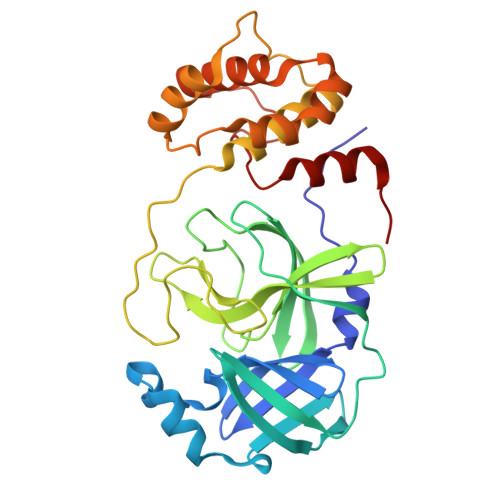
Starting from a simple scaffold hopping exercise based on our previous exploration of cysteine protease inhibitors against legumain, compound 6a was identified as a starting point for the development of a SARS-CoV-2 main protease (M Pro ) inhibitor. Compound 6a displayed submicromolar biochemical potency in the ultrasensitive assay developed by Drag and co-workers. Through an iterative structure-activity relationship campaign, we discovered an unexpected improvement in both biochemical and cellular potency through the incorporation of an ortho substituent within the P3 benzamide. X-ray crystallography revealed that incorporation of the ortho substituent caused a subtle but important binding enhancement of the P1 glutamate group within the M Pro S1 pocket. While incorporation of the ortho substituent improved the potency, the off-target selectivity against a panel of cysteine proteases and cell activity remained suboptimal. Further scanning of the P2 core revealed that incorporation of the 3.1.0 proline could address these issues and afford compound 22e , a highly potent and cellularly active M Pro inhibitor.
- Protease Drug Development Lab, Patrick G Johnston Centre for Cancer Research, Queen's University Belfast, 97 Lisburn Road, Belfast BT9 7AE, Northern Ireland.
Organizational Affiliation: