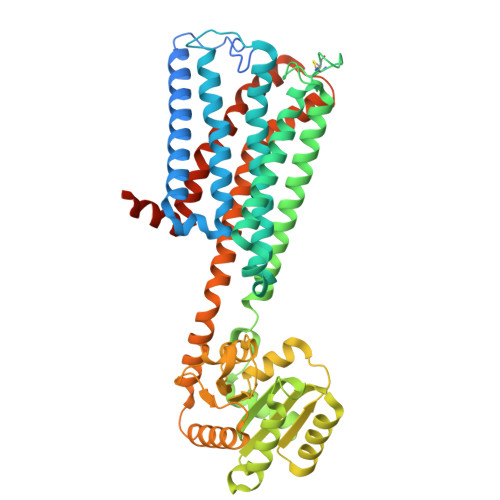
9BA0 | pdb_00009ba0

Structural mechanism of CB1R binding to peripheral and biased inverse agonists


Experimental Data Snapshot

  • Method: ELECTRON MICROSCOPY
  • Resolution: 3.13 Å
  • Aggregation State: PARTICLE 
  • Reconstruction Method: SINGLE PARTICLE 

wwPDB Validation 3D Report Full Report

Validation slider image for 9BA0

This is version 1.3 of the entry. See complete history

Literature

Structural mechanism of CB 1 R binding to peripheral and biased inverse agonists.

Kumari, P.Dvoracsko, S.Enos, M.D.Ramesh, K.Lim, D.Hassan, S.A.Kunos, G.Cinar, R.Iyer, M.R.Rosenbaum, D.M.

(2024) Nat Commun 15: 10694-10694

  • DOI: https://doi.org/10.1038/s41467-024-54206-0
  • Primary Citation Related Structures: 
    9B9Y, 9B9Z, 9BA0

  • PubMed Abstract: 

    The cannabinoid receptor 1 (CB 1 R) regulates synaptic transmission in the central nervous system, but also has important roles in the peripheral organs controlling cellular metabolism. While earlier generations of brain penetrant CB 1 R antagonists advanced to the clinic for their effective treatment of obesity, such molecules were ultimately shown to exhibit negative effects on central reward pathways that thwarted their further therapeutic development. The peripherally restricted CB 1 R inverse agonists MRI-1867 and MRI-1891 represent a new generation of compounds that retain the metabolic benefits of CB 1 R inhibitors while sparing the negative psychiatric effects. To understand the mechanism of binding and inhibition of CB 1 R by peripherally restricted antagonists, we developed a nanobody/fusion protein strategy for high-resolution cryo-EM structure determination of the GPCR inactive state, and used this method to determine structures of CB 1 R bound to either MRI-1867 or MRI-1891. These structures reveal how these compounds retain high affinity and specificity for CB 1 R's hydrophobic orthosteric site despite incorporating polar functionalities that lead to peripheral restriction. Further, the structure of the MRI-1891 complex along with accompanying molecular dynamics simulations shows how differential engagement with transmembrane helices and the proximal N-terminus can propagate through the receptor to contribute to biased inhibition of β-arrestin signaling.


  • Organizational Affiliation
    • Department of Biophysics, The University of Texas Southwestern Medical Center, Dallas, TX, USA.

Macromolecule Content 

  • Total Structure Weight: 75.38 kDa 
  • Atom Count: 4,742 
  • Modeled Residue Count: 601 
  • Deposited Residue Count: 663 
  • Unique protein chains: 2

Macromolecules

Find similar proteins by:|  3D Structure
Entity ID: 1
MoleculeChains  Sequence LengthOrganismDetailsImage
Cannabinoid receptor 1,Glycogen synthaseA [auth R]535Homo sapiensPyrococcus abyssi GE5Mutation(s): 0 
Gene Names: CNR1CNRPAB2292
UniProt & NIH Common Fund Data Resources
Find proteins for P21554 (Homo sapiens)
Explore P21554 
Go to UniProtKB:  P21554
PHAROS:  P21554
GTEx:  ENSG00000118432 
Find proteins for Q9V2J8 (Pyrococcus abyssi (strain GE5 / Orsay))
Explore Q9V2J8 
Go to UniProtKB:  Q9V2J8
Entity Groups
Sequence Clusters30% Identity50% Identity70% Identity90% Identity95% Identity100% Identity
UniProt GroupsQ9V2J8P21554
Sequence Annotations
Expand
Reference Sequence
Find similar proteins by:|  3D Structure
Entity ID: 2
MoleculeChains  Sequence LengthOrganismDetailsImage
CNb36B [auth N]128Lama glamaMutation(s): 0 

Small Molecules

Ligands 1 Unique
IDChains Name / Formula / InChI Key2D Diagram3D Interactions
A1AKN

Query on A1AKN


Download:Ideal Coordinates CCD File
C [auth R]N-(N-{(E)-[(4S)-3-(4-chlorophenyl)-4-phenyl-4,5-dihydro-1H-pyrazol-1-yl][4-(trifluoromethyl)benzene-1-sulfonamido]methylidene}carbamimidoyl)acetamide
C26 H22 Cl F3 N6 O3 S
GYJPQNPVIJXXTA-JOCHJYFZSA-N

Experimental Data & Validation

Experimental Data

  • Method: ELECTRON MICROSCOPY
  • Resolution: 3.13 Å
  • Aggregation State: PARTICLE 
  • Reconstruction Method: SINGLE PARTICLE 
EM Software:
TaskSoftware PackageVersion
MODEL REFINEMENTCoot
MODEL REFINEMENTPHENIX

Structure Validation

View Full Validation Report


Entry History 

& Funding Information

Deposition Data


Funding OrganizationLocationGrant Number
National Institutes of Health/National Institute of General Medical Sciences (NIH/NIGMS)United StatesGM116387

Revision History  (Full details and data files)

  • Version 1.0: 2024-11-20
    Type: Initial release
  • Version 1.1: 2024-11-27
    Changes: Data collection, Database references, Structure summary
  • Version 1.2: 2025-01-01
    Changes: Data collection, Database references
  • Version 1.3: 2025-05-28
    Changes: Data collection