9B6D | pdb_00009b6d

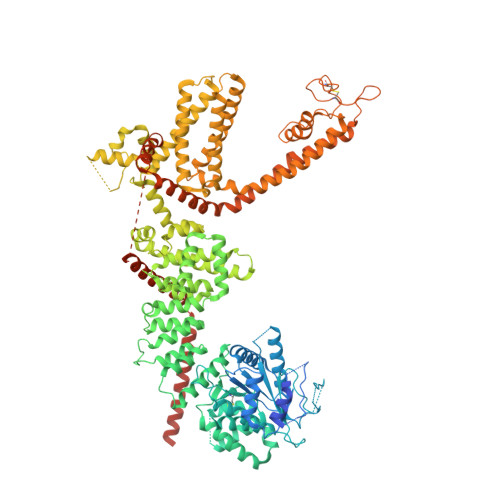
Cryo-EM structure of the mouse TRPM8 channel in the ligand-free desensitized state


Experimental Data Snapshot

  • Method: ELECTRON MICROSCOPY
  • Resolution: 3.30 Å
  • Aggregation State: PARTICLE 
  • Reconstruction Method: SINGLE PARTICLE 

Starting Model: experimental
View more details

wwPDB Validation 3D Report Full Report

Validation slider image for 9B6D

This is version 1.1 of the entry. See complete history

Literature

Mechanisms of sensory adaptation and inhibition of the cold and menthol receptor TRPM8.

Yin, Y.Park, C.G.Zhang, F.G Fedor, J.Feng, S.Suo, Y.Im, W.Lee, S.Y.

(2024) Sci Adv 10: eadp2211-eadp2211

  • DOI: https://doi.org/10.1126/sciadv.adp2211
  • Primary Citation Related Structures: 
    9B6D, 9B6E, 9B6F, 9B6G, 9B6H, 9B6I, 9B6J, 9B6K

  • PubMed Abstract: 

    Our sensory adaptation to cold and chemically induced coolness is mediated by the intrinsic property of TRPM8 channels to desensitize. TRPM8 is also implicated in cold-evoked pain disorders and migraine, highlighting its inhibitors as an avenue for pain relief. Despite the importance, the mechanisms of TRPM8 desensitization and inhibition remained unclear. We found, using cryo-electron microscopy, electrophysiology, and molecular dynamics simulations, that TRPM8 inhibitors bind selectively to the desensitized state of the channel. These inhibitors were used to reveal the overlapping mechanisms of desensitization and inhibition and that cold and cooling agonists share a common desensitization pathway. Furthermore, we identified the structural determinants crucial for the conformational change in TRPM8 desensitization. Our study illustrates how receptor-level conformational changes alter cold sensation, providing insights into therapeutic development.


  • Organizational Affiliation
    • Department of Biochemistry, Duke University School of Medicine, Durham, NC 27710, USA.

Macromolecule Content 

  • Total Structure Weight: 535.93 kDa 
  • Atom Count: 28,664 
  • Modeled Residue Count: 3,732 
  • Deposited Residue Count: 4,540 
  • Unique protein chains: 1

Macromolecules

Find similar proteins by:|  3D Structure
Entity ID: 1
MoleculeChains  Sequence LengthOrganismDetailsImage
Transient receptor potential cation channel subfamily M member 8
A, B, C, D
1,135Mus musculusMutation(s): 0 
Gene Names: Trpm8Ltrpc6Trpp8
Membrane Entity: Yes 
UniProt
Find proteins for Q8R4D5 (Mus musculus)
Explore Q8R4D5 
Go to UniProtKB:  Q8R4D5
Entity Groups
Sequence Clusters30% Identity50% Identity70% Identity90% Identity95% Identity100% Identity
UniProt GroupQ8R4D5
Sequence Annotations
Expand
Reference Sequence

Small Molecules

Ligands 1 Unique
IDChains Name / Formula / InChI Key2D Diagram3D Interactions
Y01

Query on Y01


Download:Ideal Coordinates CCD File
E [auth A]
F [auth A]
G [auth A]
H [auth A]
I [auth A]
E [auth A],
F [auth A],
G [auth A],
H [auth A],
I [auth A],
J [auth B],
K [auth B],
L [auth B],
M [auth B],
N [auth B],
O [auth C],
P [auth C],
Q [auth C],
R [auth C],
S [auth C],
T [auth D],
U [auth D],
V [auth D],
W [auth D],
X [auth D]
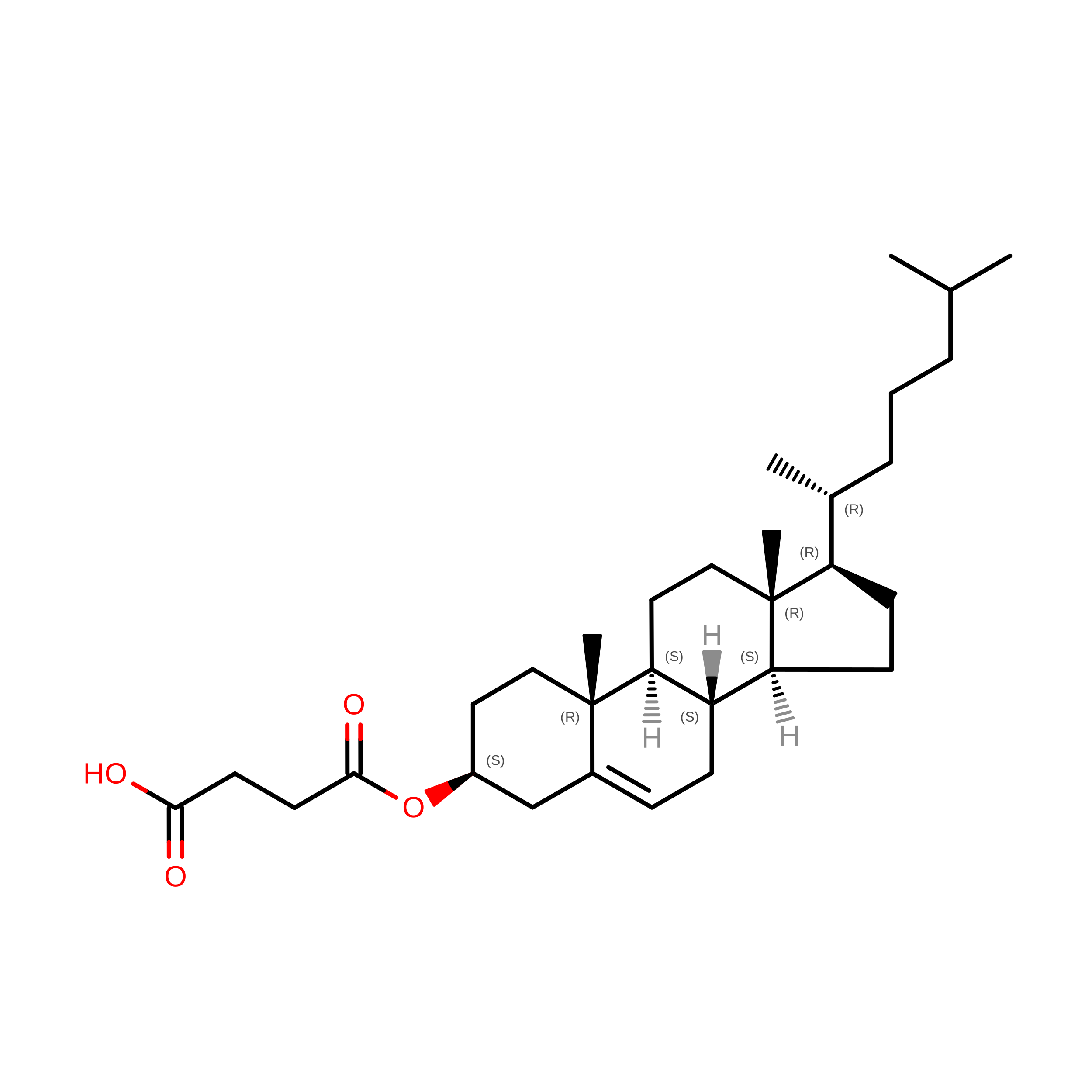
CHOLESTEROL HEMISUCCINATE
C31 H50 O4
WLNARFZDISHUGS-MIXBDBMTSA-N

Experimental Data & Validation

Experimental Data

  • Method: ELECTRON MICROSCOPY
  • Resolution: 3.30 Å
  • Aggregation State: PARTICLE 
  • Reconstruction Method: SINGLE PARTICLE 
EM Software:
TaskSoftware PackageVersion
RECONSTRUCTIONcryoSPARC
MODEL REFINEMENTPHENIX

Structure Validation

View Full Validation Report


Entry History 

& Funding Information

Deposition Data


Funding OrganizationLocationGrant Number
National Institutes of Health/National Eye Institute (NIH/NEI)United States--
National Institutes of Health/National Institute of Neurological Disorders and Stroke (NIH/NINDS)United States--

Revision History  (Full details and data files)

  • Version 1.0: 2024-08-21
    Type: Initial release
  • Version 1.1: 2024-11-20
    Changes: Data collection, Structure summary