9B5Y | pdb_00009b5y

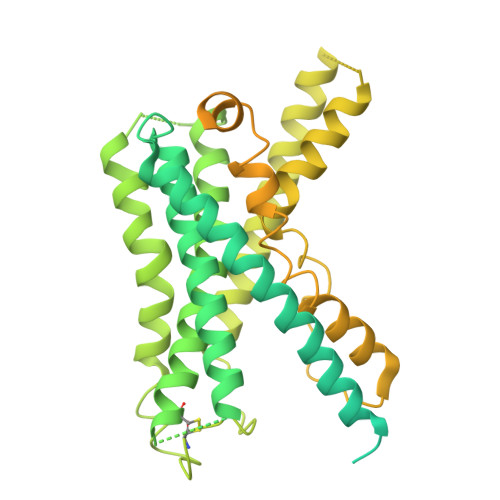
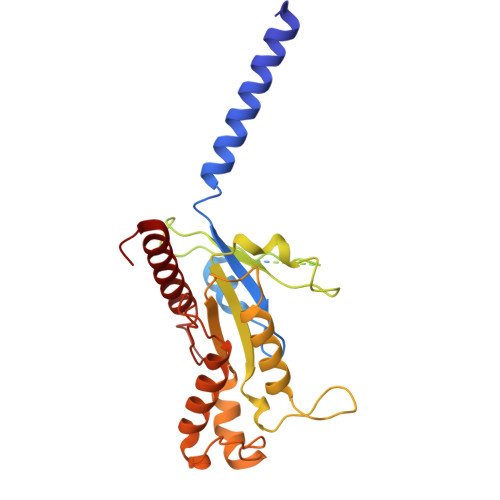
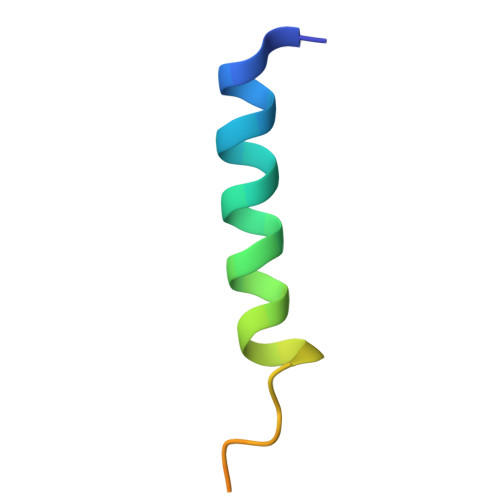
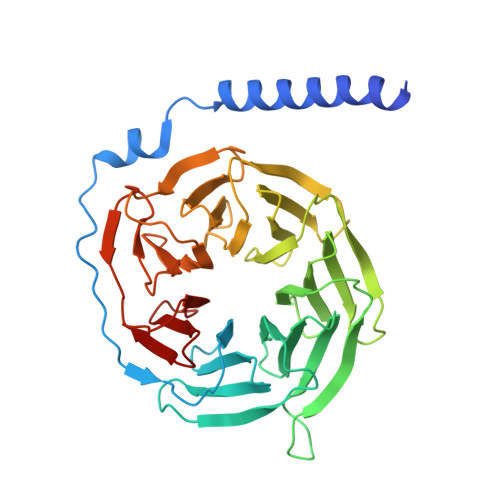
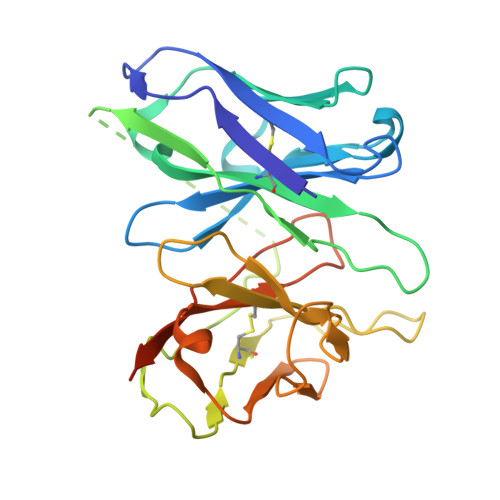
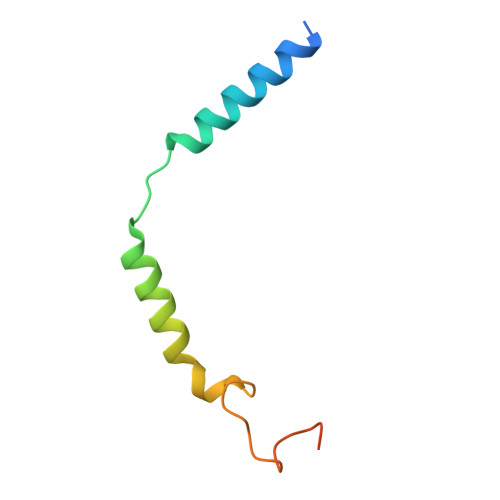
Cryo-EM structure of the LAPTH-bound PTH1R in complex with Gq


Experimental Data Snapshot

  • Method: ELECTRON MICROSCOPY
  • Resolution: 3.49 Å
  • Aggregation State: PARTICLE 
  • Reconstruction Method: SINGLE PARTICLE 

wwPDB Validation   3D Report Full Report


This is version 1.2 of the entry. See complete history


Literature

Allosteric mechanism in the distinctive coupling of G q and G s to the parathyroid hormone type 1 receptor.

Zhang, X.Lee, J.Y.Pacheco, J.Sutkeviciute, I.Anitha, A.K.Liu, H.Singh, S.Ventura, C.Savransky, S.Khatri, A.Zhang, C.Bahar, I.Vilardaga, J.P.

(2025) Proc Natl Acad Sci U S A 122: e2426178122-e2426178122

  • DOI: https://doi.org/10.1073/pnas.2426178122
  • Primary Citation of Related Structures:  
    9B5Y

  • PubMed Abstract: 

    The mechanism determining the preferential stimulation of one heterotrimeric G protein signaling pathway over another by a ligand remains undetermined. By reporting the cryogenic electron microscopy (cryo-EM) structure of the parathyroid hormone (PTH) type 1 receptor (PTH1R) complexed with Gq and comparing its allosteric dynamics with that of PTH1R in complex with G s , we uncover a mechanism underlying such preferences. We show that an allosteric coupling between the ligand PTH and the C-terminal helix α5 of the Gα subunit controls the stability of the PTH1R complex with the specific G protein, G s or G q . Single-cell-level experiments further validate the G protein-selective effects of the PTH binding pose by demonstrating the differential, G protein-dependent residence times and affinity of this ligand at the PTH1R binding site. The findings deepen our understanding of the selective coupling of PTH1R to G s or G q and how it relates to the stability and kinetics of ligand binding. They explain the observed variability in the ligand-binding affinity of a GPCR when coupled to different G proteins.


  • Organizational Affiliation
    • Department of Pharmacology and Chemical Biology, School of Medicine, University of Pittsburgh, Pittsburgh, PA 15261.

Macromolecules
Find similar proteins by:  (by identity cutoff)  |  3D Structure
Entity ID: 1
MoleculeChains Sequence LengthOrganismDetailsImage
Parathyroid hormone/parathyroid hormone-related peptide receptorA [auth R]693Homo sapiensMutation(s): 0 
Gene Names: PTH1R
Membrane Entity: Yes 
UniProt & NIH Common Fund Data Resources
Find proteins for Q03431 (Homo sapiens)
Explore Q03431 
Go to UniProtKB:  Q03431
PHAROS:  Q03431
GTEx:  ENSG00000160801 
Entity Groups  
Sequence Clusters30% Identity50% Identity70% Identity90% Identity95% Identity100% Identity
UniProt GroupQ03431
Sequence Annotations
Expand
  • Reference Sequence
Find similar proteins by:  (by identity cutoff)  |  3D Structure
Entity ID: 2
MoleculeChains Sequence LengthOrganismDetailsImage
Guanine nucleotide-binding protein G(q)B [auth A]353Homo sapiensMutation(s): 0 
Gene Names: GNAQ
UniProt
Find proteins for A0A8D2GGC9 (Theropithecus gelada)
Explore A0A8D2GGC9 
Go to UniProtKB:  A0A8D2GGC9
Entity Groups  
Sequence Clusters30% Identity50% Identity70% Identity90% Identity95% Identity100% Identity
UniProt GroupA0A8D2GGC9
Sequence Annotations
Expand
  • Reference Sequence
Find similar proteins by:  (by identity cutoff)  |  3D Structure
Entity ID: 3
MoleculeChains Sequence LengthOrganismDetailsImage
Long-acting parathyroid hormone analogC [auth L]36Homo sapiensMutation(s): 0 
Membrane Entity: Yes 
UniProt & NIH Common Fund Data Resources
Find proteins for F5GZD9 (Homo sapiens)
Explore F5GZD9 
Go to UniProtKB:  F5GZD9
GTEx:  ENSG00000087494 
Entity Groups  
Sequence Clusters30% Identity50% Identity70% Identity90% Identity95% Identity100% Identity
UniProt GroupF5GZD9
Sequence Annotations
Expand
  • Reference Sequence
Find similar proteins by:  (by identity cutoff)  |  3D Structure
Entity ID: 4
MoleculeChains Sequence LengthOrganismDetailsImage
Guanine nucleotide-binding protein G(I)/G(S)/G(T) subunit beta-1D [auth B]351Homo sapiensMutation(s): 0 
Gene Names: GNB1
UniProt & NIH Common Fund Data Resources
Find proteins for P62873 (Homo sapiens)
Explore P62873 
Go to UniProtKB:  P62873
PHAROS:  P62873
GTEx:  ENSG00000078369 
Entity Groups  
Sequence Clusters30% Identity50% Identity70% Identity90% Identity95% Identity100% Identity
UniProt GroupP62873
Sequence Annotations
Expand
  • Reference Sequence
Find similar proteins by:  (by identity cutoff)  |  3D Structure
Entity ID: 5
MoleculeChains Sequence LengthOrganismDetailsImage
scFv16E [auth N]266Mus musculusMutation(s): 0 
Entity Groups  
Sequence Clusters30% Identity50% Identity70% Identity90% Identity95% Identity100% Identity
Sequence Annotations
Expand
  • Reference Sequence
Find similar proteins by:  (by identity cutoff)  |  3D Structure
Entity ID: 6
MoleculeChains Sequence LengthOrganismDetailsImage
Guanine nucleotide-binding protein G(I)/G(S)/G(O) subunit gamma-2F [auth G]71Homo sapiensMutation(s): 0 
Gene Names: GNG2
Membrane Entity: Yes 
UniProt & NIH Common Fund Data Resources
Find proteins for P59768 (Homo sapiens)
Explore P59768 
Go to UniProtKB:  P59768
PHAROS:  P59768
GTEx:  ENSG00000186469 
Entity Groups  
Sequence Clusters30% Identity50% Identity70% Identity90% Identity95% Identity100% Identity
UniProt GroupP59768
Sequence Annotations
Expand
  • Reference Sequence
Experimental Data & Validation

Experimental Data

  • Method: ELECTRON MICROSCOPY
  • Resolution: 3.49 Å
  • Aggregation State: PARTICLE 
  • Reconstruction Method: SINGLE PARTICLE 
EM Software:
TaskSoftware PackageVersion
MODEL REFINEMENTPHENIX

Structure Validation

View Full Validation Report


Entry History & Funding Information

Deposition Data


Funding OrganizationLocationGrant Number
National Institutes of Health/National Institute of Diabetes and Digestive and Kidney Disease (NIH/NIDDK)United StatesR01DK116780
National Institutes of Health/National Institute of Diabetes and Digestive and Kidney Disease (NIH/NIDDK)United StatesR01DK122259
National Institutes of Health/National Institute of Dental and Craniofacial Research (NIH/NIDCR)United StatesR21DE032478

Revision History  (Full details and data files)

  • Version 1.0: 2025-03-19
    Type: Initial release
  • Version 1.1: 2025-04-09
    Changes: Data collection, Database references
  • Version 1.2: 2025-06-04
    Changes: Data collection