Download Mendeley
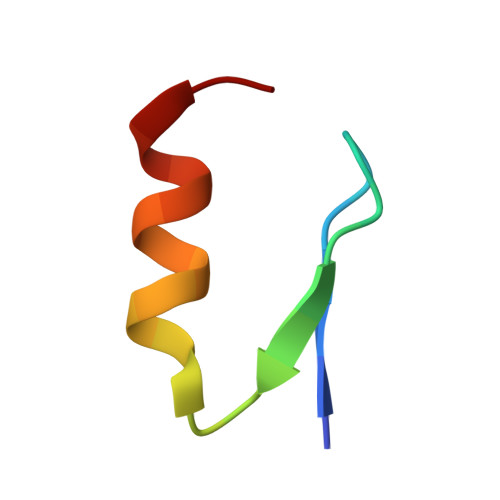
A tetramer of BCL11A is required for stable protein production and fetal hemoglobin silencing.
Zheng, G., Yin, M., Mehta, S., Chu, I.T., Wang, S., AlShaye, A., Drainville, K., Buyanbat, A., Bienfait, F., Tenglin, K., Zhu, Q., Orkin, S.H.(2024) Science 386: 1010-1018
- PubMed: 39607926 Search on PubMedSearch on PubMed Central
- DOI: https://doi.org/10.1126/science.adp3025
- Primary Citation Related Structures:
9B4P - PubMed Abstract:
Down-regulation of BCL11A protein reverses the fetal (HbF, α 2 γ 2 ) to adult (HbA, α 2 β 2 ) hemoglobin switch and is exploited in gene-based therapy for hemoglobin disorders. Because of reliance on ex vivo cell manipulation and marrow transplant, such therapies cannot lessen disease burden. To develop new small-molecule approaches, we investigated the state of BCL11A protein in erythroid cells. We report that tetramer formation mediated by a single zinc finger (ZnF0) is required for production of steady-state protein. Beyond its role in protein stability, the tetramer state is necessary for γ-globin gene repression, because an engineered monomer fails to engage a critical co-repressor complex. These aspects of BCL11A protein production identify tetramer formation as a vulnerability for HbF silencing and provide opportunities for drug discovery.
- Dana-Farber/Boston Children's Hospital Cancer and Blood Disorder Center, Department of Pediatrics, Harvard Medical School, Boston, MA, USA.
Organizational Affiliation: