Download Mendeley
Characterization of lignin-degrading enzyme PmdC, which catalyzes a key step in the synthesis of polymer precursor 2-pyrone-4,6-dicarboxylic acid.
Rodrigues, A.V., Moriarty, N.W., Kakumanu, R., DeGiovanni, A., Pereira, J.H., Gin, J.W., Chen, Y., Baidoo, E.E.K., Petzold, C.J., Adams, P.D.(2024) J Biol Chem 300: 107736-107736
- PubMed: 39222681 Search on PubMedSearch on PubMed Central
- DOI: https://doi.org/10.1016/j.jbc.2024.107736
- Primary Citation Related Structures:
9AZO - PubMed Abstract:
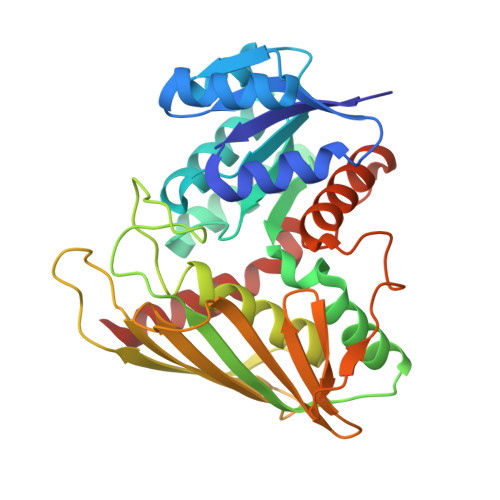
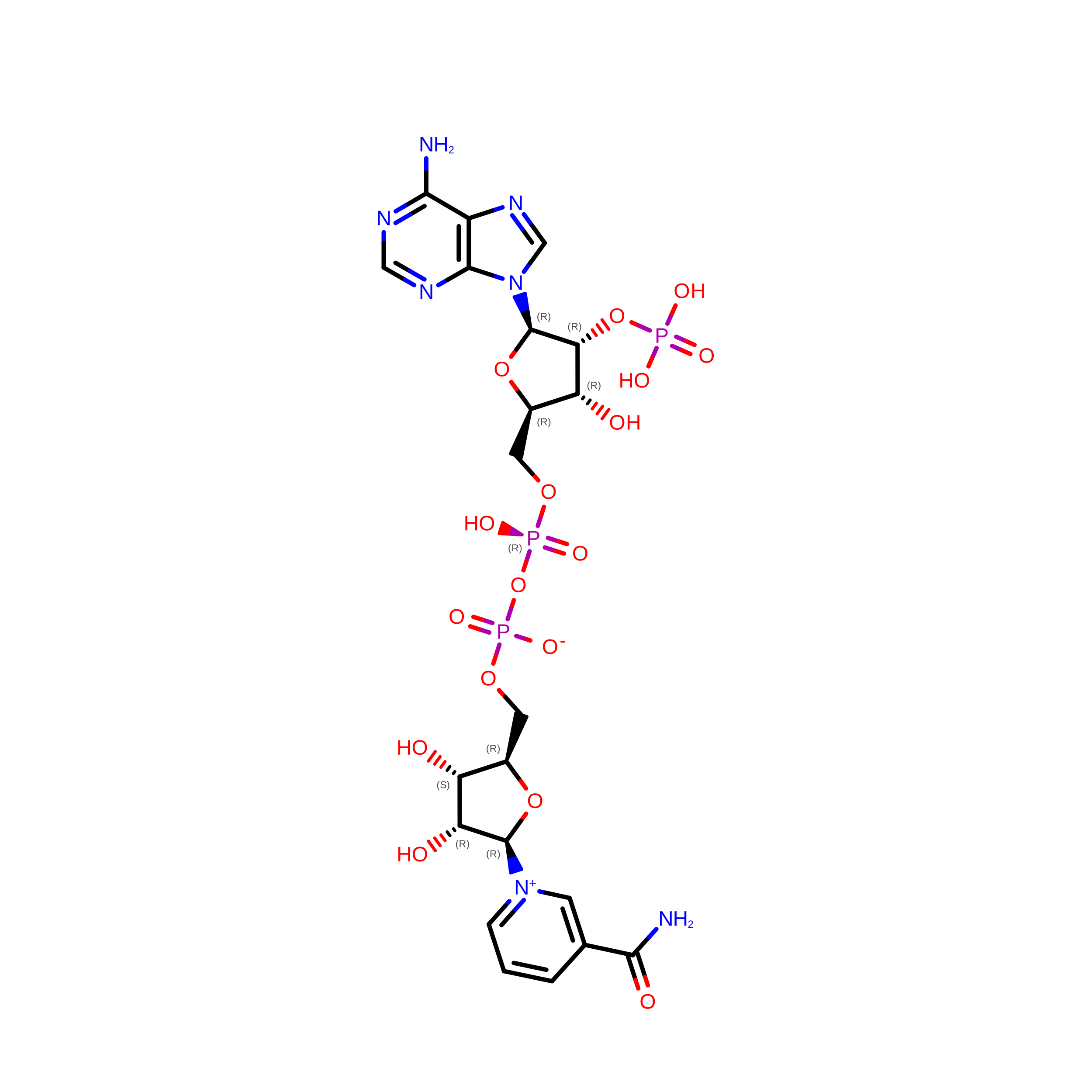
Pyrone-2,4-dicarboxylic acid (PDC) is a valuable polymer precursor that can be derived from the microbial degradation of lignin. The key enzyme in the microbial production of PDC is 4-carboxy-2-hydroxymuconate-6-semialdehyde (CHMS) dehydrogenase, which acts on the substrate CHMS. We present the crystal structure of CHMS dehydrogenase (PmdC from Comamonas testosteroni) bound to the cofactor NADP, shedding light on its three-dimensional architecture, and revealing residues responsible for binding NADP. Using a combination of structural homology, molecular docking, and quantum chemistry calculations, we have predicted the binding site of CHMS. Key histidine residues in a conserved sequence are identified as crucial for binding the hydroxyl group of CHMS and facilitating dehydrogenation with NADP. Mutating these histidine residues results in a loss of enzyme activity, leading to a proposed model for the enzyme's mechanism. These findings are expected to help guide efforts in protein and metabolic engineering to enhance PDC yields in biological routes to polymer feedstock synthesis.
- Joint BioEnergy Institute, Emeryville, California, United States; Molecular Biophysics and Integrated Bioimaging, Lawrence Berkeley National Laboratory, Berkeley, California, United States. Electronic address: avrodrigues@lbl.gov.
Organizational Affiliation: