9ARC | pdb_00009arc

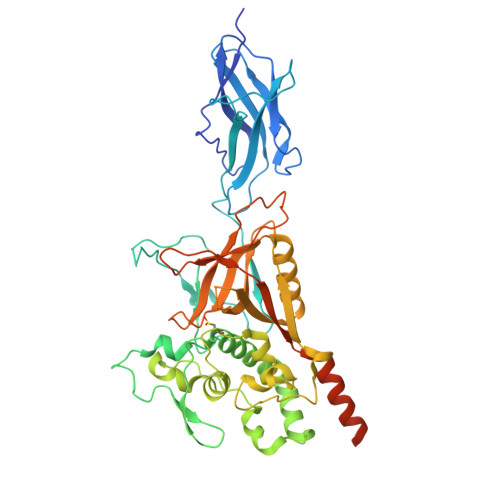
Crystal Structure of C0362 (TDE_0362 [TDE0362] resi 205-647)


Experimental Data Snapshot

  • Method: X-RAY DIFFRACTION
  • Resolution: 1.77 Å
  • R-Value Free: 
    0.227 (Depositor), 0.226 (DCC) 
  • R-Value Work: 
    0.198 (Depositor), 0.198 (DCC) 
  • R-Value Observed: 
    0.199 (Depositor) 

Starting Model: experimental
View more details

wwPDB Validation   3D Report Full Report


This is version 1.2 of the entry. See complete history


Literature

A bipartite bacterial virulence factor targets the complement system and neutrophil activation.

Kurniyati, K.Clark, N.D.Wang, H.Deng, Y.Sze, C.W.Visser, M.B.Malkowski, M.G.Li, C.

(2025) EMBO J 44: 1154-1184

  • DOI: https://doi.org/10.1038/s44318-024-00342-8
  • Primary Citation of Related Structures:  
    9ARC

  • PubMed Abstract: 

    The complement system and neutrophils constitute the two main pillars of the host innate immune defense against infection by bacterial pathogens. Here, we identify T-Mac, a novel virulence factor of the periodontal pathogen Treponema denticola that allows bacteria to evade both defense systems. We show that T-Mac is expressed as a pre-protein that is cleaved into two functional units. The N-terminal fragment has two immunoglobulin-like domains and binds with high affinity to the major neutrophil chemokine receptors FPR1 and CXCR1, blocking N-formyl-Met-Leu-Phe- and IL-8-induced neutrophil chemotaxis and activation. The C-terminal fragment functions as a cysteine protease with a unique proteolytic activity and structure, which degrades several components of the complement system, such as C3 and C3b. Murine infection studies further reveal a critical T-Mac role in tissue damage and inflammation caused by bacterial infection. Collectively, these results disclose a novel innate immunity-evasion strategy, and open avenues for investigating the role of cysteine proteases and immunoglobulin-like domains of gram-positive and -negative bacterial pathogens.


  • Organizational Affiliation
    • Philips Institute for Oral Health Research, School of Dentistry, Virginia Commonwealth University, Richmond, VA, USA.

Macromolecules
Find similar proteins by:  (by identity cutoff)  |  3D Structure
Entity ID: 1
MoleculeChains Sequence LengthOrganismDetailsImage
Bacterial Ig-like domain protein C0362476Treponema denticolaMutation(s): 0 
Gene Names: TDE_0362
UniProt
Find proteins for Q73QT1 (Treponema denticola (strain ATCC 35405 / DSM 14222 / CIP 103919 / JCM 8153 / KCTC 15104))
Explore Q73QT1 
Go to UniProtKB:  Q73QT1
Entity Groups  
Sequence Clusters30% Identity50% Identity70% Identity90% Identity95% Identity100% Identity
UniProt GroupQ73QT1
Sequence Annotations
Expand
  • Reference Sequence
Experimental Data & Validation

Experimental Data

  • Method: X-RAY DIFFRACTION
  • Resolution: 1.77 Å
  • R-Value Free:  0.227 (Depositor), 0.226 (DCC) 
  • R-Value Work:  0.198 (Depositor), 0.198 (DCC) 
  • R-Value Observed: 0.199 (Depositor) 
Space Group: P 2 21 21
Unit Cell:
Length ( Å )Angle ( ˚ )
a = 41.598α = 90
b = 99.258β = 90
c = 121.31γ = 90
Software Package:
Software NamePurpose
PHENIXrefinement
Cootmodel building
PHASERphasing
cctbx.xfeldata reduction
Aimlessdata scaling
DIALSdata reduction
xia2data reduction
Blu-Icedata collection

Structure Validation

View Full Validation Report


Entry History & Funding Information

Deposition Data


Funding OrganizationLocationGrant Number
National Institutes of Health/National Institute of Dental and Craniofacial Research (NIH/NIDCR)United States5R01DE023080-10

Revision History  (Full details and data files)

  • Version 1.0: 2024-11-27
    Type: Initial release
  • Version 1.1: 2025-02-12
    Changes: Database references
  • Version 1.2: 2025-03-05
    Changes: Database references