9ABP | pdb_00009abp

A PRO TO GLY MUTATION IN THE HINGE OF THE ARABINOSE-BINDING PROTEIN ENHANCES BINDING AND ALTERS SPECIFICITY: SUGAR-BINDING AND CRYSTALLOGRAPHIC STUDIES


Experimental Data Snapshot

  • Method: X-RAY DIFFRACTION
  • Resolution: 1.97 Å
  • R-Value Observed: 
    0.180 (Depositor) 

wwPDB Validation 3D Report Full Report

Validation slider image for 9ABP

This is version 2.1 of the entry. See complete history

Literature

A Pro to Gly mutation in the hinge of the arabinose-binding protein enhances binding and alters specificity. Sugar-binding and crystallographic studies.

Vermersch, P.S.Tesmer, J.J.Lemon, D.D.Quiocho, F.A.

(1990) J Biological Chem 265: 16592-16603

  • Primary Citation Related Structures: 
    1APB, 1BAP, 9ABP

  • PubMed Abstract: 

    The L-arabinose-binding protein (ABP) of Escherichia coli consists structurally of two distinct globular domains connected by a hinge of three separate peptide segments. Arabinose is bound and completely sequestered within the deep cleft between the two domains. With reduced affinity, ABP also binds D-galactose (approximately 2-fold reduction) and D-fucose (approximately 40-fold reduction). Experiments have been conducted to explore the role in sugar binding of the hinge connecting the two domains of ABP. To increase the flexibility of the hinge region, a glycine was substituted for a proline at position 254 by site-directed mutagenesis. Unexpectedly, this mutation resulted in the dramatic enhancement of galactose binding over that of arabinose. The affinity of the mutant ABP for galactose increased by over 20-fold, while that for arabinose and fucose remained relatively unchanged. We have measured association and dissociation rates of the Gly-254 ABP with L-arabinose, D-galactose, and D-fucose and have determined the crystallographic structure of the protein complexed with each of the three sugars. Both the ligand-binding kinetic measurements and structure analysis indicate that the altered specificity is due to an effective increase in the rigidity of the hinge in the closed conformation which is induced upon galactose binding. Stabilizing contacts are formed between the strands of the hinge in the Gly-254 ABP when galactose is bound which are not found in complexes with the other sugars or the liganded wild-type protein.


  • Organizational Affiliation
    • Howard Hughes Medical Institute, Baylor College of Medicine, Houston, Texas 77030.

Macromolecule Content 

  • Total Structure Weight: 33.57 kDa 
  • Atom Count: 2,511 
  • Modeled Residue Count: 305 
  • Deposited Residue Count: 306 
  • Unique protein chains: 1

Macromolecules

Find similar proteins by:|  3D Structure
Entity ID: 1
MoleculeChains  Sequence LengthOrganismDetailsImage
L-ARABINOSE-BINDING PROTEIN306Escherichia coliMutation(s): 0 
UniProt
Find proteins for P02924 (Escherichia coli (strain K12))
Explore P02924 
Go to UniProtKB:  P02924
Entity Groups
Sequence Clusters30% Identity50% Identity70% Identity90% Identity95% Identity100% Identity
UniProt GroupP02924
Sequence Annotations
Expand
Reference Sequence

Small Molecules

Ligands 2 Unique
IDChains Name / Formula / InChI Key2D Diagram3D Interactions
GLA

Query on GLA


Download:Ideal Coordinates CCD File
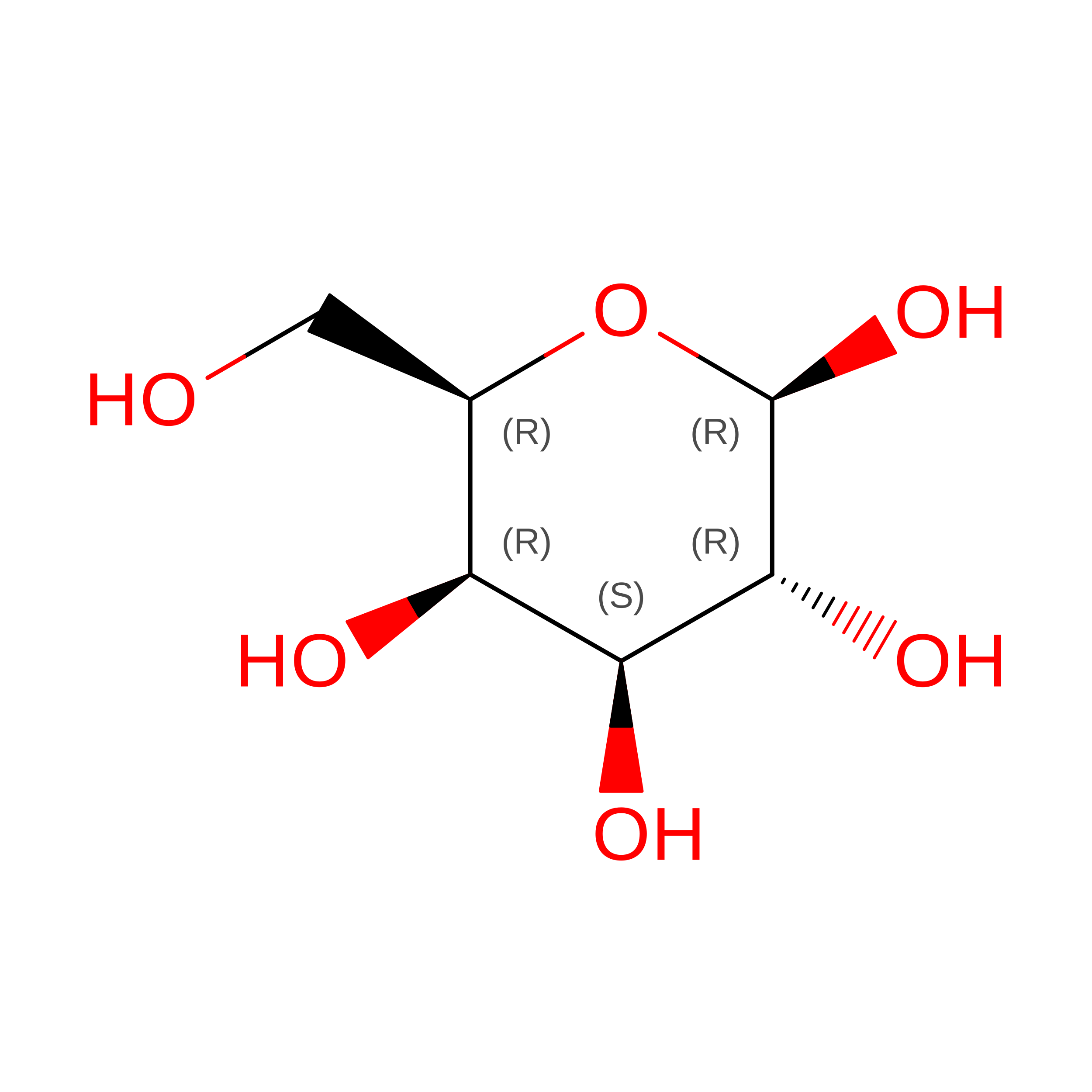
B [auth A]alpha-D-galactopyranose
C6 H12 O6
WQZGKKKJIJFFOK-PHYPRBDBSA-N
GAL

Query on GAL


Download:Ideal Coordinates CCD File
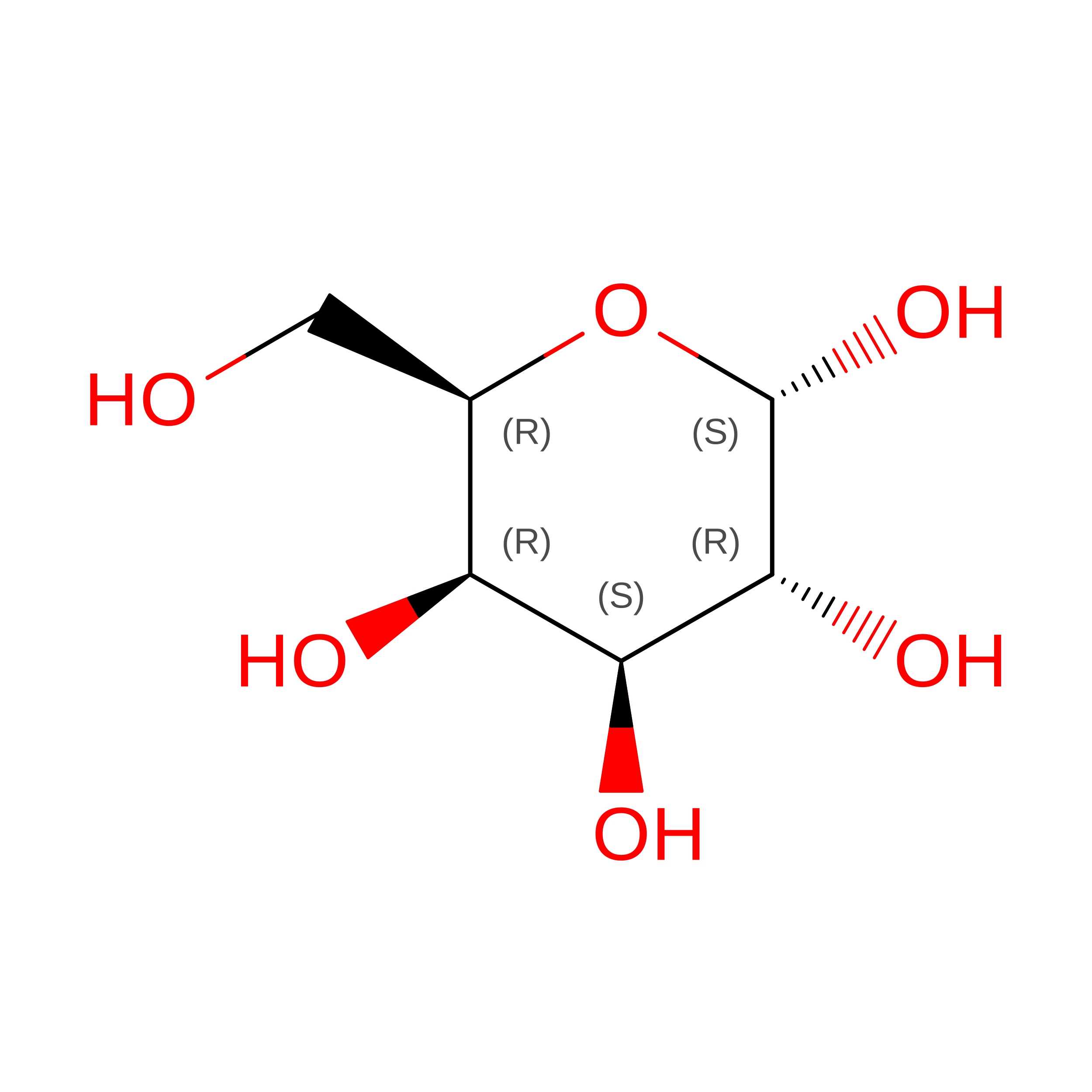
C [auth A]beta-D-galactopyranose
C6 H12 O6
WQZGKKKJIJFFOK-FPRJBGLDSA-N

Experimental Data & Validation

Experimental Data

  • Method: X-RAY DIFFRACTION
  • Resolution: 1.97 Å
  • R-Value Observed: 0.180 (Depositor) 
Space Group: P 21 21 21
Unit Cell:
Length ( Å )Angle ( ˚ )
a = 55.46α = 90
b = 71.82β = 90
c = 77.84γ = 90
Software Package:
Software NamePurpose
PROLSQrefinement

Structure Validation

View Full Validation Report


Entry History 

Deposition Data

Revision History  (Full details and data files)

  • Version 1.0: 1992-01-15
    Type: Initial release
  • Version 1.1: 2008-03-25
    Changes: Version format compliance
  • Version 1.2: 2011-07-13
    Changes: Version format compliance
  • Version 2.0: 2020-07-29
    Type: Remediation
    Reason: Carbohydrate remediation
    Changes: Atomic model, Data collection, Database references, Derived calculations, Other, Structure summary
  • Version 2.1: 2024-02-14
    Changes: Data collection, Database references, Structure summary