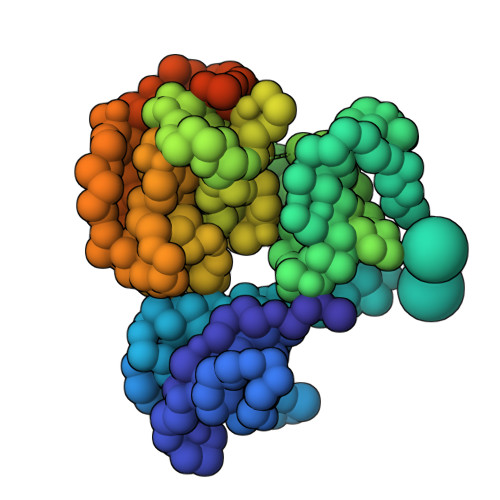
9AAA | pdb_00009aaa

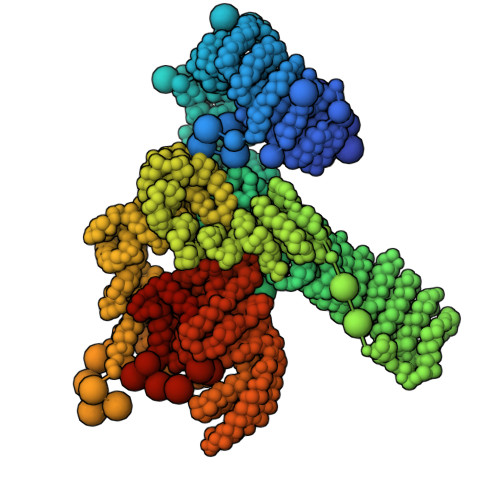
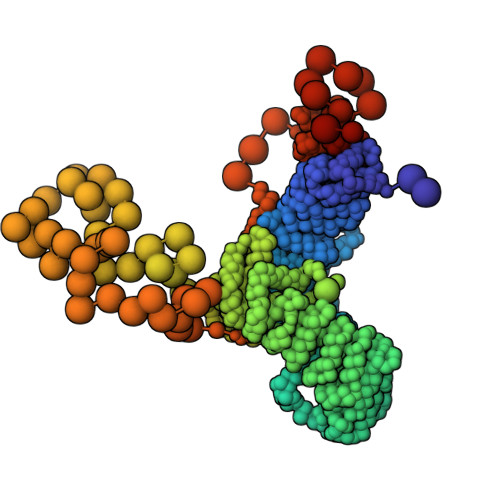
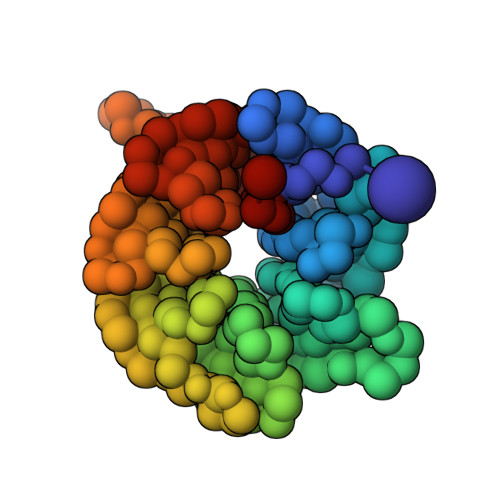
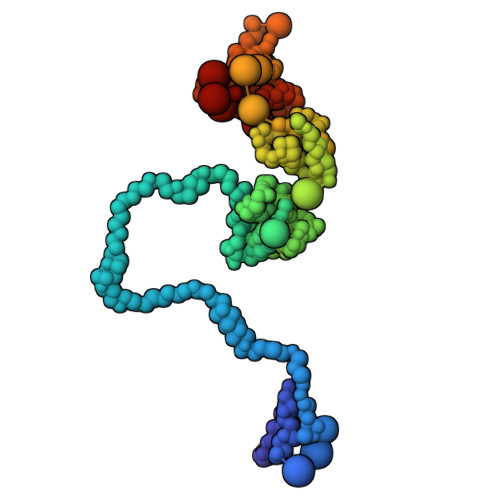
mTORC2-AKT1

Integrative structure models are generated using different types of input information, including varied experimental data, physical principles, statistical preferences, and other prior information.


Integrative Structure Snapshot

  • Multi-Scale: Yes 
  • Multi-State: No 
  • Ordered-State: No 
  • Deposited Models: 1 
  • Representative Model: 1 

This is version 1.0 of the entry. See complete history


Literature

Structural Basis for the Recruitment and Selective Phosphorylation of Akt by mTORC2

Taylor, M.S.Chen, M.Hancock, M.Wranik, M.Miller, B.D.O'Meara, T.R.Palanski, B.A.Ficarro, S.B.Groendyke, B.J.Xiang, Y.Kondo, K.T.Linde-Garelli, K.Y.Lee, M.J.Mondal, D.Freund, D.Congreve, S.Matas, K.Hennik, M.Xibinaku, K.Valenstein, M.L.van Euwen, T.Marto, J.A.Sali, A.Shi, Y.Gray, N.S.Sabatini, D.M.Chu, N.Rogala, K.B.Cole, P.A.

(2025) Science 391

  • DOI: https://doi.org/10.1126/science.adv7111
  • Primary Citation Related Structures: 
    9AAA, 9ZBJ, 9ZBK

  • PubMed Abstract: 

    The mechanistic target of rapamycin (mTOR) protein kinase forms two multiprotein complexes, mTORC1 and mTORC2, that function in distinct signaling pathways. mTORC1 is regulated by nutrients, and mTORC2 is a central node in phosphoinositide-3 kinase (PI3K) and small guanosine triphosphate Ras signaling networks commonly deregulated in cancer and diabetes. Although mTOR phosphorylates many substrates in vitro, in cells, mTORC1 and mTORC2 have high specificity: mTORC2 phosphorylates the protein kinases Akt and PKC, but not closely related kinases that are mTORC1 substrates. To understand how mTORC2 recognizes substrates, we created semisynthetic probes to trap the mTORC2 :: Akt complex and determine its structure. Whereas most protein kinases recognize amino acids adjacent to the phosphorylation site, local sequence contributes little to substrate recognition by mTORC2. Instead, the specificity determinants were secondary and tertiary structural elements of Akt that bound the mTORC2 component mSin1 distal to the mTOR active site and were conserved among at least 18 related substrates. These results reveal how mTORC2 recognizes its canonical substrates and may enable the design of mTORC2-specific inhibitors.


  • Organizational Affiliation
    • Department of Pathology and Laboratory Medicine, Brown University, Providence, RI, USA.

Macromolecules
Find similar proteins by:  (by identity cutoff) 
|   3D Structure  
Entity ID: 1
MoleculeChains Sequence LengthOrganismDetailsImage
MTOR
A, B
2,549Homo sapiensMutation(s): 0 
Gene Names: MTOR
EC: 2.7.11.1 (UniProt), 2.7.10.2 (UniProt)
UniProt & NIH Common Fund Data Resources
Find proteins for P42345 (Homo sapiens)
Explore P42345 
Go to UniProtKB:  P42345
PHAROS:  P42345
GTEx:  ENSG00000198793 
Entity Groups  
Sequence Clusters30% Identity50% Identity70% Identity90% Identity95% Identity100% Identity
UniProt GroupP42345
Sequence Annotations
Expand
  • Reference Sequence
Find similar proteins by:  (by identity cutoff) 
|   3D Structure  
Entity ID: 2
MoleculeChains Sequence LengthOrganismDetailsImage
RICTOR
C, D
1,708Homo sapiensMutation(s): 0 
Gene Names: RICTOR
UniProt & NIH Common Fund Data Resources
Find proteins for Q6R327 (Homo sapiens)
Explore Q6R327 
Go to UniProtKB:  Q6R327
PHAROS:  Q6R327
GTEx:  ENSG00000164327 
Entity Groups  
Sequence Clusters30% Identity50% Identity70% Identity90% Identity95% Identity100% Identity
UniProt GroupQ6R327
Sequence Annotations
Expand
  • Reference Sequence
Find similar proteins by:  (by identity cutoff) 
|   3D Structure  
Entity ID: 3
MoleculeChains Sequence LengthOrganismDetailsImage
MLST8
E, F
326Homo sapiensMutation(s): 0 
Gene Names: MLST8
UniProt & NIH Common Fund Data Resources
Find proteins for Q9BVC4 (Homo sapiens)
Explore Q9BVC4 
Go to UniProtKB:  Q9BVC4
PHAROS:  Q9BVC4
GTEx:  ENSG00000167965 
Entity Groups  
Sequence Clusters30% Identity50% Identity70% Identity90% Identity95% Identity100% Identity
UniProt GroupQ9BVC4
Sequence Annotations
Expand
  • Reference Sequence
Find similar proteins by:  (by identity cutoff) 
|   3D Structure  
Entity ID: 4
MoleculeChains Sequence LengthOrganismDetailsImage
MSIN1
G, H
522Homo sapiensMutation(s): 0 
Gene Names: MAPKAP1
UniProt & NIH Common Fund Data Resources
Find proteins for Q9BPZ7 (Homo sapiens)
Explore Q9BPZ7 
Go to UniProtKB:  Q9BPZ7
PHAROS:  Q9BPZ7
GTEx:  ENSG00000119487 
Entity Groups  
Sequence Clusters30% Identity50% Identity70% Identity90% Identity95% Identity100% Identity
UniProt GroupQ9BPZ7
Sequence Annotations
Expand
  • Reference Sequence
Find similar proteins by:  (by identity cutoff) 
|   3D Structure  
Entity ID: 5
MoleculeChains Sequence LengthOrganismDetailsImage
AKT1
I, J
480Homo sapiensMutation(s): 0 
Gene Names: AKT1
EC: 2.7.11.1
UniProt & NIH Common Fund Data Resources
Find proteins for P31749 (Homo sapiens)
Explore P31749 
Go to UniProtKB:  P31749
PHAROS:  P31749
GTEx:  ENSG00000142208 
Entity Groups  
Sequence Clusters30% Identity50% Identity70% Identity90% Identity95% Identity100% Identity
UniProt GroupP31749
Sequence Annotations
Expand
  • Reference Sequence
Experimental Data & Validation

Integrative Structure Snapshot

  • Multi-Scale: Yes 
  • Multi-State: No 
  • Ordered-State: No 
  • Deposited Models: 1 
  • Representative Model: 1 

Structure Validation

View Full Validation Report

View Summary Validation Report


Entry History 

Deposition Data

Revision History  (Full details and data files)

  • Version 1.0: 2026-04-29
    Type: Initial release