Download Mendeley
Photoinduced isomerization sampling of retinal in bacteriorhodopsin
Ren, Z.(2022) Pnas Nexus 1: pgac103
- PubMed: 35967979 Search on PubMedSearch on PubMed Central
- DOI: https://doi.org/10.1093/pnasnexus/pgac103
- Primary Citation Related Structures:
9A1Z, 9A21, 9A22, 9A23 - PubMed Abstract:
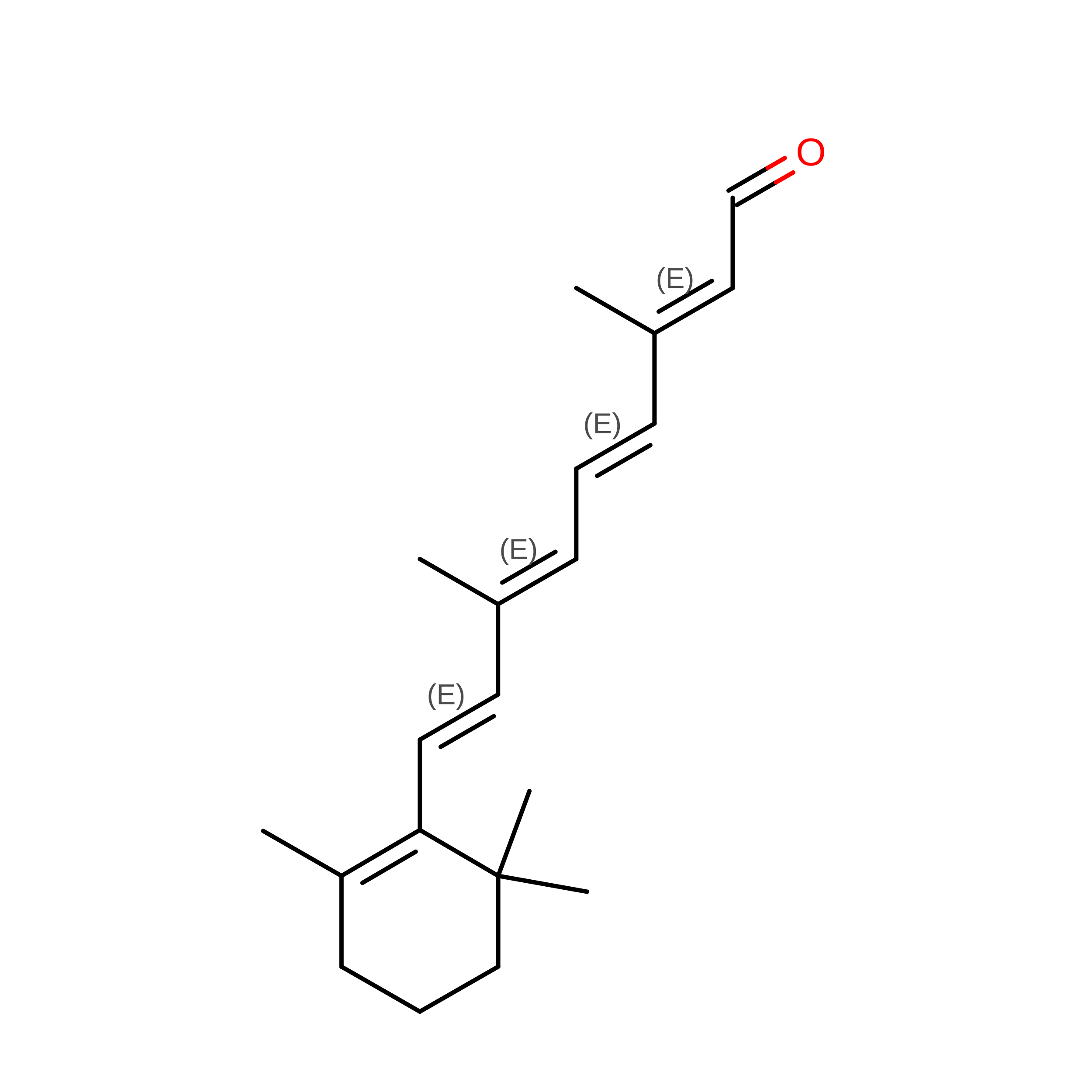
Photoisomerization of retinoids inside a confined protein pocket represents a critical chemical event in many important biological processes from animal vision, nonvisual light effects, to bacterial light sensing and harvesting. Light-driven proton pumping in bacteriorhodopsin entails exquisite electronic and conformational reconfigurations during its photocycle. However, it has been a major challenge to delineate transient molecular events preceding and following the photoisomerization of the retinal from noisy electron density maps when varying populations of intermediates coexist and evolve as a function of time. Here, I report several distinct early photoproducts deconvoluted from the recently observed mixtures in time-resolved serial crystallography. This deconvolution substantially improves the quality of the electron density maps, hence demonstrates that the all- trans retinal undergoes extensive isomerization sampling before it proceeds to the productive 13- cis configuration. Upon light absorption, the chromophore attempts to perform trans -to- cis isomerization at every double bond together with the stalled anti -to- syn rotations at multiple single bonds along its polyene chain. Such isomerization sampling pushes all seven transmembrane helices to bend outward, resulting in a transient expansion of the retinal binding pocket, and later, a contraction due to recoiling. These ultrafast responses observed at the atomic resolution support that the productive photoreaction in bacteriorhodopsin is initiated by light-induced charge separation in the prosthetic chromophore yet governed by stereoselectivity of its protein pocket. The method of a numerical resolution of concurrent events from mixed observations is also generally applicable.
- Department of Chemistry, University of Illinois at Chicago, Chicago, IL 60607, USA.
Organizational Affiliation: