Download Mendeley
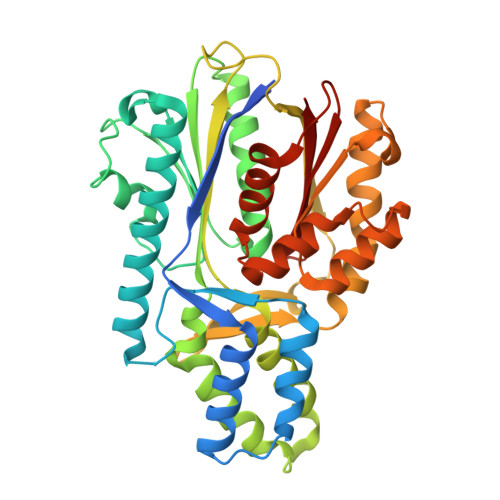
Structural insights into type III polyketide synthase CylI from cylindrocyclophane biosynthesis.
Wang, H.Q., Xiang, Z.(2024) Protein Sci 33: e5130-e5130
- PubMed: 39302095 Search on PubMedSearch on PubMed Central
- DOI: https://doi.org/10.1002/pro.5130
- Primary Citation Related Structures:
8YSP, 8YST, 8YT0, 8YW7 - PubMed Abstract:
Type III polyketide synthases (PKSs) catalyze the formation of a variety of polyketide natural products with remarkable structural diversity and biological activities. Despite significant progress in structural and mechanistic studies of type III PKSs in bacteria, fungi, and plants, research on type III PKSs in cyanobacteria is lacking. Here, we report structural and mechanistic insights into CylI, a type III PKS that catalyzes the formation of the alkylresorcinol intermediate in cylindrocyclophane biosynthesis. The crystal structure of apo-CylI reveals a distinct arrangement of structural elements that are proximal to the active site. We further solved the crystal structures of CylI in complexes with two substrate analogues at resolutions of 1.9 Å. The complex structures indicate that N259 is the key residue that determines the substrate preference of CylI. We also solved the crystal structure of CylI complexed with the alkylresorcinol product at a resolution of 2.0 Å. Structural analysis and mutagenesis experiments suggested that S170 functions as a key residue that determines cyclization specificity. On the basis of this result, a double mutant was engineered to completely switch the cyclization of CylI from aldol condensation to lactonization. This work elucidates the molecular basis of type III PKS in cyanobacteria and lays the foundation for engineering CylI-like enzymes to generate new products.
- State Key Laboratory of Chemical Oncogenomics, Shenzhen Key Laboratory of Chemical Genomics, AI for Science (AI4S) Preferred Program, School of Chemical Biology and Biotechnology, Peking University Shenzhen Graduate School, Shenzhen, PR China.
Organizational Affiliation: