8VBB | pdb_00008vbb

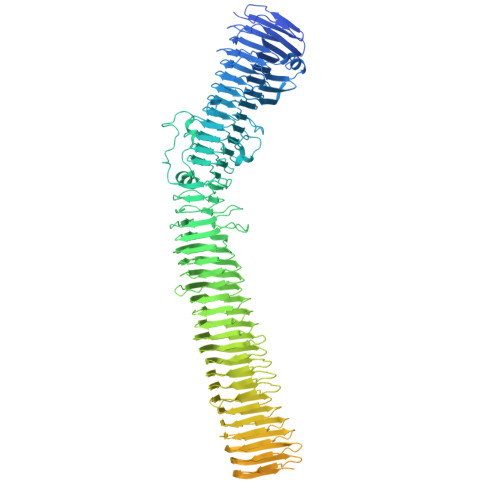
The secreted adhesin EtpA of Enterotoxigenic Escherichia coli in complex with the mouse mAb 1G05


Experimental Data Snapshot

  • Method: ELECTRON MICROSCOPY
  • Resolution: 3.97 Å
  • Aggregation State: PARTICLE 
  • Reconstruction Method: SINGLE PARTICLE 

Starting Model: in silico
View more details

wwPDB Validation   3D Report Full Report


This is version 1.2 of the entry. See complete history


Literature

Repeat modules and N-linked glycans define structure and antigenicity of a critical enterotoxigenic E. coli adhesin.

Berndsen, Z.T.Akhtar, M.Thapa, M.Vickers, T.J.Schmitz, A.Torres, J.L.Baboo, S.Kumar, P.Khatoon, N.Sheikh, A.Hamrick, M.Diedrich, J.K.Martinez-Bartolome, S.Garrett, P.T.Yates 3rd, J.R.Turner, J.S.Laird, R.M.Poly, F.Porter, C.K.Copps, J.Ellebedy, A.H.Ward, A.B.Fleckenstein, J.M.

(2024) PLoS Pathog 20: e1012241-e1012241

  • DOI: https://doi.org/10.1371/journal.ppat.1012241
  • Primary Citation of Related Structures:  
    8VBB

  • PubMed Abstract: 

    Enterotoxigenic Escherichia coli (ETEC) cause hundreds of millions of cases of infectious diarrhea annually, predominantly in children from low-middle income regions. Notably, in children, as well as volunteers challenged with ETEC, diarrheal severity is significantly increased in blood group A (bgA) individuals. EtpA, is a secreted glycoprotein adhesin that functions as a blood group A lectin to promote critical interactions between ETEC and blood group A glycans on intestinal epithelia for effective bacterial adhesion and toxin delivery. EtpA is highly immunogenic resulting in robust antibody responses following natural infection and experimental challenge of volunteers with ETEC. To understand how EtpA directs ETEC-blood group A interactions and stimulates adaptive immunity, we mutated EtpA, mapped its glycosylation by mass-spectrometry (MS), isolated polyclonal (pAbs) and monoclonal antibodies (mAbs) from vaccinated mice and ETEC-infected volunteers, and determined structures of antibody-EtpA complexes by cryo-electron microscopy. Both bgA and mAbs that inhibited EtpA-bgA interactions and ETEC adhesion, bound to the C-terminal repeat domain highlighting this region as crucial for ETEC pathogen-host interaction. MS analysis uncovered extensive and heterogeneous N-linked glycosylation of EtpA and cryo-EM structures revealed that mAbs directly engage these unique glycan containing epitopes. Finally, electron microscopy-based polyclonal epitope mapping revealed antibodies targeting numerous distinct epitopes on N and C-terminal domains, suggesting that EtpA vaccination generates responses against neutralizing and decoy regions of the molecule. Collectively, we anticipate that these data will inform our general understanding of pathogen-host glycan interactions and adaptive immunity relevant to rational vaccine subunit design.


  • Organizational Affiliation
    • Department of Integrative Structural and Computational Biology, Scripps Research, La Jolla, California, United States of America.

Macromolecules
Find similar proteins by:  (by identity cutoff)  |  3D Structure
Entity ID: 1
MoleculeChains Sequence LengthOrganismDetailsImage
EtpA1,564Escherichia coli ETEC H10407Mutation(s): 0 
Gene Names: etpA
UniProt
Find proteins for Q29XT7 (Escherichia coli)
Explore Q29XT7 
Go to UniProtKB:  Q29XT7
Entity Groups  
Sequence Clusters30% Identity50% Identity70% Identity90% Identity95% Identity100% Identity
UniProt GroupQ29XT7
Glycosylation
Glycosylation Sites: 38
Sequence Annotations
Expand
  • Reference Sequence
Find similar proteins by:  (by identity cutoff)  |  3D Structure
Entity ID: 2
MoleculeChains Sequence LengthOrganismDetailsImage
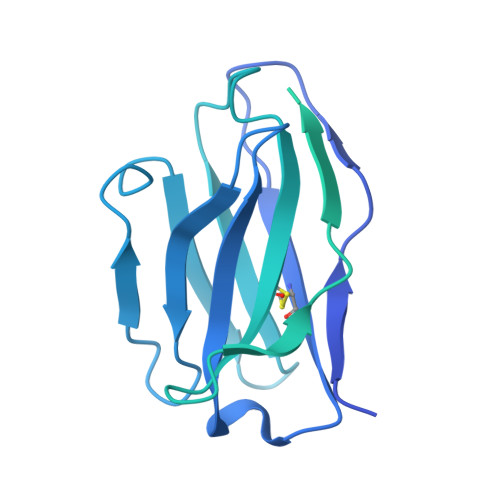
mouse mAb 1G05 Heavy ChainB [auth H]467Mus musculusMutation(s): 0 
Entity Groups  
Sequence Clusters30% Identity50% Identity70% Identity90% Identity95% Identity100% Identity
Sequence Annotations
Expand
  • Reference Sequence
Find similar proteins by:  (by identity cutoff)  |  3D Structure
Entity ID: 3
MoleculeChains Sequence LengthOrganismDetailsImage
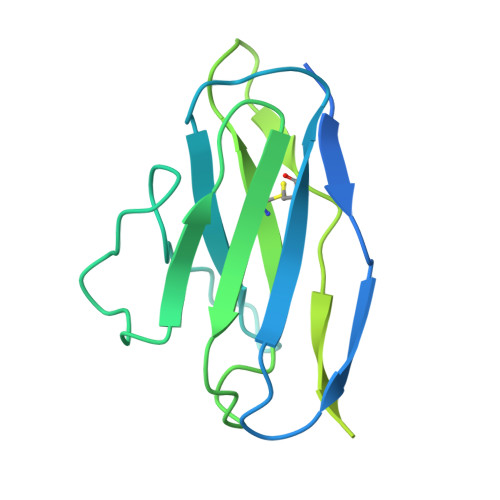
mouse mAb 1G05 Light ChainC [auth L]233Mus musculusMutation(s): 0 
Entity Groups  
Sequence Clusters30% Identity50% Identity70% Identity90% Identity95% Identity100% Identity
Sequence Annotations
Expand
  • Reference Sequence
Small Molecules
Ligands 1 Unique
IDChains Name / Formula / InChI Key2D Diagram3D Interactions
BGC (Subject of Investigation/LOI)
Query on BGC

Download Ideal Coordinates CCD File 
AA [auth A]
BA [auth A]
CA [auth A]
D [auth A]
DA [auth A]
AA [auth A],
BA [auth A],
CA [auth A],
D [auth A],
DA [auth A],
E [auth A],
EA [auth A],
F [auth A],
FA [auth A],
G [auth A],
GA [auth A],
H [auth A],
HA [auth A],
I [auth A],
IA [auth A],
J [auth A],
JA [auth A],
K [auth A],
KA [auth A],
L [auth A],
LA [auth A],
M [auth A],
MA [auth A],
N [auth A],
NA [auth A],
O [auth A],
OA [auth A],
P [auth A],
Q [auth A],
R [auth A],
S [auth A],
T [auth A],
U [auth A],
V [auth A],
W [auth A],
X [auth A],
Y [auth A],
Z [auth A]
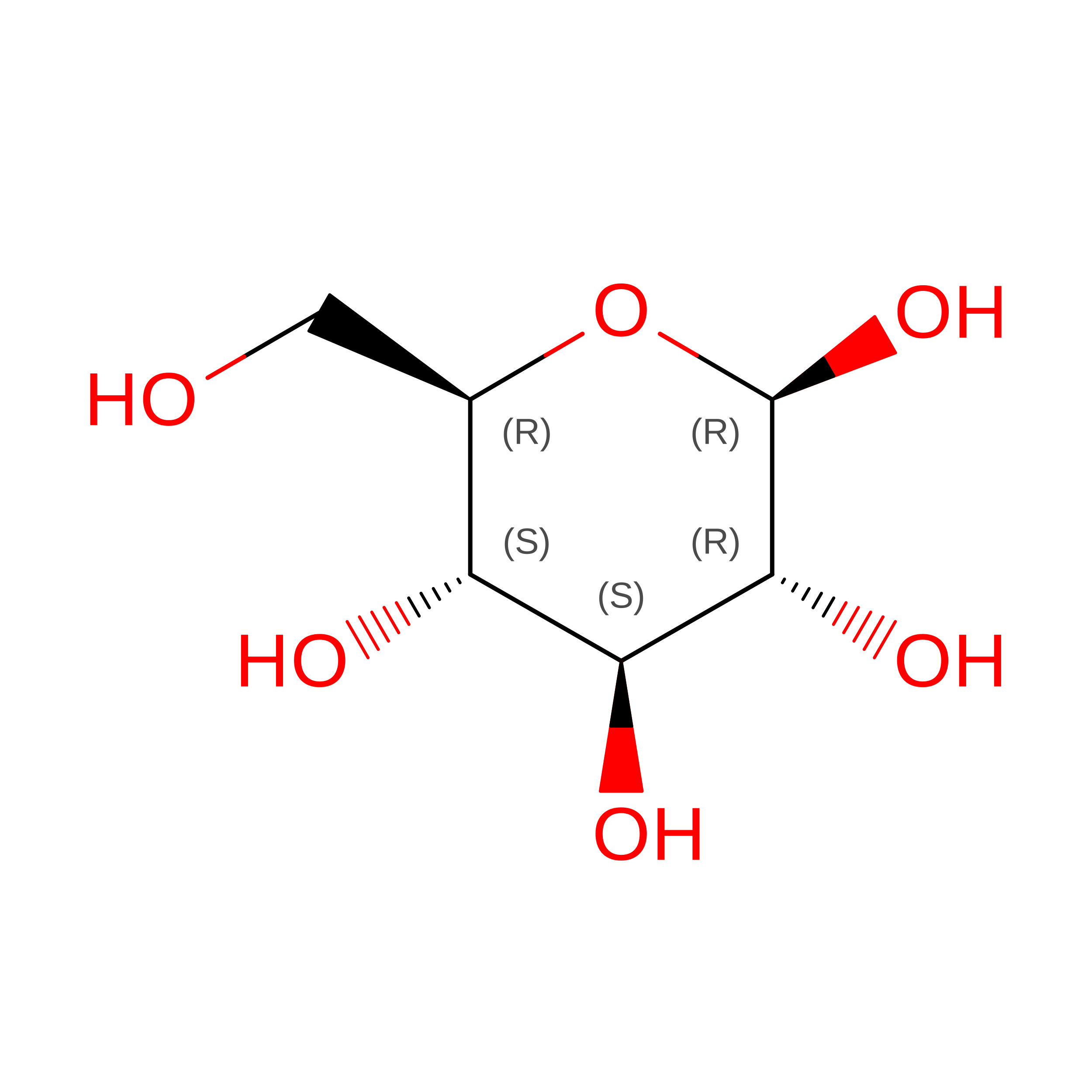
beta-D-glucopyranose
C6 H12 O6
WQZGKKKJIJFFOK-VFUOTHLCSA-N
Experimental Data & Validation

Experimental Data

  • Method: ELECTRON MICROSCOPY
  • Resolution: 3.97 Å
  • Aggregation State: PARTICLE 
  • Reconstruction Method: SINGLE PARTICLE 
EM Software:
TaskSoftware PackageVersion
MODEL REFINEMENTPHENIX
RECONSTRUCTIONcryoSPARC

Structure Validation

View Full Validation Report


Entry History & Funding Information

Deposition Data


Funding OrganizationLocationGrant Number
National Institutes of Health/National Institute Of Allergy and Infectious Diseases (NIH/NIAID)United StatesR01 AI126887
National Institutes of Health/National Institute Of Allergy and Infectious Diseases (NIH/NIAID)United StatesR01 AI089894
Department of Veterans Affairs (VA, United States)United States5I01BX001469-05).
National Institutes of Health/National Institute Of Allergy and Infectious Diseases (NIH/NIAID)United StatesT32AI007172
Consortia for HIV/AIDS Vaccine DevelopmentUnited StatesUM1 AI144462
National Institutes of Health/National Institute Of Allergy and Infectious Diseases (NIH/NIAID)United StatesUM1 AI100663
National Institutes of Health/National Institute Of Allergy and Infectious Diseases (NIH/NIAID)United StatesR01 AI113867

Revision History  (Full details and data files)

  • Version 1.0: 2024-09-04
    Type: Initial release
  • Version 1.1: 2024-10-09
    Changes: Data collection, Structure summary
  • Version 1.2: 2025-03-19
    Changes: Data collection, Database references