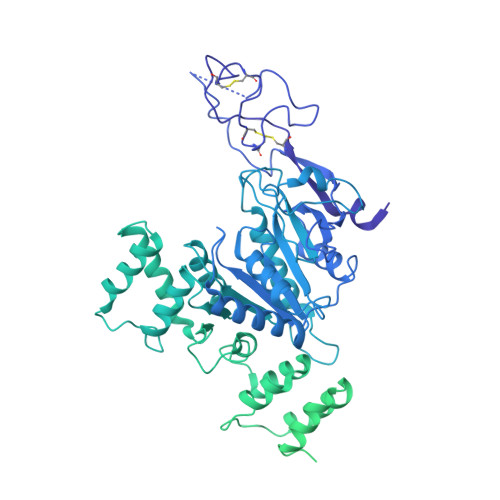
8SIB | pdb_00008sib

Cryo-EM structure of TRPM7 MHR1-3 domain

  • Classification: MEMBRANE PROTEIN
  • Organism(s): Mus musculus
  • Expression System: Homo sapiens
  • Mutation(s): No 

  • Deposited: 2023-04-14 Released: 2023-05-17 
  • Deposition Author(s): Nadezhdin, K.D., Neuberger, A., Sobolevsky, A.I.
  • Funding Organization(s): National Institutes of Health/National Cancer Institute (NIH/NCI), National Institutes of Health/National Institute of Neurological Disorders and Stroke (NIH/NINDS), National Institutes of Health/National Institute of Arthritis and Musculoskeletal and Skin Diseases (NIH/NIAMS), German Research Foundation (DFG)

Experimental Data Snapshot

  • Method: ELECTRON MICROSCOPY
  • Resolution: 2.62 Å
  • Aggregation State: PARTICLE 
  • Reconstruction Method: SINGLE PARTICLE 

wwPDB Validation 3D Report Full Report

Validation slider image for 8SIB

This is version 1.2 of the entry. See complete history

Literature

Structural mechanisms of TRPM7 activation and inhibition.

Nadezhdin, K.D.Correia, L.Narangoda, C.Patel, D.S.Neuberger, A.Gudermann, T.Kurnikova, M.G.Chubanov, V.Sobolevsky, A.I.

(2023) Nat Commun 14: 2639-2639

  • DOI: https://doi.org/10.1038/s41467-023-38362-3
  • Primary Citation Related Structures: 
    8SI2, 8SI3, 8SI4, 8SI5, 8SI6, 8SI7, 8SI8, 8SIA, 8SIB

  • PubMed Abstract: 

    The transient receptor potential channel TRPM7 is a master regulator of the organismal balance of divalent cations that plays an essential role in embryonic development, immune responses, cell mobility, proliferation, and differentiation. TRPM7 is implicated in neuronal and cardiovascular disorders, tumor progression and has emerged as a new drug target. Here we use cryo-EM, functional analysis, and molecular dynamics simulations to uncover two distinct structural mechanisms of TRPM7 activation by a gain-of-function mutation and by the agonist naltriben, which show different conformational dynamics and domain involvement. We identify a binding site for highly potent and selective inhibitors and show that they act by stabilizing the TRPM7 closed state. The discovered structural mechanisms provide foundations for understanding the molecular basis of TRPM7 channelopathies and drug development.


  • Organizational Affiliation
    • Department of Biochemistry and Molecular Biophysics, Columbia University, New York, NY, USA.

Macromolecule Content 

  • Total Structure Weight: 146.89 kDa 
  • Atom Count: 3,544 
  • Modeled Residue Count: 454 
  • Deposited Residue Count: 1,279 
  • Unique protein chains: 1

Macromolecules

Find similar proteins by:|  3D Structure
Entity ID: 1
MoleculeChains  Sequence LengthOrganismDetailsImage
Transient receptor potential cation channel subfamily M member 71,279Mus musculusMutation(s): 0 
Gene Names: Trpm7ChakLtrpc7
EC: 2.7.11.1
UniProt & NIH Common Fund Data Resources
Find proteins for Q923J1 (Mus musculus)
Explore Q923J1 
Go to UniProtKB:  Q923J1
IMPC:  MGI:1929996
Entity Groups
Sequence Clusters30% Identity50% Identity70% Identity90% Identity95% Identity100% Identity
UniProt GroupQ923J1
Sequence Annotations
Expand
Reference Sequence

Experimental Data & Validation

Experimental Data

  • Method: ELECTRON MICROSCOPY
  • Resolution: 2.62 Å
  • Aggregation State: PARTICLE 
  • Reconstruction Method: SINGLE PARTICLE 
EM Software:
TaskSoftware PackageVersion
MODEL REFINEMENTPHENIX1.18

Structure Validation

View Full Validation Report


Entry History 

& Funding Information

Deposition Data


Funding OrganizationLocationGrant Number
National Institutes of Health/National Cancer Institute (NIH/NCI)United StatesR01 CA206573
National Institutes of Health/National Institute of Neurological Disorders and Stroke (NIH/NINDS)United StatesR01 NS083660
National Institutes of Health/National Institute of Neurological Disorders and Stroke (NIH/NINDS)United StatesR01 NS107253
National Institutes of Health/National Institute of Arthritis and Musculoskeletal and Skin Diseases (NIH/NIAMS)United StatesR01 AR078814
German Research Foundation (DFG)Germany464295817

Revision History  (Full details and data files)

  • Version 1.0: 2023-05-17
    Type: Initial release
  • Version 1.1: 2023-05-24
    Changes: Database references
  • Version 1.2: 2024-10-30
    Changes: Data collection, Structure summary