8PXO | pdb_00008pxo

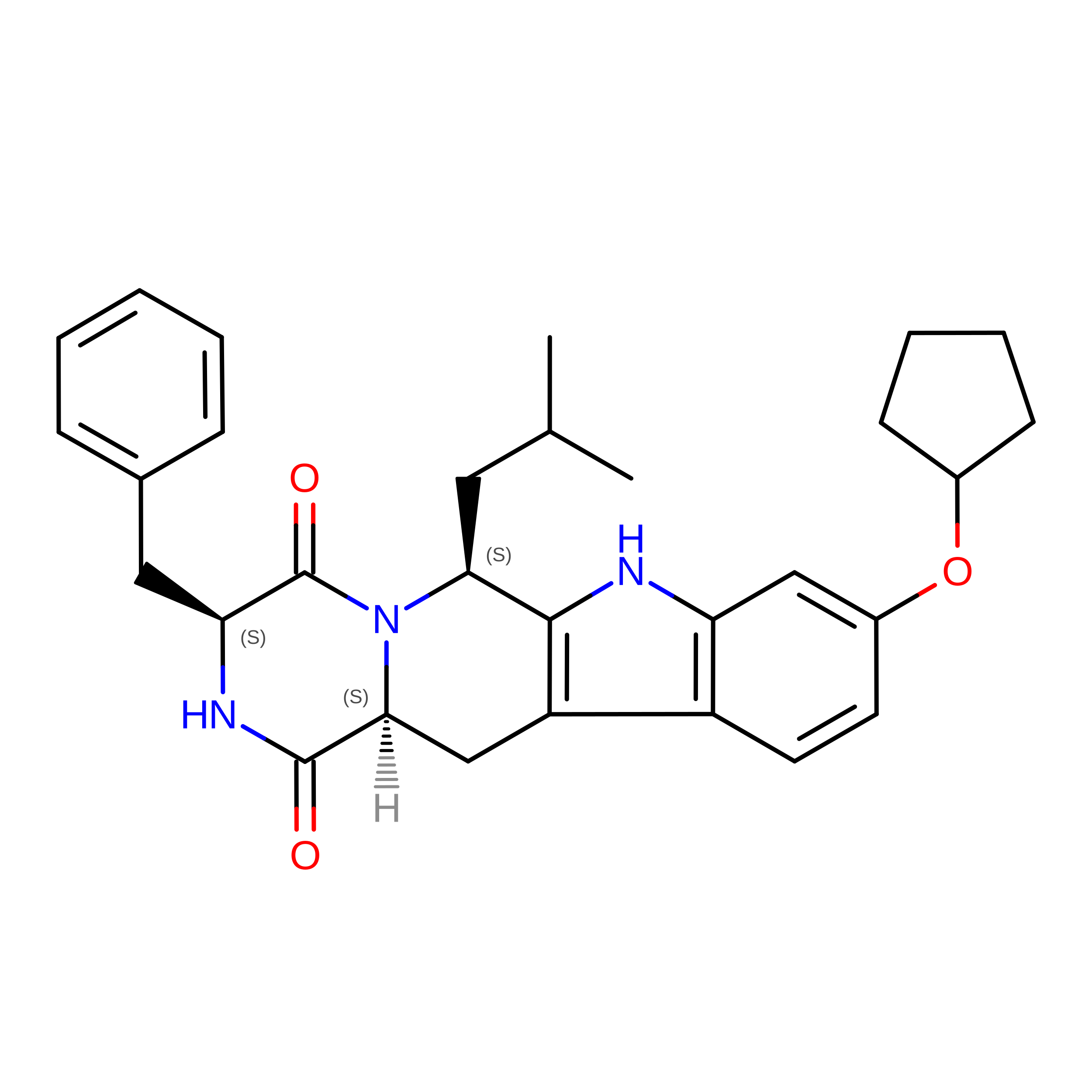
ABCG2 in complex with AZ99 and 5D3 Fab


Experimental Data Snapshot

  • Method: ELECTRON MICROSCOPY
  • Resolution: 3.00 Å
  • Aggregation State: PARTICLE 
  • Reconstruction Method: SINGLE PARTICLE 

wwPDB Validation 3D Report Full Report

Validation slider image for 8PXO

This is version 1.1 of the entry. See complete history

Literature

Modulation of ABCG2 Transporter Activity by Ko143 Derivatives.

Yu, Q.Dehghani-Ghahnaviyeh, S.Rasouli, A.Sadurni, A.Kowal, J.Bang-Soerensen, R.Wen, P.C.Tinzl-Zechner, M.Irobalieva, R.N.Ni, D.Stahlberg, H.Altmann, K.H.Tajkhorshid, E.Locher, K.P.

(2024) ACS Chem Biol 19: 2304-2313

  • DOI: https://doi.org/10.1021/acschembio.4c00353
  • Primary Citation Related Structures: 
    8PXO, 8PY4, 8Q7B, 8QCM

  • PubMed Abstract: 

    ABCG2 is a multidrug transporter that protects tissues from xenobiotics, affects drug pharmacokinetics, and contributes to multidrug resistance of cancer cells. Here, we present tetracyclic fumitremorgin C analog Ko143 derivatives, evaluate their in vitro modulation of purified ABCG2, and report four high-resolution cryo-EM structures and computational analyses to elucidate their interactions with ABCG2. We found that Ko143 derivatives that are based on a ring-opened scaffold no longer inhibit ABCG2-mediated transport activity. In contrast, closed-ring, tetracyclic analogs were highly potent inhibitors. Strikingly, the least potent of these compounds, MZ82, bound deeper into the central ABCG2 cavity than the other inhibitors and it led to partial closure of the transmembrane domains and increased flexibility of the nucleotide-binding domains. Minor structural modifications can thus convert a potent inhibitor into a compound that induces conformational changes in ABCG2 similar to those observed during binding of a substrate. Molecular dynamics simulations and free energy binding calculations further supported the correlation between reduced potency and distinct binding pose of the compounds. We introduce the highly potent inhibitor AZ99 that may exhibit improved in vivo stability.


  • Organizational Affiliation
    • Institute of Molecular Biology and Biophysics, Department of Biology, ETH Zurich, Zurich 8093, Switzerland.

Macromolecule Content 

  • Total Structure Weight: 245.3 kDa 
  • Atom Count: 12,542 
  • Modeled Residue Count: 1,581 
  • Deposited Residue Count: 2,200 
  • Unique protein chains: 3

Macromolecules

Find similar proteins by:|  3D Structure
Entity ID: 1
MoleculeChains  Sequence LengthOrganismDetailsImage
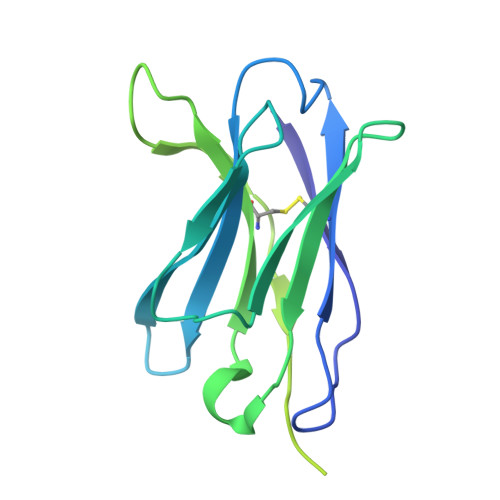
5D3(Fab) heavy chain variable domain|Mus musculusA [auth D],
C [auth F]
221Mus musculusMutation(s): 0 
Find similar proteins by:|  3D Structure
Entity ID: 2
MoleculeChains  Sequence LengthOrganismDetailsImage
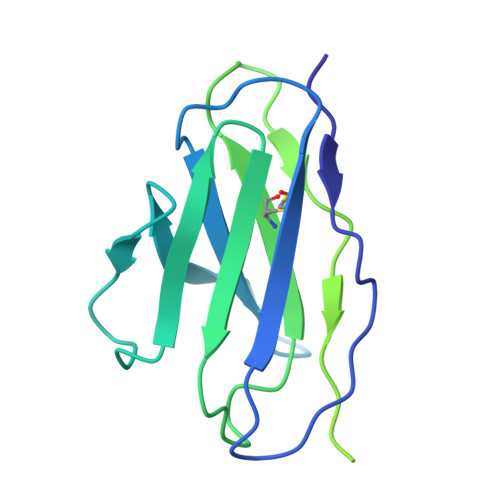
5D3(Fab) light chain variable domainB [auth E],
F [auth C]
214Mus musculusMutation(s): 0 
Find similar proteins by:|  3D Structure
Entity ID: 3
MoleculeChains  Sequence LengthOrganismDetailsImage
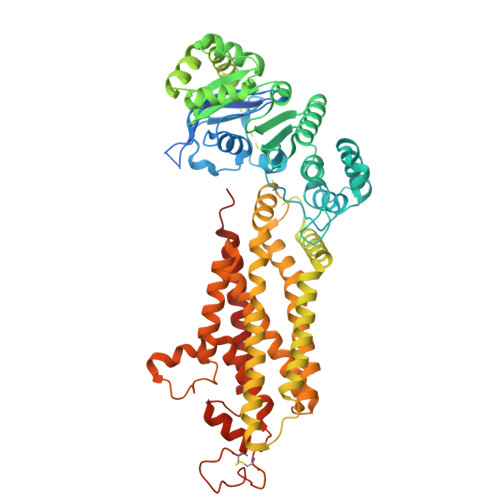
Broad substrate specificity ATP-binding cassette transporter ABCG2D [auth B],
E [auth A]
665Homo sapiensMutation(s): 0 
Gene Names: ABCG2ABCPBCRPBCRP1MXR
EC: 7.6.2.2
Membrane Entity: Yes 
UniProt & NIH Common Fund Data Resources
Find proteins for Q9UNQ0 (Homo sapiens)
Explore Q9UNQ0 
Go to UniProtKB:  Q9UNQ0
PHAROS:  Q9UNQ0
GTEx:  ENSG00000118777 
Entity Groups
Sequence Clusters30% Identity50% Identity70% Identity90% Identity95% Identity100% Identity
UniProt GroupQ9UNQ0
Sequence Annotations
Expand
Reference Sequence

Oligosaccharides

Help  
Entity ID: 4
MoleculeChains Length2D Diagram GlycosylationD Interactions
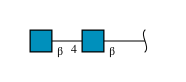
2-acetamido-2-deoxy-beta-D-glucopyranose-(1-4)-2-acetamido-2-deoxy-beta-D-glucopyranoseG [auth X],
H [auth G]
2N/A
Glycosylation Resources
GlyTouCan: G42666HT
GlyCosmos: G42666HT
GlyGen: G42666HT

Experimental Data & Validation

Experimental Data

  • Method: ELECTRON MICROSCOPY
  • Resolution: 3.00 Å
  • Aggregation State: PARTICLE 
  • Reconstruction Method: SINGLE PARTICLE 

Structure Validation

View Full Validation Report


Entry History 

& Funding Information

Deposition Data


Funding OrganizationLocationGrant Number
Swiss National Science FoundationSwitzerland--

Revision History  (Full details and data files)

  • Version 1.0: 2024-11-06
    Type: Initial release
  • Version 1.1: 2024-11-27
    Changes: Data collection, Database references