8PQO | pdb_00008pqo

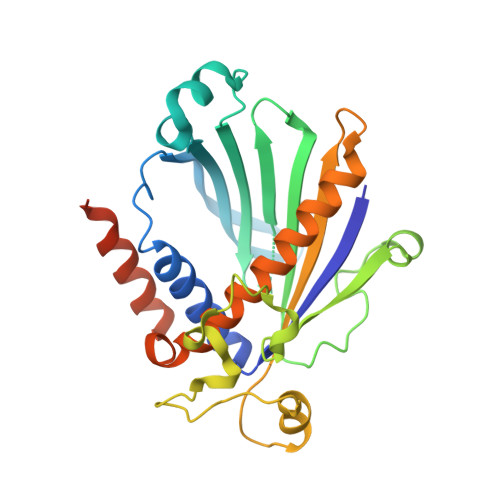
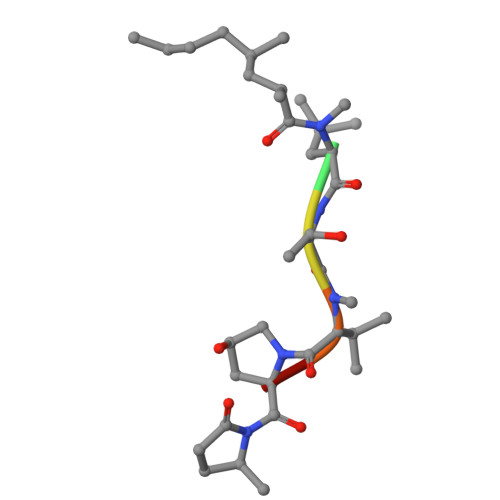
PITP in complex with the inhibitor VT01545


Experimental Data Snapshot

  • Method: X-RAY DIFFRACTION
  • Resolution: 2.30 Å
  • R-Value Free: 
    0.282 (Depositor), 0.283 (DCC) 
  • R-Value Work: 
    0.235 (Depositor), 0.235 (DCC) 
  • R-Value Observed: 
    0.237 (Depositor) 

Starting Model: experimental
View more details

wwPDB Validation   3D Report Full Report


This is version 3.1 of the entry. See complete history


Literature

Non-vesicular phosphatidylinositol transfer plays critical roles in defining organelle lipid composition.

Kim, Y.J.Pemberton, J.G.Eisenreichova, A.Mandal, A.Koukalova, A.Rohilla, P.Sohn, M.Konradi, A.W.Tang, T.T.Boura, E.Balla, T.

(2024) EMBO J 43: 2035-2061

  • DOI: https://doi.org/10.1038/s44318-024-00096-3
  • Primary Citation of Related Structures:  
    8PQO

  • PubMed Abstract: 

    Phosphatidylinositol (PI) is the precursor lipid for the minor phosphoinositides (PPIns), which are critical for multiple functions in all eukaryotic cells. It is poorly understood how phosphatidylinositol, which is synthesized in the ER, reaches those membranes where PPIns are formed. Here, we used VT01454, a recently identified inhibitor of class I PI transfer proteins (PITPs), to unravel their roles in lipid metabolism, and solved the structure of inhibitor-bound PITPNA to gain insight into the mode of inhibition. We found that class I PITPs not only distribute PI for PPIns production in various organelles such as the plasma membrane (PM) and late endosomes/lysosomes, but that their inhibition also significantly reduced the levels of phosphatidylserine, di- and triacylglycerols, and other lipids, and caused prominent increases in phosphatidic acid. While VT01454 did not inhibit Golgi PI4P formation nor reduce resting PM PI(4,5)P 2 levels, the recovery of the PM pool of PI(4,5)P 2 after receptor-mediated hydrolysis required both class I and class II PITPs. Overall, these studies show that class I PITPs differentially regulate phosphoinositide pools and affect the overall cellular lipid landscape.


  • Organizational Affiliation
    • Section on Molecular Signal Transduction, Eunice Kennedy Shriver, National Institute of Child Health and Human Development, National Institutes of Health, Bethesda, MD, 20892, USA.

Macromolecules
Find similar proteins by:  (by identity cutoff)  |  3D Structure
Entity ID: 1
MoleculeChains Sequence LengthOrganismDetailsImage
Phosphatidylinositol transfer protein alpha isoform271Homo sapiensMutation(s): 0 
Gene Names: PITPNAPITPN
UniProt & NIH Common Fund Data Resources
Find proteins for Q00169 (Homo sapiens)
Explore Q00169 
Go to UniProtKB:  Q00169
PHAROS:  Q00169
GTEx:  ENSG00000174238 
Entity Groups  
Sequence Clusters30% Identity50% Identity70% Identity90% Identity95% Identity100% Identity
UniProt GroupQ00169
Sequence Annotations
Expand
  • Reference Sequence

Find similar proteins by:  Sequence   |   3D Structure  

Entity ID: 2
MoleculeChains Sequence LengthOrganismDetailsImage
Inhibitor VT01545B [auth C]6synthetic constructMutation(s): 0 
Sequence Annotations
Expand
  • Reference Sequence
Experimental Data & Validation

Experimental Data

  • Method: X-RAY DIFFRACTION
  • Resolution: 2.30 Å
  • R-Value Free:  0.282 (Depositor), 0.283 (DCC) 
  • R-Value Work:  0.235 (Depositor), 0.235 (DCC) 
  • R-Value Observed: 0.237 (Depositor) 
Space Group: P 2 21 21
Unit Cell:
Length ( Å )Angle ( ˚ )
a = 50.33α = 90
b = 81.906β = 90
c = 94.701γ = 90
Software Package:
Software NamePurpose
PHENIXrefinement
XDSdata reduction
XDSdata scaling
PHASERphasing

Structure Validation

View Full Validation Report


Entry History & Funding Information

Deposition Data


Funding OrganizationLocationGrant Number
Not funded--

Revision History  (Full details and data files)

  • Version 1.0: 2024-05-08
    Type: Initial release
  • Version 1.1: 2024-05-29
    Changes: Database references
  • Version 2.0: 2024-07-10
    Changes: Advisory, Atomic model, Author supporting evidence, Data collection, Database references, Derived calculations, Experimental preparation, Non-polymer description, Other, Polymer sequence, Source and taxonomy, Structure summary
  • Version 3.0: 2024-07-17
    Changes: Advisory, Atomic model, Data collection, Database references, Derived calculations, Non-polymer description, Polymer sequence, Structure summary
  • Version 3.1: 2025-11-19
    Changes: Database references, Derived calculations, Structure summary