Download Mendeley
The Molecular Basis of Heat-Stable Enterotoxin for Vaccine Development and Cancer Cell Detection.
Goto, M., Yoshino, S., Hiroshima, K., Kawakami, T., Murota, K., Shimamoto, S., Hidaka, Y.(2023) Molecules 28
- PubMed: 36770798 Search on PubMedSearch on PubMed Central
- DOI: https://doi.org/10.3390/molecules28031128
- Primary Citation Related Structures:
8HR3 - PubMed Abstract:
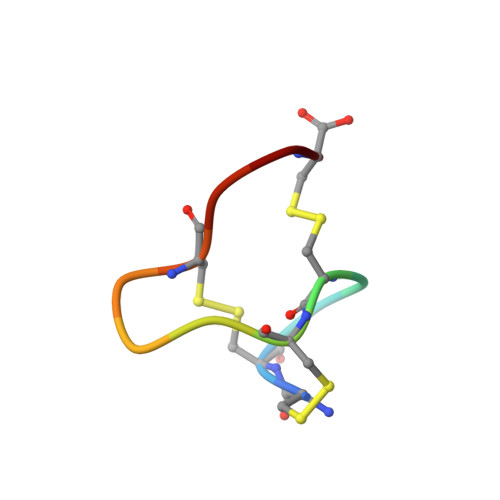
Heat-stable enterotoxin (ST a ) produced by Enterotoxigenic E. coli is responsible for causing acute diarrhea in infants in developing countries. However, the chemical synthesis of ST a peptides with the native conformation and the correct intra-molecular disulfide bonds is a major hurdle for vaccine development. To address this issue, we herein report on the design and preparation of ST a analogs and a convenient chemical method for obtaining ST a molecules with the correct conformation. To develop an ST a vaccine, we focused on a structure in a type II β-turn in the ST a molecule and introduced a D-Lys residue as a conjugation site for carrier proteins. In addition, the -Glu-Leu- sequence in the ST a molecule was replaced with a -Asp-Val- sequence to decrease the toxic activity of the peptide to make it more amenable for use in vaccinations. To solve several issues associated with the synthesis of ST a , such as the formation of non-native disulfide isomers, the native disulfide pairings were regioselectively formed in a stepwise manner. A native form or topological isomer of the designed ST a peptide, which possesses a right-handed or a left-handed spiral structure, respectively, were synthesized in high synthetic yields. The conformation of the synthetic ST a peptide was also confirmed by CD and NMR spectroscopy. To further utilize the designed ST a peptide, it was labeled with fluorescein for fluorescent detection, since recent studies have also focused on the use of ST a for detecting cancer cells, such as Caco-2 and T84. The labeled ST a peptide was able to specifically and efficiently detect 293T cells expressing the recombinant ST a receptor (GC-C) protein and Caco-2 cells. The findings reported here provide an outline of the molecular basis for using ST a for vaccine development and in the detection of cancer cells.
- Faculty of Science and Engineering, Kindai University, 3-4-1 Kowakae, Higashi-Osaka, Osaka 577-8502, Japan.
Organizational Affiliation: