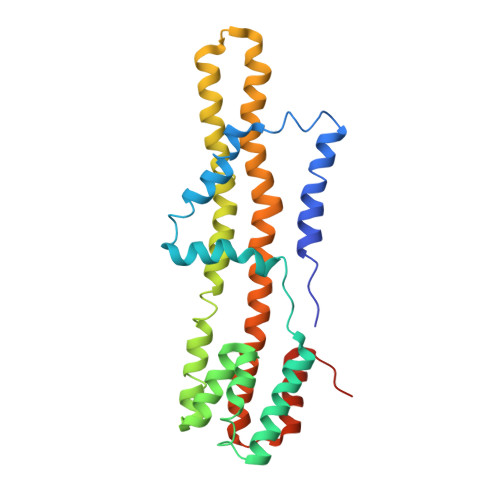
8GQY | pdb_00008gqy

CryoEM structure of pentameric MotA from Aquifex aeolicus


Experimental Data Snapshot

  • Method: ELECTRON MICROSCOPY
  • Resolution: 3.40 Å
  • Aggregation State: PARTICLE 
  • Reconstruction Method: SINGLE PARTICLE 

Starting Model: experimental
View more details

wwPDB Validation 3D Report Full Report

Validation slider image for 8GQY

This is version 1.2 of the entry. See complete history

Literature

Structure of MotA, a flagellar stator protein, from hyperthermophile.

Nishikino, T.Takekawa, N.Tran, D.P.Kishikawa, J.I.Hirose, M.Onoe, S.Kojima, S.Homma, M.Kitao, A.Kato, T.Imada, K.

(2022) Biochem Biophys Res Commun 631: 78-85

  • DOI: https://doi.org/10.1016/j.bbrc.2022.09.072
  • Primary Citation Related Structures: 
    8GQY

  • PubMed Abstract: 

    Many motile bacteria swim and swarm toward favorable environments using the flagellum, which is rotated by a motor embedded in the inner membrane. The motor is composed of the rotor and the stator, and the motor torque is generated by the change of the interaction between the rotor and the stator induced by the ion flow through the stator. A stator unit consists of two types of membrane proteins termed A and B. Recent cryo-EM studies on the stators from mesophiles revealed that the stator consists of five A and two B subunits, whereas the low-resolution EM analysis showed that purified hyperthermophilic MotA forms a tetramer. To clarify the assembly formation and factors enhancing thermostability of the hyperthermophilic stator, we determined the cryo-EM structure of MotA from Aquifex aeolicus (Aa-MotA), a hyperthermophilic bacterium, at 3.42 Å resolution. Aa-MotA forms a pentamer with pseudo C5 symmetry. A simulated model of the Aa-MotA 5 MotB 2 stator complex resembles the structures of mesophilic stator complexes, suggesting that Aa-MotA can assemble into a pentamer equivalent to the stator complex without MotB. The distribution of hydrophobic residues of MotA pentamers suggests that the extremely hydrophobic nature in the subunit boundary and the transmembrane region is a key factor to stabilize hyperthermophilic Aa-MotA.


  • Organizational Affiliation
    • Institute for Protein Research, Osaka University, 3-2 Yamadaoka, Suita, Osaka, 565-0871, Japan. Electronic address: nishikino.tatsuro@protein.osaka-u.ac.jp.

Macromolecule Content 

  • Total Structure Weight: 144.32 kDa 
  • Atom Count: 9,515 
  • Modeled Residue Count: 1,265 
  • Deposited Residue Count: 1,330 
  • Unique protein chains: 1

Macromolecules

Find similar proteins by:|  3D Structure
Entity ID: 1
MoleculeChains  Sequence LengthOrganismDetailsImage
Motility protein A
A, B, C, D, E
266Aquifex aeolicus VF5Mutation(s): 0 
Gene Names: motAaq_1003
Membrane Entity: Yes 
UniProt
Find proteins for O67122 (Aquifex aeolicus (strain VF5))
Explore O67122 
Go to UniProtKB:  O67122
Entity Groups
Sequence Clusters30% Identity50% Identity70% Identity90% Identity95% Identity100% Identity
UniProt GroupO67122
Sequence Annotations
Expand
Reference Sequence

Experimental Data & Validation

Experimental Data

  • Method: ELECTRON MICROSCOPY
  • Resolution: 3.40 Å
  • Aggregation State: PARTICLE 
  • Reconstruction Method: SINGLE PARTICLE 
EM Software:
TaskSoftware PackageVersion
MODEL REFINEMENTPHENIX
RECONSTRUCTIONRELION3.1

Structure Validation

View Full Validation Report


Entry History 

& Funding Information

Deposition Data


Funding OrganizationLocationGrant Number
Japan Society for the Promotion of Science (JSPS)JapanJP20J00329
Japan Society for the Promotion of Science (JSPS)JapanJP16J01859
Japan Society for the Promotion of Science (JSPS)JapanJP20K15732
Japan Society for the Promotion of Science (JSPS)JapanJP20K06514
Japan Society for the Promotion of Science (JSPS)JapanJP22K18359
Japan Society for the Promotion of Science (JSPS)JapanJP22H02559
Japan Society for the Promotion of Science (JSPS)JapanJP21H02443

Revision History  (Full details and data files)

  • Version 1.0: 2022-10-26
    Type: Initial release
  • Version 1.1: 2022-11-09
    Changes: Data collection, Source and taxonomy, Structure summary
  • Version 1.2: 2024-07-03
    Changes: Data collection, Refinement description