Download Mendeley
Simultaneous enhancement of multiple functional properties using evolution-informed protein design.
Fram, B., Su, Y., Truebridge, I., Riesselman, A.J., Ingraham, J.B., Passera, A., Napier, E., Thadani, N.N., Lim, S., Roberts, K., Kaur, G., Stiffler, M.A., Marks, D.S., Bahl, C.D., Khan, A.R., Sander, C., Gauthier, N.P.(2024) Nat Commun 15: 5141-5141
- PubMed: 38902262 Search on PubMedSearch on PubMed Central
- DOI: https://doi.org/10.1038/s41467-024-49119-x
- Primary Citation Related Structures:
8GII, 8GIJ, 8RQU - PubMed Abstract:
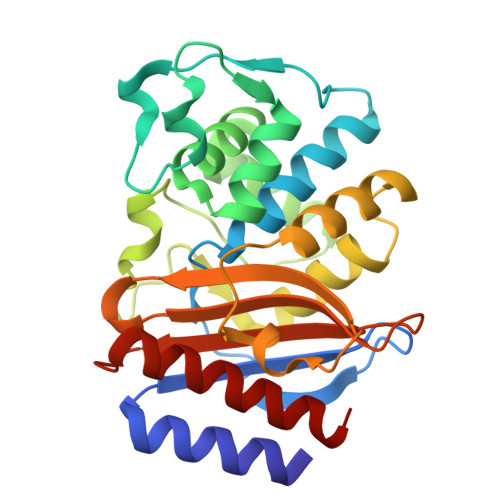
A major challenge in protein design is to augment existing functional proteins with multiple property enhancements. Altering several properties likely necessitates numerous primary sequence changes, and novel methods are needed to accurately predict combinations of mutations that maintain or enhance function. Models of sequence co-variation (e.g., EVcouplings), which leverage extensive information about various protein properties and activities from homologous protein sequences, have proven effective for many applications including structure determination and mutation effect prediction. We apply EVcouplings to computationally design variants of the model protein TEM-1 β-lactamase. Nearly all the 14 experimentally characterized designs were functional, including one with 84 mutations from the nearest natural homolog. The designs also had large increases in thermostability, increased activity on multiple substrates, and nearly identical structure to the wild type enzyme. This study highlights the efficacy of evolutionary models in guiding large sequence alterations to generate functional diversity for protein design applications.
- Department of Systems Biology, Harvard Medical School, Boston, MA, USA. benjamin.fram.research@gmail.com.
Organizational Affiliation: