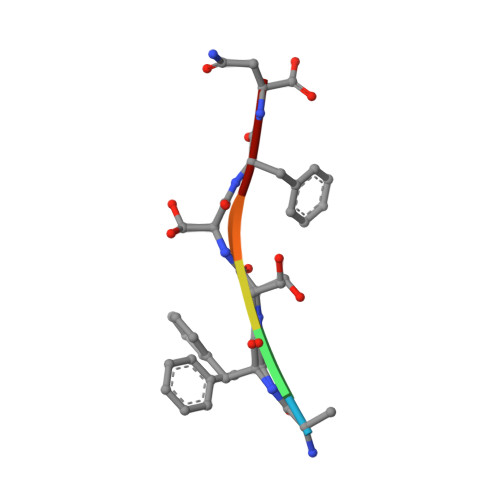
8DTS | pdb_00008dts

X-ray crystal structure of AFSSFN from chaperone DNAJB8.


Experimental Data Snapshot

  • Method: X-RAY DIFFRACTION
  • Resolution: 0.75 Å
  • R-Value Free: 
    0.226 (Depositor), 0.224 (DCC) 
  • R-Value Work: 
    0.203 (Depositor), 0.202 (DCC) 
  • R-Value Observed: 
    0.205 (Depositor) 

wwPDB Validation 3D Report Full Report

Validation slider image for 8DTS

This is version 1.1 of the entry. See complete history

Literature

DNAJB8 oligomerization is mediated by an aromatic-rich motif that is dispensable for substrate activity.

Ryder, B.D.Ustyantseva, E.Boyer, D.R.Mendoza-Oliva, A.Kuska, M.I.Wydorski, P.M.Macierzynska, P.Morgan, N.Sawaya, M.R.Diamond, M.I.Kampinga, H.H.Joachimiak, L.A.

(2024) Structure 32: 662-678.e8

  • DOI: https://doi.org/10.1016/j.str.2024.02.015
  • Primary Citation Related Structures: 
    8DTS

  • PubMed Abstract: 

    J-domain protein (JDP) molecular chaperones have emerged as central players that maintain a healthy proteome. The diverse members of the JDP family function as monomers/dimers and a small subset assemble into micron-sized oligomers. The oligomeric JDP members have eluded structural characterization due to their low-complexity, intrinsically disordered middle domains. This in turn, obscures the biological significance of these larger oligomers in protein folding processes. Here, we identified a short, aromatic motif within DNAJB8 that drives self-assembly through π-π stacking and determined its X-ray structure. We show that mutations in the motif disrupt DNAJB8 oligomerization in vitro and in cells. DNAJB8 variants that are unable to assemble bind to misfolded tau seeds more specifically and retain capacity to reduce protein aggregation in vitro and in cells. We propose a new model for DNAJB8 function in which the sequences in the low-complexity domains play distinct roles in assembly and substrate activity.


  • Organizational Affiliation
    • Center for Alzheimer's and Neurodegenerative Diseases, Peter O'Donnell Jr. Brain Institute, University of Texas Southwestern Medical Center, Dallas, TX 75390, USA.

Macromolecule Content 

  • Total Structure Weight: 8.06 kDa 
  • Atom Count: 924 
  • Modeled Residue Count: 72 
  • Deposited Residue Count: 72 
  • Unique protein chains: 1

Macromolecules

Find similar proteins by:  Sequence   |   3D Structure  
Entity ID: 1
MoleculeChains  Sequence LengthOrganismDetailsImage
DNAJB8 peptide AFSSFN
A, B, C, D, E
A, B, C, D, E, F, G, H, I, J, K, L
6Homo sapiensMutation(s): 0 
UniProt & NIH Common Fund Data Resources
Find proteins for Q8NHS0 (Homo sapiens)
Explore Q8NHS0 
Go to UniProtKB:  Q8NHS0
PHAROS:  Q8NHS0
GTEx:  ENSG00000179407 
Entity Groups
UniProt GroupQ8NHS0
Sequence Annotations
Expand
Reference Sequence

Experimental Data & Validation

Experimental Data

  • Method: X-RAY DIFFRACTION
  • Resolution: 0.75 Å
  • R-Value Free:  0.226 (Depositor), 0.224 (DCC) 
  • R-Value Work:  0.203 (Depositor), 0.202 (DCC) 
  • R-Value Observed: 0.205 (Depositor) 
Space Group: P 1
Unit Cell:
Length ( Å )Angle ( ˚ )
a = 38.38α = 90
b = 9.48β = 90
c = 30.4γ = 90.01
Software Package:
Software NamePurpose
PHENIXrefinement
XDSdata reduction
XSCALEdata scaling
SHELXDphasing
PDB_EXTRACTdata extraction

Structure Validation

View Full Validation Report


Entry History 

& Funding Information

Deposition Data


Funding OrganizationLocationGrant Number
National Institutes of Health/National Institute on Aging (NIH/NIA)United States--

Revision History  (Full details and data files)

  • Version 1.0: 2024-01-31
    Type: Initial release
  • Version 1.1: 2024-08-14
    Changes: Database references