Download Mendeley
Structure-function studies of a nucleoplasmin isoform from Plasmodium falciparum.
Saharan, K., Baral, S., Gandhi, S., Singh, A.K., Ghosh, S., Das, R., Nagaraj, V.A., Vasudevan, D.(2025) J Biol Chem 301: 108379-108379
- PubMed: 40049416 Search on PubMedSearch on PubMed Central
- DOI: https://doi.org/10.1016/j.jbc.2025.108379
- Primary Citation Related Structures:
8ZS0 - PubMed Abstract:
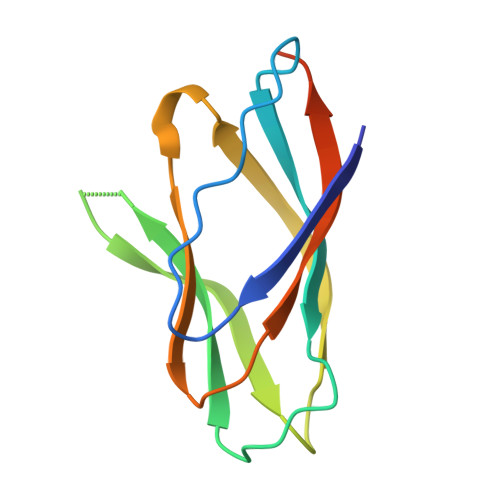
An organized regulation of gene expression and DNA replication is vital for the progression of the complex life cycle of Plasmodium falciparum (Pf), involving multiple hosts and various stages. These attributes rely on the dynamic architecture of chromatin governed by several factors, including histone chaperones. Nucleoplasmin class of histone chaperones perform histone chaperoning function and participate in various developmental processes in eukaryotes. Here, our crystal structure confirmed that Pf indeed possesses a nucleoplasmin isoform (PfNPM), and the N-terminal core domain (NTD) adopts the characteristic pentameric doughnut conformation. Furthermore, PfNPM exists as a pentamer in solution, and the N-terminal core domain exhibits thermal and chemical stability. PfNPM interacts individually with assembled H2A/H2B and H3/H4 with an equimolar stoichiometry, wherein the acidic tracts of PfNPM were found to be necessary for these interactions. Further, H3/H4 displays a higher binding affinity for PfNPM than H2A/H2B, potentially due to stronger electrostatic interactions. The interaction studies also suggested that H2A/H2B and H3/H4 might share the same binding site on the PfNPM distal face, wherein H3/H4 could substitute H2A/H2B due to a higher binding affinity. Intriguingly, PfNPM neither demonstrated direct interaction with the nucleosome core particles nor displayed nucleosome assembly function, suggesting it may not be directly associated with histone deposition on the parasite genomic DNA. Furthermore, our immunofluorescence results suggested that PfNPM predominantly localizes in the nucleus and exhibits expression only in the early blood stages, such as ring and trophozoite. Altogether, we provide the first report on the structural and functional characterization of PfNPM.
- Structural Biology Laboratory, BRIC-Institute of Life Sciences (BRIC-ILS), Bhubaneswar, India; Regional Centre for Biotechnology, Faridabad, India.
Organizational Affiliation: