Download Mendeley
Functional Characterization and Molecular Basis of a Multi-Site Halogenase in Naphthacemycin Biosynthesis.
Hu, Y., Peng, S.Y., Ma, X., Chen, H., Nie, Q.Y., He, J.B., Chen, Q., Zhou, Q., Lu, X.H., Hua, Q., Yang, D., Liang, Y., Ma, M., Tang, G.L.(2025) Angew Chem Int Ed Engl 64: e202418843-e202418843
- PubMed: 39612320 Search on PubMed
- DOI: https://doi.org/10.1002/anie.202418843
- Primary Citation Related Structures:
8ZOP - PubMed Abstract:
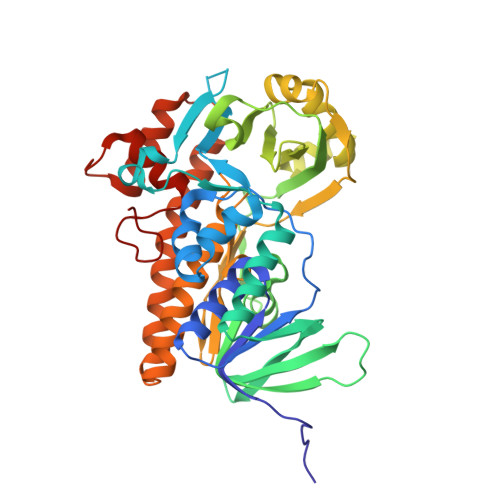
Halogenases are spurring a growing interest in the fields of biosynthesis and biocatalysis. Although various halogenases have been identified in numerous natural product biosynthetic pathways, the mechanisms for multiple halogenations and site-selectivity remain largely unclear. In this study, we biochemically characterized FasV, a flavin-dependent halogenase (FDH) that catalyzes five successive chlorinations in the biosynthesis of the naphthacene-containing aromatic polyketide naphthacemycin. This multiple halogenation reaction was elucidated to occur in an orderly fashion, as evidenced by enzyme kinetics, time-course assays, and computational simulations. Crystallographic analyses and mutagenesis studies revealed previously unrecognized amino acid residues, including T53, L81, F93, and I212, that are crucial for controlling regioselectivity and substrate specificity. Based on this, a I212T mutant was generated to exclusively catalyze selective monohalogenation. We propose a novel dual-activation mechanism and demonstrate that the larger binding pocket of FasV makes it a valuable biocatalyst for other substrates with diverse structures. Therefore, this study provides new insight into multi-site polyhalogenases and highlights the potential for engineering FasV-like FDHs for biocatalytic applications.
- State Key Laboratory of Chemical Biology, Shanghai Institute of Organic Chemistry, University of Chinese Academy of Sciences, Chinese Academy of Sciences, Shanghai, 200032, China.
Organizational Affiliation: