Download Mendeley
Discovery of glycosidated glycyrrhetinic acid derivatives: Natural product-based soluble epoxide hydrolase inhibitors.
Liu, Q., Wang, Y.X., Ge, Z.H., Zhu, M.Z., Ding, J., Wang, H., Liu, S.M., Liu, R.C., Li, C., Yu, M.J., Feng, Y., Zhu, X.H., Liang, J.H.(2024) Eur J Med Chem 280: 116937-116937
- PubMed: 39413443 Search on PubMed
- DOI: https://doi.org/10.1016/j.ejmech.2024.116937
- Primary Citation Related Structures:
8ZBL - PubMed Abstract:
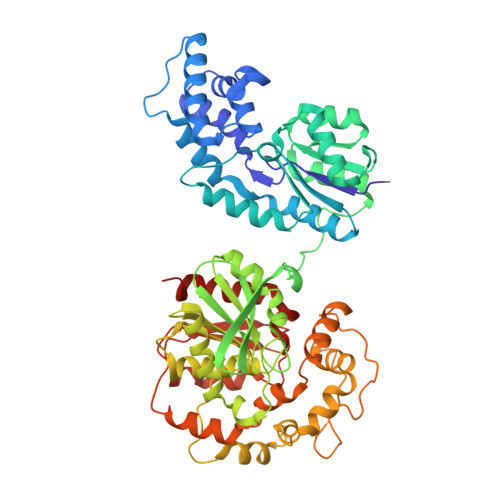
There are few reports on soluble epoxide hydrolase (sEH) structure-activity relationship studies using natural product-based scaffolds. In this study, we discovered that C-30 urea derivatives of glycyrrhetinic acid such as 33, rather than C-20/C-3 urea derivatives, possess in vitro sEH inhibitory capabilities. Furthermore, we explored the impact of stereoconfigurations at C-3 and C-18 positions, and glycosidic bonds at the 3-OH on the compound's activity. Consequently, a glycoside of 33, specifically 49Cα containing alpha-oriented mannose, exhibited promising in vivo efficacy in alleviating carrageenan-induced paw edema and acetic acid-induced writhing. Meanwhile, 49Cα demonstrated potential in mitigating acute pancreatitis by modulating the ratios of anti-inflammatory epoxyeicosatrienoic acids (EETs) to pro-inflammatory dihydroxyeicosatrienoic acids (DHETs). The co-crystal structure of sEH in complex with 49Cα revealed that the N-tetrahydropyranylmethylene urea hydrogen bonded with the residues within the sEH tunnel, contrasting with the mannose component that extended beyond the tunnel's confines. Our findings highlight 49Cα (coded LQ-38) as a promising candidate for anti-inflammatory and analgesic effects, and pave the way for the future rational design of triterpenoid-based sEH inhibitors.
- Key Laboratory of Medicinal Molecule Science and Pharmaceutical Engineering, School of Chemistry and Chemical Engineering, Beijing Institute of Technology, Beijing, 102488, China.
Organizational Affiliation: