Download Mendeley
Molecular basis of high-torque transmission of the Vibrio polar flagellar motor.
Zhang, L., Tan, J., Duan, X., Wang, X., Wang, T., Yuan, K., Homma, M., Kojima, S., Zhou, Y., Zhu, Y.(2026) Protein Cell
- PubMed: 41871453 Search on PubMed
- DOI: https://doi.org/10.1093/procel/pwag025
- Primary Citation Related Structures:
8Z5N, 8Z5S, 8Z5U, 8Z5V, 8Z5W, 8Z5X, 8Z5Y, 8Z5Z, 8Z60 - PubMed Abstract:
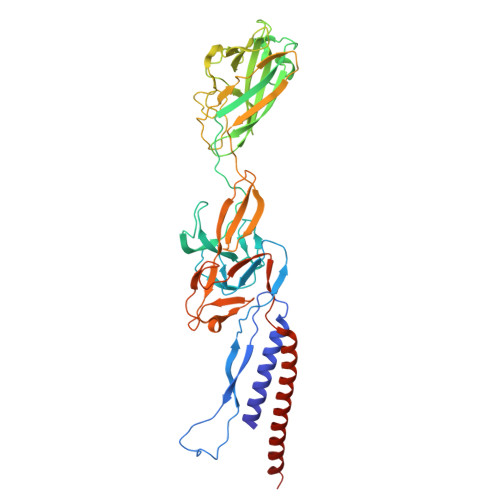
The bacterial flagellar motor is a protein nanomachine that rotates the flagellum to facilitate bacterial motility. These motors exhibit structural diversity among species, enabling the transmission of varying torques to flagellar filaments to grant bacteria diverse swimming capabilities. Compared to peritrichous flagellar motors, polar flagellar motors are faster machines that transmit higher torque to drive high-speed motility in liquids and empower swimming in viscous environments. However, structural basis of high-torque transmission of the polar flagellar motors is still unclear. Here we present a cryo-electron microscopy structure of the polar flagellar motor in complex with the hook from Vibrio alginolyticus, comprising 295 subunits from 18 proteins. Compared to the peritrichous flagellar rod, this structure reveals an increased number of inter-subunit interactions in the rod of the polar flagellar motor. Nine phospholipid molecules insert into the interface between the export apparatus and the proximal rod. The LP ring contains more electrostatic charges on the inner surface and has fewer physical contacts with the rod, while the HT ring tightly binds to the outer surface of the LP ring. FlrP, a protein of previously unknown function, is identified as a new component of the polar flagellar motor, and extensively participates in the interactions of 15 FliF peptides of the MS ring with the rod. In contrast to that in the peritrichous flagellum, the hook in the polar flagellum has two different conformational states, L- and R-types. These findings provide unprecedented insights into structural adaptations of the bacterial polar flagellar motors for high-torque transmission.
- School of Public Health, Life Sciences Institute, and Department of Infectious Diseases of the Second Affiliated Hospital, School of Medicine, Zhejiang University, Hangzhou, 310058, China.
Organizational Affiliation: