Download Mendeley
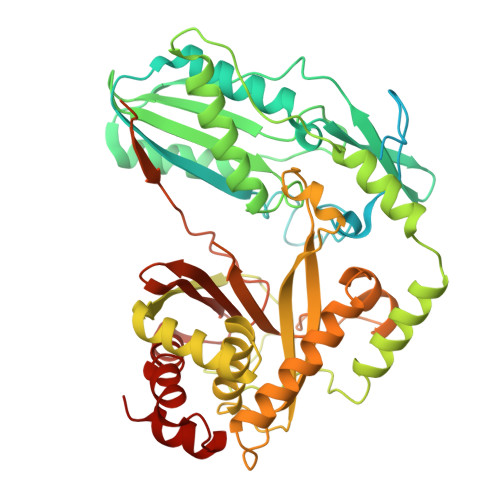
Formation of the Diketopiperazine Moiety by a Distinct Condensation-Like Domain in Hangtaimycin Biosynthesis.
Mei, Q., Wu, S., Luo, M., Ji, S., Guo, J., Dong, C., Sun, G., Wang, J., Deng, Z., Zhao, Y.L., Zhang, Z., Sun, Y.(2025) Angew Chem Int Ed Engl 64: e202421950-e202421950
- PubMed: 40000413 Search on PubMed
- DOI: https://doi.org/10.1002/anie.202421950
- Primary Citation Related Structures:
8Z0Q, 8Z0R, 8Z0S - PubMed Abstract:
Non-ribosomal peptide synthetases (NRPSs) are key enzymes in pharmaceutical synthesis, with condensation (C) domains catalyzing amide bond formation between aminoacyl substrates. However, recent research has elucidated that the catalytic capabilities of C domains extend beyond the traditional formation of peptide bonds. In this study, we elucidate the cyclization mechanism of the NRPS-derived natural products hangtaimycin (HTM), characterized by the formation of a 2,5-diketopiperazine (DKP) moiety which involves an intramolecular vinylamide-mediated nucleophilic attack instead of an N-terminal amino group. This cyclization is catalyzed by a terminal condensation-like (C T ) domain within the NRPS enzyme HtmB2. We investigated the evolutionary specificity of the HtmB2-C T within Streptomyces spectabilis CCTCC M2017417. Employing a multidisciplinary analytical approach, we have delineated the molecular underpinnings of DKP formation within the HTM biosynthesis. This process is facilitated by residue R2776, which modulates the formation of reactive species and stabilizes the amidate through electrostatic interactions. Besides, we found a positive correlation between the alkaline strength of the residue at position 2776 and the activity of HtmB2-C T . Our study elucidates the formation mechanism of DKPs in NRPS-derived natural products, thereby bridging a critical gap in the structural and mechanistic understanding of this field.
- Key Laboratory of Combinatorial Biosynthesis and Drug Discovery, Ministry of Education, and School of Pharmaceutical Sciences, Wuhan University, No. 185 East Lake Road, Wuhan, 430071, People's Republic of China.
Organizational Affiliation: