8YWH | pdb_00008ywh

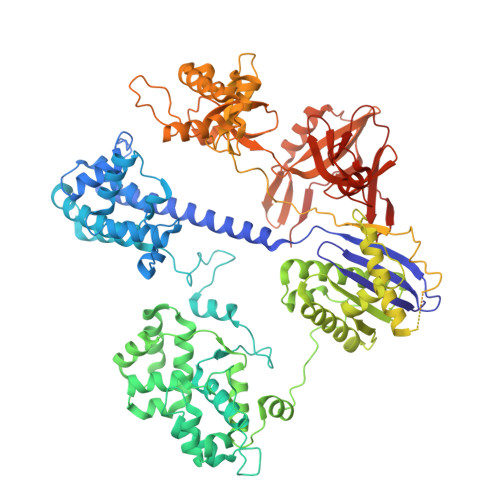
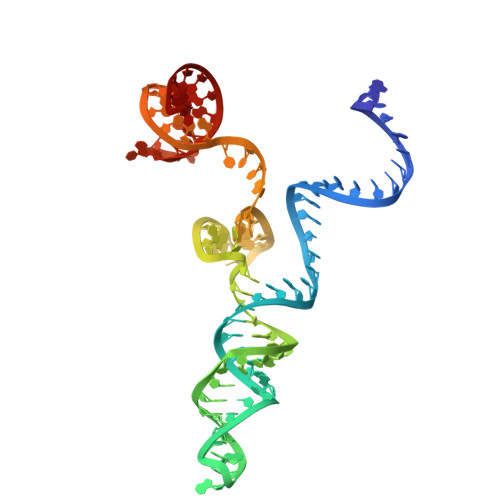
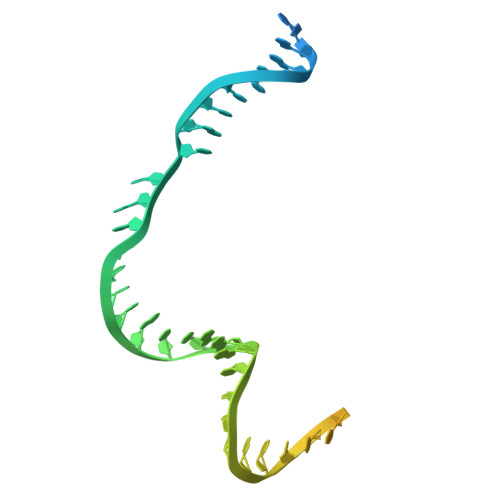
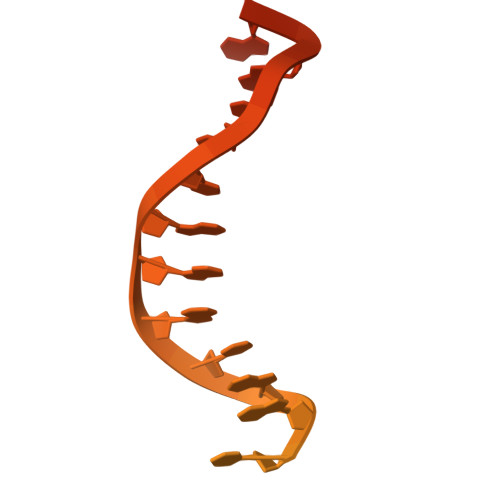
Cryo-EM structure of small and dead form SaCas9-RNA-DNA ternary complex (sdCas9)


Experimental Data Snapshot

  • Method: ELECTRON MICROSCOPY
  • Resolution: 2.97 Å
  • Aggregation State: PARTICLE 
  • Reconstruction Method: SINGLE PARTICLE 

Starting Model: experimental
View more details

wwPDB Validation   3D Report Full Report


This is version 1.2 of the entry. See complete history


Literature

Structure-Guided Engineering of Thermodynamically Enhanced SaCas9 for Improved Gene Suppression.

Kang, E.S.Kim, N.H.Lim, H.K.Jeon, H.Han, K.No, Y.H.Kim, K.Khaleel, Z.H.Shin, D.Eom, K.Nam, J.Lee, B.S.Kim, H.J.Suh, M.Lee, J.Thach, T.T.Hyun, J.Kim, Y.H.

(2025) Adv Mater 37: e2404680-e2404680

  • DOI: https://doi.org/10.1002/adma.202404680
  • Primary Citation of Related Structures:  
    8YWH

  • PubMed Abstract: 

    Proteins with multiple domains play pivotal roles in various biological processes, necessitating a thorough understanding of their structural stability and functional interplay. Here, a structure-guided protein engineering approach is proposed to develop thermostable Cas9 (CRISPR-associated protein 9) variant for CRISPR (Clustered Regularly Interspaced Short Palindromic Repeats) interference applications. By employing thermodynamic analysis, combining distance mapping and molecular dynamics simulations, deletable domains are identified to enhance stability while preserving the DNA recognition function of Cas9. The resulting engineered Cas9, termed small and dead form Cas9, exhibits improved thermostability and maintains target DNA recognition function. Cryo-electron microscopy analysis reveals structural integrity with reduced atomic density in the deleted domain. Fusion with functional elements enables intracellular delivery and nuclear localization, demonstrating efficient gene suppression in diverse cell types. Direct delivery in the mouse brain shows enhanced knockdown efficiency, highlighting the potential of structure-guided engineering to develop functional CRISPR systems tailored for specific applications. This study underscores the significance of integrating computational and experimental approaches for protein engineering, offering insights into designing tailored molecular tools for precise biological interventions.


  • Organizational Affiliation
    • SKKU Advanced Institute of Nanotechnology (SAINT), Sungkyunkwan University, Suwon, 16419, Republic of Korea.

Macromolecules

Find similar proteins by:  (by identity cutoff)  |  3D Structure
Entity ID: 1
MoleculeChains Sequence LengthOrganismDetailsImage
sCas9 (Compact SaCas9)886Staphylococcus aureusMutation(s): 0 
EC: 3.1
UniProt
Find proteins for J7RUA5 (Staphylococcus aureus)
Explore J7RUA5 
Go to UniProtKB:  J7RUA5
Entity Groups  
Sequence Clusters30% Identity50% Identity70% Identity90% Identity95% Identity100% Identity
UniProt GroupJ7RUA5
Sequence Annotations
Expand
  • Reference Sequence
Find similar nucleic acids by:  (by identity cutoff)  |  3D Structure
Entity ID: 2
MoleculeChains LengthOrganismImage
sgRNA98synthetic construct
Sequence Annotations
Expand
  • Reference Sequence
Find similar nucleic acids by:  (by identity cutoff)  |  3D Structure
Entity ID: 3
MoleculeChains LengthOrganismImage
Target DNA59synthetic construct
Sequence Annotations
Expand
  • Reference Sequence
Find similar nucleic acids by:  (by identity cutoff)  |  3D Structure
Entity ID: 4
MoleculeChains LengthOrganismImage
Non-target DNA59synthetic construct
Sequence Annotations
Expand
  • Reference Sequence
Experimental Data & Validation

Experimental Data

  • Method: ELECTRON MICROSCOPY
  • Resolution: 2.97 Å
  • Aggregation State: PARTICLE 
  • Reconstruction Method: SINGLE PARTICLE 
EM Software:
TaskSoftware PackageVersion
RECONSTRUCTIONRELION5.0
MODEL REFINEMENTCoot0.8.9.3
MODEL REFINEMENTPHENIX

Structure Validation

View Full Validation Report


Entry History & Funding Information

Deposition Data


Funding OrganizationLocationGrant Number
National Research Foundation (NRF, Korea)Korea, Republic OfNRF-2023R1A2C300573
National Research Foundation (NRF, Korea)Korea, Republic OfRS-2023-00302458

Revision History  (Full details and data files)

  • Version 1.0: 2025-04-02
    Type: Initial release
  • Version 1.1: 2025-06-25
    Changes: Data collection
  • Version 1.2: 2025-07-16
    Changes: Data collection, Database references