Download Mendeley
The F54L mutation of Thioredoxin shows protein instability and increased fluctuations of the catalytic center.
Baba, T., Ueno, G., Ohe, C., Saji, S., Yamamoto, S., Yamamoto, M., Nakagawa, H., Okazaki, N., Ouchida, M., Ohmori, I.K., Takeshita, K.(2025) Biochim Biophys Acta Gen Subj 1869: 130860-130860
- PubMed: 40953808 Search on PubMed
- DOI: https://doi.org/10.1016/j.bbagen.2025.130860
- Primary Citation Related Structures:
8YS1, 8YS3 - PubMed Abstract:
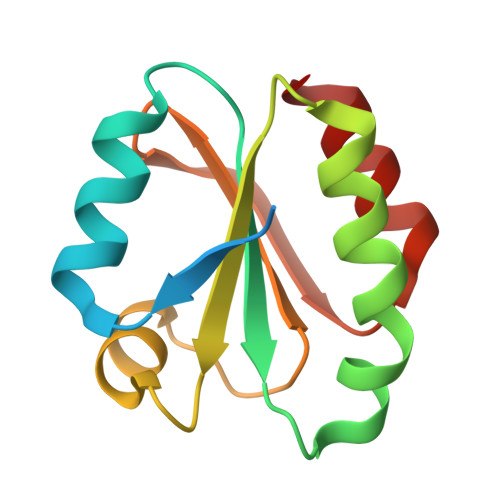
Thioredoxin is a ubiquitous redox protein that acts as an electron donor via its conserved dithiol motif (C32GPC35), catalyzing dithiol-disulfide exchange to regulate the redox state of target proteins. It supports antioxidant defense via peroxiredoxins, facilitates DNA synthesis by donating electrons to ribonucleotide reductase, and regulates redox-sensitive signaling pathways, including those controlling transcription and apoptosis. Neuronal degeneration and chronic kidney disease have been observed in Txn-F54L mutant rats; however, the details of why the Txn mutation causes these phenomena remain unknown. The present study aimed to elucidate the functional and structural changes caused by the F54L mutation. The Thioredoxin-F54L showed less insulin-reducing activity and more thermosensitivity to denaturation in the body temperature range compared to the wild type. The crystal structure revealed that F54 forms hydrophobic interactions with the surrounding hydrophobic amino acids. In addition, molecular dynamics simulation predicts increased fluctuations around the F54L mutation and a tendency for the distance between residues C32 and C35 at the catalytic center to be widened. The increased distance between residues C32 and C35 of the catalytic center may affect the reducing activity of the enzyme on the substrate. The finding that Thioredoxin-F54L is prone to denaturation at normal body temperature may reduce the normally functioning Thioredoxin. These molecular characteristics of Thioredoxin-F54L may be related to brain and kidney disease development in the Txn-F54L rats.
- Life Science Research Infrastructure Group, Advanced Photon Technology Division, RIKEN SPring-8 Center, Hyogo 679-5148, Japan; Macromolecular Dynamics and X-ray Crystallography, Graduate School of Life Science, University of Hyogo, Hyogo 678-1297, Japan.
Organizational Affiliation: