Download Mendeley
Structural insight into the poly(3-hydroxybutyrate) hydrolysis by intracellular PHB depolymerase from Bacillus thuringiensis.
Wang, Y.L., Ye, L.C., Chang, S.C., Chen, S.C., Hsu, C.H.(2024) Int J Biol Macromol 284: 137999-137999
- PubMed: 39592048 Search on PubMed
- DOI: https://doi.org/10.1016/j.ijbiomac.2024.137999
- Primary Citation Related Structures:
8YNV, 8YNW - PubMed Abstract:
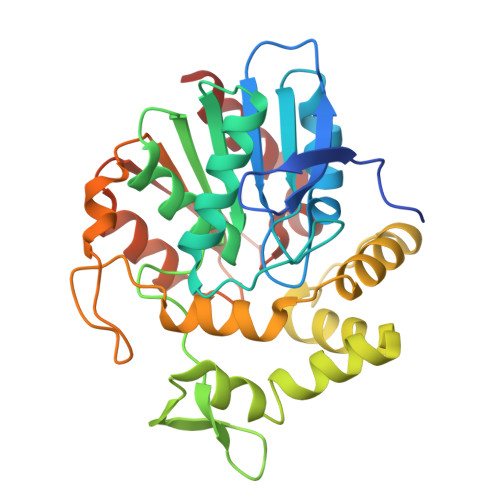
Poly((R)-3-hydroxybutyrate) (PHB) is a microbial biopolymer widely used in commercial biodegradable plastics. PHB degradation in cell is catalyzed by PHB depolymerase (PhaZ), which hydrolyzes the polyester into mono- and/or oligomeric (R)-3-hydroxylbutyrates (3HB). A novel intracellular PhaZ from Bacillus thuringiensis (BtPhaZ) was identified for potential applications in polymer biodegradation and 3HB production. Herein, we present the crystal structure of BtPhaZ at 1.42-Å resolution, making the first crystal structure for an intracellular PhaZ. BtPhaZ comprises a canonical α/β hydrolase catalytic domain and a unique α-helical cap domain. Despite lacking sequence similarity, BtPhaZ shares high structural homology with many α/β hydrolase members, exhibiting a similar active-site architecture. Alongside the most conserved superfamily signature, several new conserved signatures have been identified, contributing not only to the formations of the Ser-His-Asp catalytic triad and the oxyanion hole but also to the active-site conformation. The putative P-1 subsite appears to have limited space for accommodating only one 3HB-monomer, which may provide an explanation why the major hydrolytic product for BtPhaZ is monomeric form. Furthermore, a cluster of solvent-exposed hydrophobic residues in the helical cap domain forms an adsorption site for polymer-binding. Detailed structural comparisons reveal that various PhaZs employ distinct residues for the biopolymer-binding and hydrolysis.
- Institute of Biochemistry and Molecular Biology, National Yang Ming Chiao Tung University, Taipei 112, Taiwan.
Organizational Affiliation: