Download Mendeley
Development of novel antivrial agents that induce the degradation of the main protease of human-infecting coronaviruses.
Cheng, S., Feng, Y., Li, W., Liu, T., Lv, X., Tong, X., Xi, G., Ye, X., Li, X.(2024) Eur J Med Chem 275: 116629-116629
- PubMed: 38941718 Search on PubMed
- DOI: https://doi.org/10.1016/j.ejmech.2024.116629
- Primary Citation Related Structures:
8YLS - PubMed Abstract:
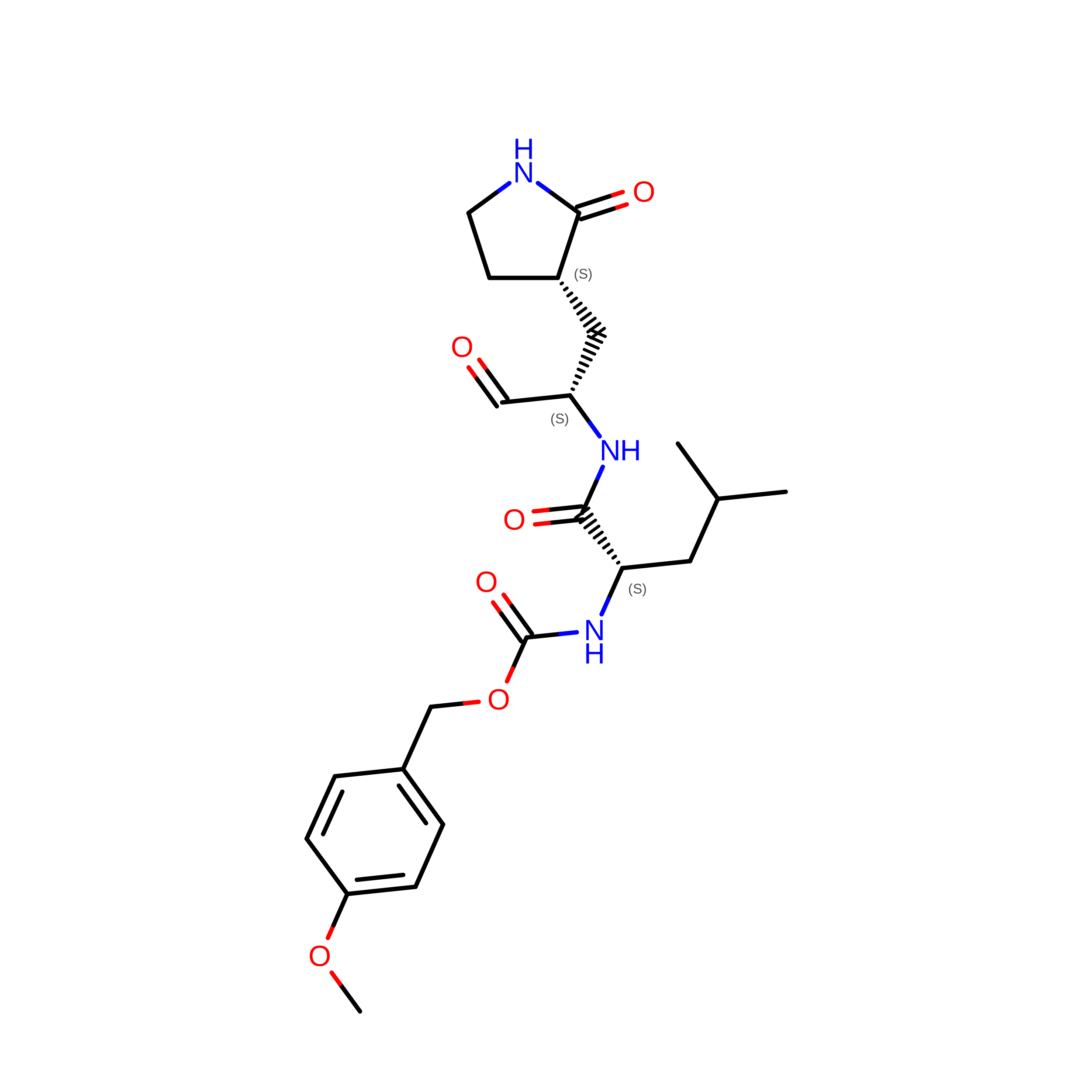
The family of human-infecting coronaviruses (HCoVs) poses a serious threat to global health and includes several highly pathogenic strains that cause severe respiratory illnesses. It is essential that we develop effective broad-spectrum anti-HCoV agents to prepare for future outbreaks. In this study, we used PROteolysis TArgeting Chimera (PROTAC) technology focused on degradation of the HCoV main protease (M pro ), a conserved enzyme essential for viral replication and pathogenicity. By adapting the M pro inhibitor GC376, we produced two novel PROTACs, P2 and P3, which showed relatively broad-spectrum activity against the human-infecting CoVs HCoV-229E, HCoV-OC43, and SARS-CoV-2. The concentrations of these PROTACs that reduced virus replication by 50 % ranged from 0.71 to 4.6 μM, and neither showed cytotoxicity at 100 μM. Furthermore, mechanistic binding studies demonstrated that P2 and P3 effectively targeted HCoV-229E, HCoV-OC43, and SARS-CoV-2 by degrading M pro within cells in vitro. This study highlights the potential of PROTAC technology in the development of broad-spectrum anti-HCoVs agents, presenting a novel approach for dealing with future viral outbreaks, particularly those stemming from CoVs.
- CAS Key Laboratory of Pathogenic Microbiology and Immunology, Institute of Microbiology, Chinese Academy of Sciences, Chaoyang District, Beijing, 100101, China; Savaid Medical School, University of Chinese Academy of Sciences, Huairou District, Beijing, 101408, China. Electronic address: csh_04@163.com.
Organizational Affiliation: