8YG2 | pdb_00008yg2

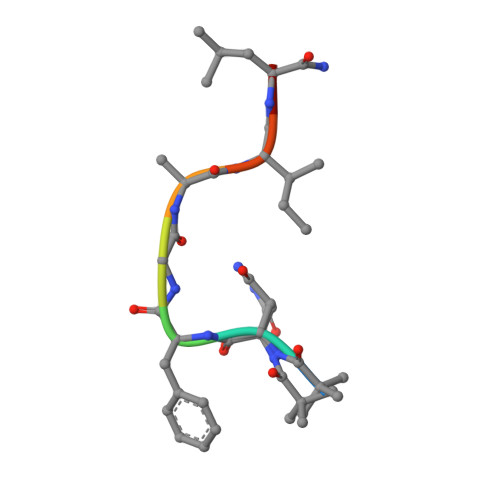
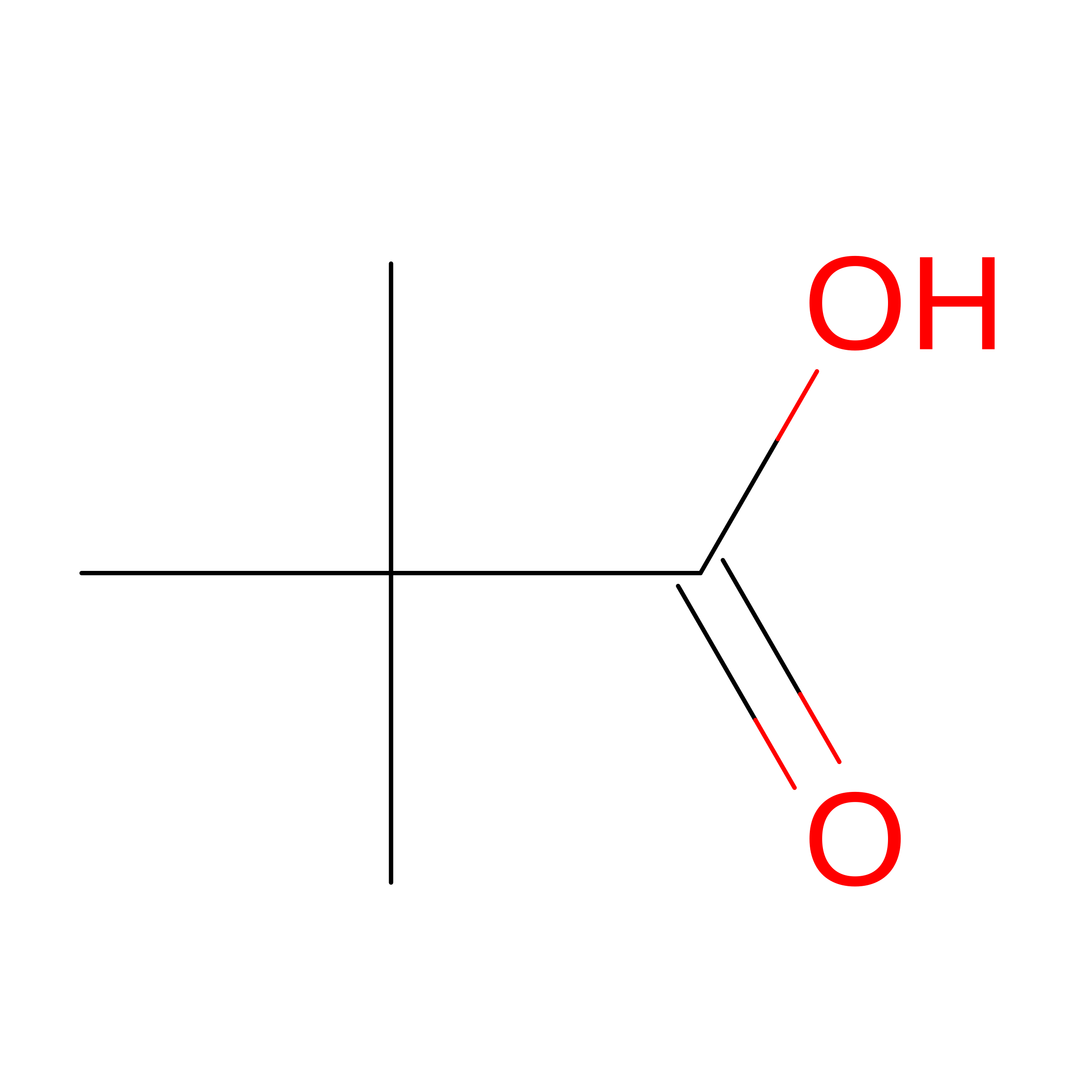
Crystal structure of amyloidogenic peptide Piv-NFGAIL-NH2 from Islet Amyloid Polypeptide


Experimental Data Snapshot

  • Method: X-RAY DIFFRACTION
  • Resolution: 1.25 Å
  • R-Value Free: 
    0.201 (Depositor), 0.196 (DCC) 
  • R-Value Work: 
    0.174 (Depositor), 0.177 (DCC) 

Starting Model: experimental
View more details

wwPDB Validation 3D Report Full Report

Validation slider image for 8YG2

This is version 1.1 of the entry. See complete history

Literature

Catalysis driven by an amyloid-substrate complex.

Sawazaki, T.Sasaki, D.Sohma, Y.

(2024) Proc Natl Acad Sci U S A 121: e2314704121-e2314704121

  • DOI: https://doi.org/10.1073/pnas.2314704121
  • Primary Citation Related Structures: 
    8YG2

  • PubMed Abstract: 

    Amine modification through nucleophilic attack of the amine functionality is a very common chemical transformation. Under biorelevant conditions using acidic-to-neutral pH buffer, however, the nucleophilic reaction of alkyl amines (pKa ≈ 10) is not facile due to the generation of ammonium ions lacking nucleophilicity. Here, we disclose a unique molecular transformation system, c atalysis driven by a myloid- s ubstrate comp l ex (CASL), that promotes amine modifications in acidic buffer. Ammonium ions attached to molecules with amyloid-binding capability were activated through deprotonation due to the close proximity to the amyloid catalyst formed by Ac-Asn-Phe-Gly-Ala-Ile-Leu-NH 2 ( NL6 ), derived from islet amyloid polypeptide (IAPP). Under the CASL conditions, alkyl amines underwent various modifications, i.e., acylation, arylation, cyclization, and alkylation, in acidic buffer. Crystallographic analysis and chemical modification studies of the amyloid catalysts suggested that the carbonyl oxygen of the Phe-Gly amide bond of NL6 plays a key role in activating the substrate amine by forming a hydrogen bond. Using CASL, selective conversion of substrates possessing equivalently reactive amine functionalities was achieved in catalytic reactions using amyloids. CASL provides a unique method for applying nucleophilic conversion reactions of amines in diverse fields of chemistry and biology.


  • Organizational Affiliation
    • Department of Medicinal Chemistry, School of Pharmaceutical Sciences, Wakayama Medical University, Wakayama 640-8156, Japan.

Macromolecule Content 

  • Total Structure Weight: 0.76 kDa 
  • Atom Count: 68 
  • Modeled Residue Count: 8 
  • Deposited Residue Count: 8 
  • Unique protein chains: 1

Macromolecules

Find similar proteins by:  Sequence   |   3D Structure  
Entity ID: 1
MoleculeChains  Sequence LengthOrganismDetailsImage
Amyloidogenic peptide from Islet Amyloid Polypeptide8Homo sapiensMutation(s): 0 
UniProt & NIH Common Fund Data Resources
Find proteins for P10997 (Homo sapiens)
Explore P10997 
Go to UniProtKB:  P10997
PHAROS:  P10997
GTEx:  ENSG00000121351 
Entity Groups
UniProt GroupP10997
Sequence Annotations
Expand
Reference Sequence

Small Molecules

Ligands 1 Unique
IDChains Name / Formula / InChI Key2D Diagram3D Interactions
FMT

Query on FMT


Download:Ideal Coordinates CCD File
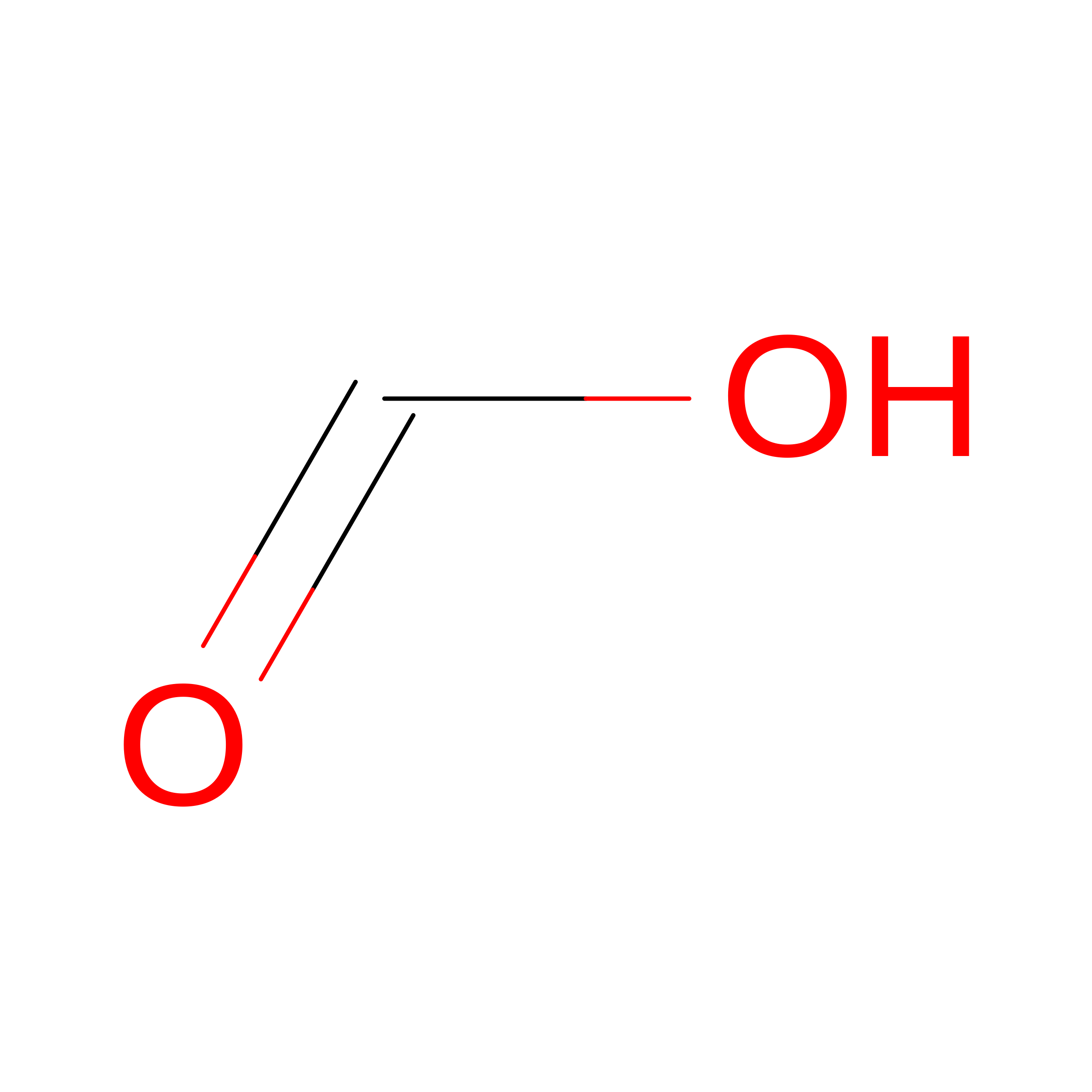
B [auth A]FORMIC ACID
C H2 O2
BDAGIHXWWSANSR-UHFFFAOYSA-N

Experimental Data & Validation

Experimental Data

  • Method: X-RAY DIFFRACTION
  • Resolution: 1.25 Å
  • R-Value Free:  0.201 (Depositor), 0.196 (DCC) 
  • R-Value Work:  0.174 (Depositor), 0.177 (DCC) 
Space Group: P 1 21 1
Unit Cell:
Length ( Å )Angle ( ˚ )
a = 4.864α = 90
b = 20.466β = 88.6
c = 20.855γ = 90
Software Package:
Software NamePurpose
REFMACrefinement
DIALSdata reduction
DIALSdata scaling
PHASERphasing
Cootmodel building

Structure Validation

View Full Validation Report


Entry History 

& Funding Information

Deposition Data


Funding OrganizationLocationGrant Number
Japan Society for the Promotion of Science (JSPS)Japan--

Revision History  (Full details and data files)

  • Version 1.0: 2024-05-08
    Type: Initial release
  • Version 1.1: 2024-11-20
    Changes: Structure summary