8Y9O | pdb_00008y9o

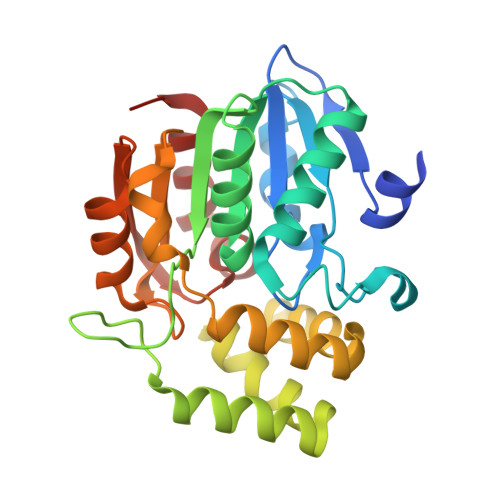
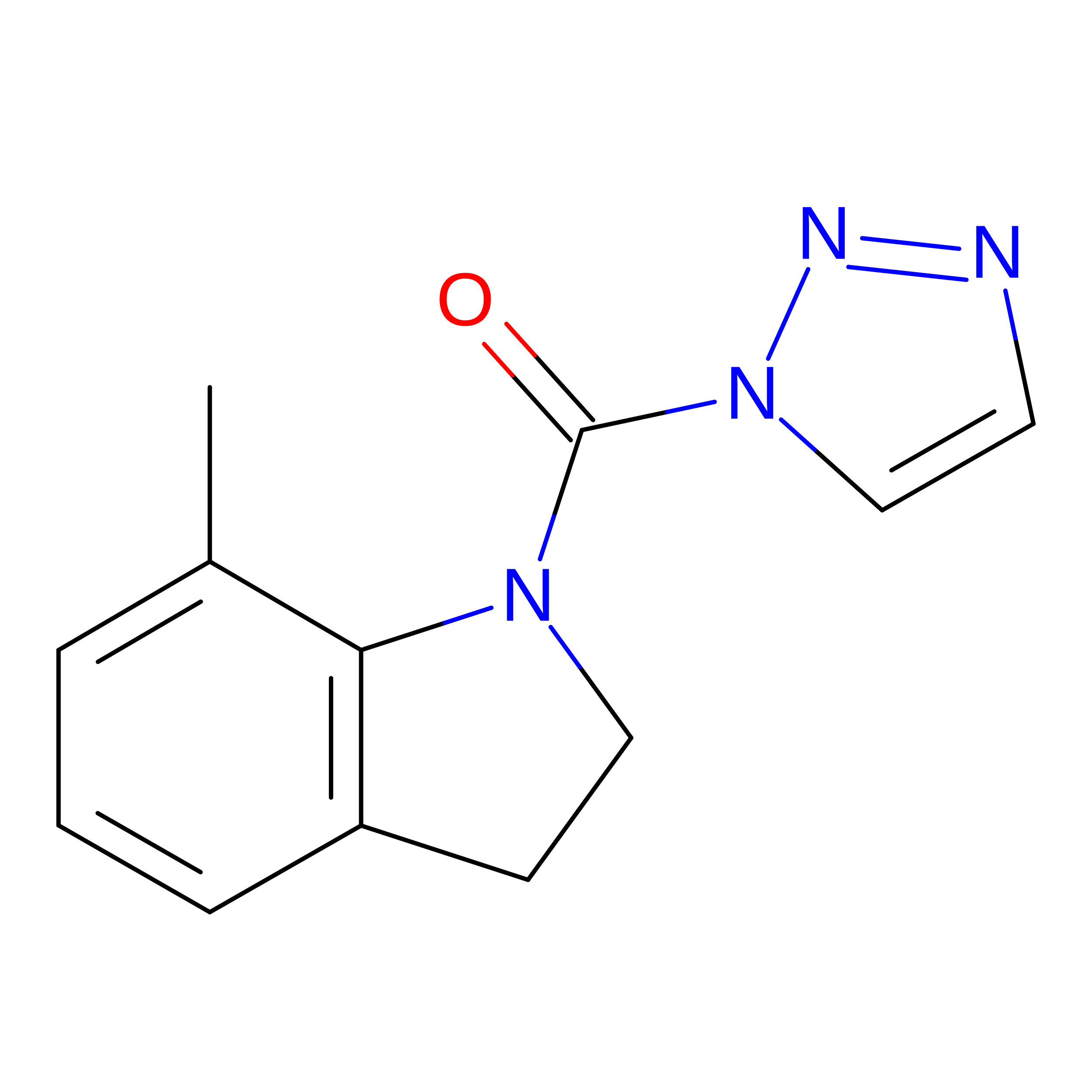
Crystal structure of AtKAI2 in complex with KK181N1


Experimental Data Snapshot

  • Method: X-RAY DIFFRACTION
  • Resolution: 1.90 Å
  • R-Value Free: 
    0.275 (Depositor), 0.275 (DCC) 
  • R-Value Work: 
    0.239 (Depositor), 0.239 (DCC) 
  • R-Value Observed: 
    0.241 (Depositor) 

Starting Model: experimental
View more details

wwPDB Validation   3D Report Full Report


Ligand Structure Quality Assessment 


This is version 1.1 of the entry. See complete history


Literature

Identification and structure-guided development of triazole urea-based selective antagonists of Arabidopsis karrikin signaling.

Wang, J.Takahashi, I.Kikuzato, K.Sakai, T.Zhu, Z.Jiang, K.Nakamura, H.Nakano, T.Tanokura, M.Miyakawa, T.Asami, T.

(2025) Nat Commun 16: 104-104

  • DOI: https://doi.org/10.1038/s41467-024-54801-1
  • Primary Citation of Related Structures:  
    8Y9O

  • PubMed Abstract: 

    The smoke-derived butenolides, karrikins (KARs), regulate many aspects of plant growth and development. However, KARs and a plant hormone, strigolactones (SLs), have high resemblance in signal perception and transduction, making it hard to delineate KARs response due to the shortage of chemical-genetic tools. Here, we identify a triazole urea KK181N1 as an inhibitor of the KARs receptor KAI2. KK181N1 selectively depress the KAR-induced phenotypes in Arabidopsis. We further elucidate the antagonistic, KAI2 binding mechanism of KK181N1, showing that KK181N1 binds to the catalytic pockets of KAI2 in a non-covalent binding manner. Our experiments also demonstrate the binding affinity of triazole urea compounds are regulated by the structured water molecule networks. By fine-tuning this network, we successfully develop a more potent derivative of KK181N1. We anticipate that these chemicals will be applicable to the elucidation of KARs biology, especially for discriminating the molecular and physiological aspects of KARs and SL signaling.


  • Organizational Affiliation
    • Graduate School of Agricultural and Life Sciences, The University of Tokyo, Tokyo, Japan.

Macromolecules
Find similar proteins by:  (by identity cutoff)  |  3D Structure
Entity ID: 1
MoleculeChains Sequence LengthOrganismDetailsImage
Probable esterase KAI2
A, B, C
277Arabidopsis thalianaMutation(s): 0 
Gene Names: KAI2D14LHTLAt4g37470F6G17.120
UniProt
Find proteins for Q9SZU7 (Arabidopsis thaliana)
Explore Q9SZU7 
Go to UniProtKB:  Q9SZU7
Entity Groups  
Sequence Clusters30% Identity50% Identity70% Identity90% Identity95% Identity100% Identity
UniProt GroupQ9SZU7
Sequence Annotations
Expand
  • Reference Sequence
Experimental Data & Validation

Experimental Data

  • Method: X-RAY DIFFRACTION
  • Resolution: 1.90 Å
  • R-Value Free:  0.275 (Depositor), 0.275 (DCC) 
  • R-Value Work:  0.239 (Depositor), 0.239 (DCC) 
  • R-Value Observed: 0.241 (Depositor) 
Space Group: P 1 21 1
Unit Cell:
Length ( Å )Angle ( ˚ )
a = 85.314α = 90
b = 64.042β = 104.79
c = 114.958γ = 90
Software Package:
Software NamePurpose
PHENIXrefinement
XDSdata reduction
Aimlessdata scaling
PHASERphasing

Structure Validation

View Full Validation Report


Ligand Structure Quality Assessment 


Entry History & Funding Information

Deposition Data


Funding OrganizationLocationGrant Number
Japan Society for the Promotion of Science (JSPS)Japan18H05266
Japan Science and TechnologyJapan--
Chinese Scholarship CouncilChina--

Revision History  (Full details and data files)

  • Version 1.0: 2024-12-04
    Type: Initial release
  • Version 1.1: 2025-01-15
    Changes: Database references