8Y7L | pdb_00008y7l

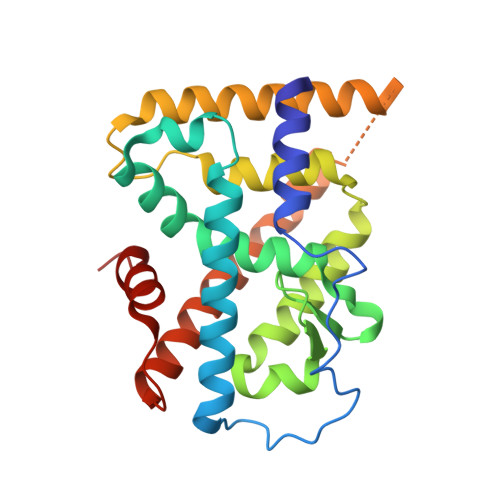
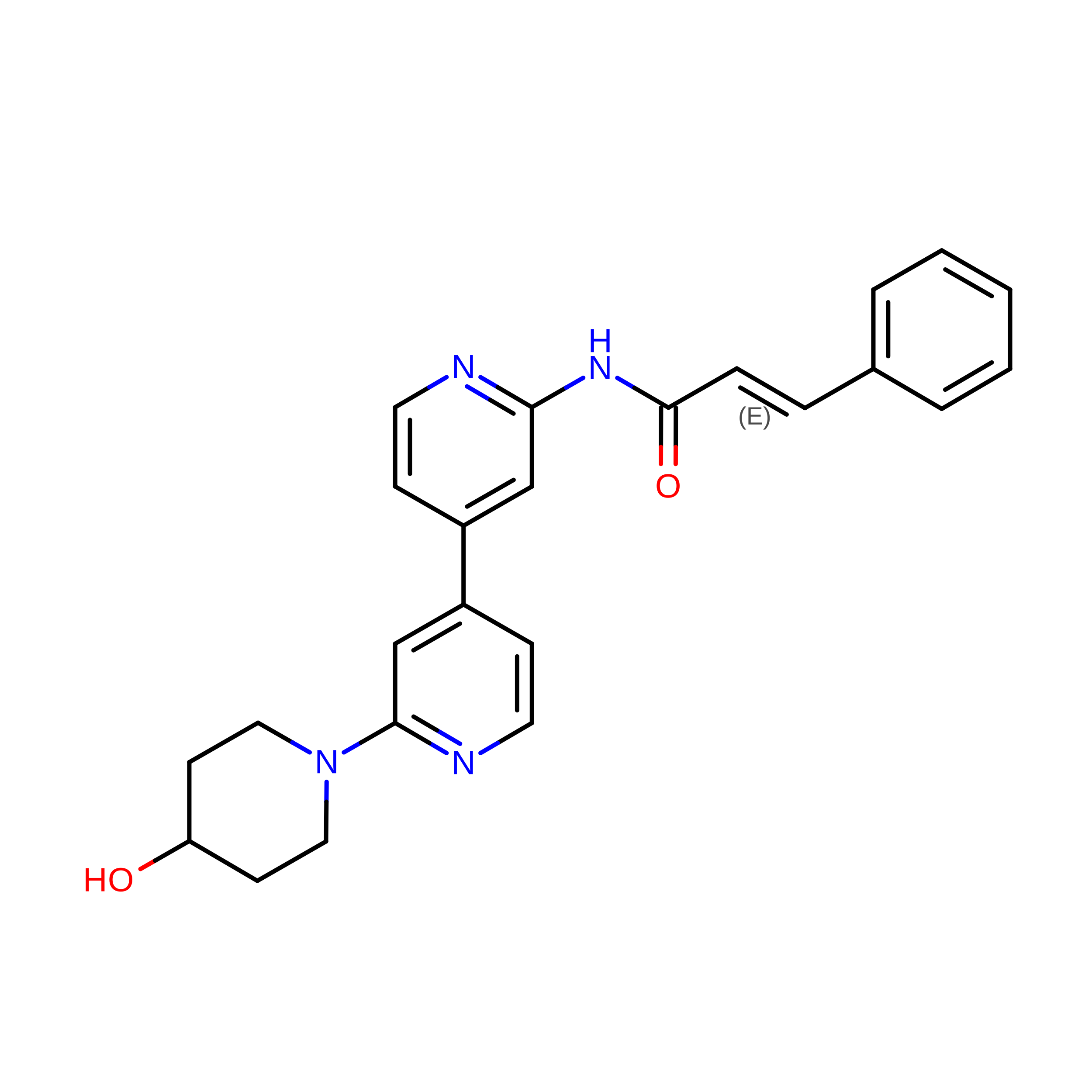
Crystal Structure of Nur77 LBD in complex with N-(2'-(4-hydroxypiperidin-1-yl)-[4,4'-bipyridin]-2-yl)cinnamamide


Experimental Data Snapshot

  • Method: X-RAY DIFFRACTION
  • Resolution: 2.68 Å
  • R-Value Free: 
    0.242 (Depositor), 0.250 (DCC) 
  • R-Value Work: 
    0.204 (Depositor), 0.210 (DCC) 

Starting Model: experimental
View more details

wwPDB Validation   3D Report Full Report


Ligand Structure Quality Assessment 


This is version 1.1 of the entry. See complete history


Literature

Discovery of a novel exceptionally potent and orally active Nur77 ligand NB1 with a distinct binding mode for cancer therapy.

Chen, J.Zhao, T.Hong, W.Li, H.Ao, M.Zhong, Y.Chen, X.Qiu, Y.Wang, X.Wu, Z.Lin, T.Li, B.Chen, X.Fang, M.

(2024) Acta Pharm Sin B 14: 5493-5504

  • DOI: https://doi.org/10.1016/j.apsb.2024.07.012
  • Primary Citation of Related Structures:  
    8Y7L

  • PubMed Abstract: 

    The orphan nuclear receptor Nur77 is emerging as an attractive target for cancer therapy, and activating Nur77's non-genotypic anticancer function has demonstrated strong therapeutic potential. However, few Nur77 site B ligands have been identified as excellent anticancer compounds. There are no co-crystal structures of effective anticancer agents at Nur77 site B, which greatly limits the development of novel Nur77 site B ligands. Moreover, the lack of pharmaceutical ligands restricts Nur77's therapeutic proof of concept. Herein, we developed a first-in-class Nur77 site B ligand (NB1) that significantly inhibited cancer cells by mediating the Nur77/Bcl-2-related apoptotic effect at mitochondria. The X-ray crystallography suggests that NB1 is bound to the Nur77 site B with a distinct binding mode. Importantly, NB1 showed favorable pharmacokinetic profiles and safety, as evidenced by its good oral bioavailability in rats and lack of mortality, bodyweight loss, and pathological damage at the 512.0 mg/kg dose in mice. Furthermore, oral administration of NB1 demonstrated remarkable in vivo anticancer efficacy in an MDA-MB-231 xenograft model. Together, our work discovers NB1 as a new generation Nur77 ligand that activates the Nur77/Bcl-2 apoptotic pathway with a safe and effective cancer therapeutic potency.


  • Organizational Affiliation
    • State Key Laboratory of Cellular Stress Biology and Fujian Provincial Key Laboratory of Innovative Drug Target Research, School of Pharmaceutical Science, Xiamen University, Xiamen 361102, China.

Macromolecules
Find similar proteins by:  (by identity cutoff)  |  3D Structure
Entity ID: 1
MoleculeChains Sequence LengthOrganismDetailsImage
Nuclear receptor subfamily 4immunitygroup A member 1
A, B
238Homo sapiensMutation(s): 0 
Gene Names: NR4A1GFRP1HMRNAK1
UniProt & NIH Common Fund Data Resources
Find proteins for P22736 (Homo sapiens)
Explore P22736 
Go to UniProtKB:  P22736
PHAROS:  P22736
GTEx:  ENSG00000123358 
Entity Groups  
Sequence Clusters30% Identity50% Identity70% Identity90% Identity95% Identity100% Identity
UniProt GroupP22736
Sequence Annotations
Expand
  • Reference Sequence
Small Molecules
Ligands 1 Unique
IDChains Name / Formula / InChI Key2D Diagram3D Interactions
A1D59
Query on A1D59

Download Ideal Coordinates CCD File 
C [auth B](~{E})-~{N}-[4-[2-(4-oxidanylpiperidin-1-yl)pyridin-4-yl]pyridin-2-yl]-3-phenyl-prop-2-enamide
C24 H24 N4 O2
LLCXZJGKTNDVLE-UHFFFAOYSA-N
Experimental Data & Validation

Experimental Data

  • Method: X-RAY DIFFRACTION
  • Resolution: 2.68 Å
  • R-Value Free:  0.242 (Depositor), 0.250 (DCC) 
  • R-Value Work:  0.204 (Depositor), 0.210 (DCC) 
Space Group: P 21 21 21
Unit Cell:
Length ( Å )Angle ( ˚ )
a = 74.781α = 90
b = 76.125β = 90
c = 128.813γ = 90
Software Package:
Software NamePurpose
REFMACrefinement
HKL-3000data reduction
HKL-3000data scaling
PHASERphasing

Structure Validation

View Full Validation Report


Ligand Structure Quality Assessment 


Entry History & Funding Information

Deposition Data


Funding OrganizationLocationGrant Number
National Natural Science Foundation of China (NSFC)China--

Revision History  (Full details and data files)

  • Version 1.0: 2024-07-24
    Type: Initial release
  • Version 1.1: 2025-01-29
    Changes: Database references, Structure summary