8Y6X | pdb_00008y6x

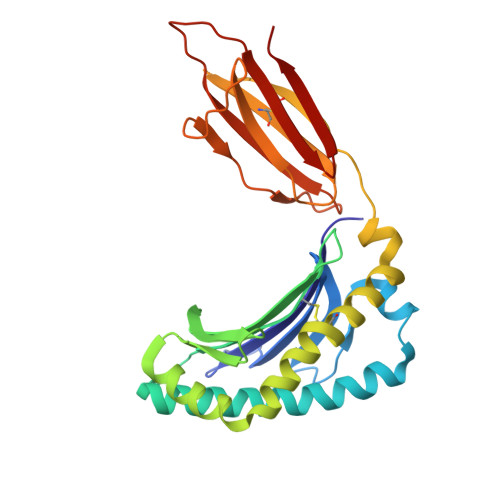
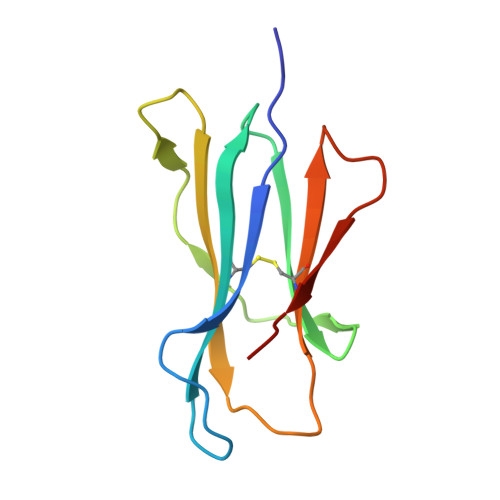
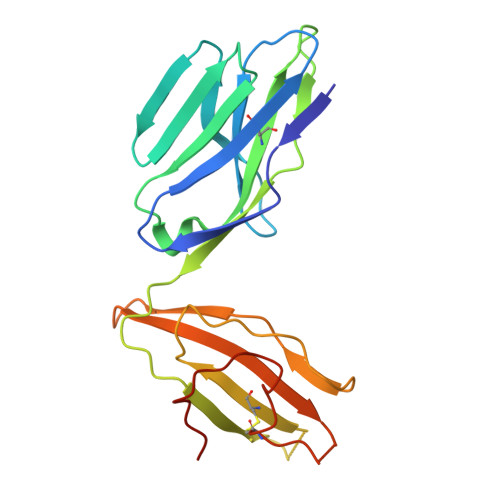
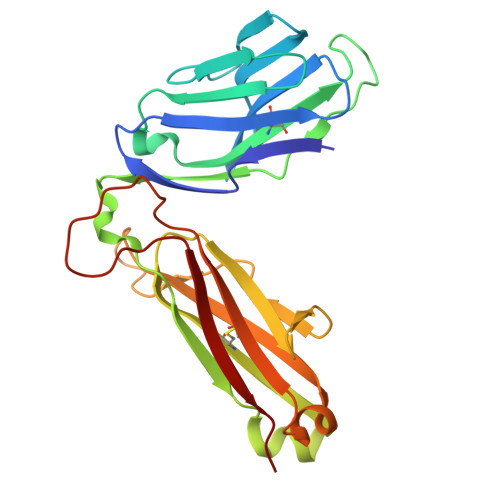
Crystal structure of ternary complex of human MR1, ligand #4, and MAIT-TCR A-F7


Experimental Data Snapshot

  • Method: X-RAY DIFFRACTION
  • Resolution: 3.40 Å
  • R-Value Free: 
    0.208 (Depositor), 0.213 (DCC) 
  • R-Value Work: 
    0.176 (Depositor), 0.182 (DCC) 
  • R-Value Observed: 
    0.178 (Depositor) 

Starting Model: experimental
View more details

wwPDB Validation   3D Report Full Report


Ligand Structure Quality Assessment 


This is version 1.1 of the entry. See complete history


Literature

Development of Ribityllumazine Analogue as Mucosal-Associated Invariant T Cell Ligands.

Takasaki, R.Ito, E.Nagae, M.Takahashi, Y.Matsuoka, T.Yasue, W.Arichi, N.Ohno, H.Yamasaki, S.Inuki, S.

(2024) J Am Chem Soc 146: 29964-29976

  • DOI: https://doi.org/10.1021/jacs.4c12997
  • Primary Citation of Related Structures:  
    8Y6X

  • PubMed Abstract: 

    Mucosal-associated invariant T (MAIT) cells are a subset of innate-like T cells abundant in human tissues that play a significant role in defense against bacterial and viral infections and in tissue repair. MAIT cells are activated by recognizing microbial-derived small-molecule ligands presented by the MHC class I related-1 protein. Although several MAIT cell modulators have been identified in the past decade, potent and chemically stable ligands remain limited. Herein, we carried out a structure-activity relationship study of ribityllumazine derivatives and found a chemically stable MAIT cell ligand with a pteridine core and a 2-oxopropyl group as the Lys-reactive group. The ligand showed high potency in a cocultivation assay using model cell lines of antigen-presenting cells and MAIT cells. The X-ray crystallographic analysis revealed the binding mode of the ligand to MR1 and the T cell receptor, indicating that it forms a covalent bond with MR1 via Schiff base formation. Furthermore, we found that the ligand stimulated proliferation of human MAIT cells in human peripheral blood mononuclear cells and showed an adjuvant effect in mice. Our developed ligand is one of the most potent among chemically stable MAIT cell ligands, contributing to accelerating therapeutic applications of MAIT cells.


  • Organizational Affiliation
    • Graduate School of Pharmaceutical Sciences, Kyoto University, Kyoto, Kyoto 606-8501, Japan.

Macromolecules
Find similar proteins by:  (by identity cutoff)  |  3D Structure
Entity ID: 1
MoleculeChains Sequence LengthOrganismDetailsImage
Major histocompatibility complex class I-related gene protein271Homo sapiensMutation(s): 1 
Gene Names: MR1
UniProt & NIH Common Fund Data Resources
Find proteins for Q95460 (Homo sapiens)
Explore Q95460 
Go to UniProtKB:  Q95460
PHAROS:  Q95460
GTEx:  ENSG00000153029 
Entity Groups  
Sequence Clusters30% Identity50% Identity70% Identity90% Identity95% Identity100% Identity
UniProt GroupQ95460
Sequence Annotations
Expand
  • Reference Sequence
Find similar proteins by:  (by identity cutoff)  |  3D Structure
Entity ID: 2
MoleculeChains Sequence LengthOrganismDetailsImage
Beta-2-microglobulin100Homo sapiensMutation(s): 0 
Gene Names: B2M
UniProt & NIH Common Fund Data Resources
Find proteins for P61769 (Homo sapiens)
Explore P61769 
Go to UniProtKB:  P61769
PHAROS:  P61769
GTEx:  ENSG00000166710 
Entity Groups  
Sequence Clusters30% Identity50% Identity70% Identity90% Identity95% Identity100% Identity
UniProt GroupP61769
Sequence Annotations
Expand
  • Reference Sequence
Find similar proteins by:  (by identity cutoff)  |  3D Structure
Entity ID: 3
MoleculeChains Sequence LengthOrganismDetailsImage
MAIT T cell receptor (A-F7) alpha chainC [auth D]203Homo sapiensMutation(s): 0 
UniProt & NIH Common Fund Data Resources
Find proteins for P01848 (Homo sapiens)
Explore P01848 
Go to UniProtKB:  P01848
PHAROS:  P01848
Entity Groups  
Sequence Clusters30% Identity50% Identity70% Identity90% Identity95% Identity100% Identity
UniProt GroupP01848
Sequence Annotations
Expand
  • Reference Sequence
Find similar proteins by:  (by identity cutoff)  |  3D Structure
Entity ID: 4
MoleculeChains Sequence LengthOrganismDetailsImage
MAIT T cell receptor (A-F7) beta chainD [auth E]245Homo sapiensMutation(s): 0 
UniProt
Find proteins for P0DTU4 (Homo sapiens)
Explore P0DTU4 
Go to UniProtKB:  P0DTU4
Entity Groups  
Sequence Clusters30% Identity50% Identity70% Identity90% Identity95% Identity100% Identity
UniProt GroupP0DTU4
Sequence Annotations
Expand
  • Reference Sequence
Small Molecules
Ligands 1 Unique
IDChains Name / Formula / InChI Key2D Diagram3D Interactions
A1LXU (Subject of Investigation/LOI)
Query on A1LXU

Download Ideal Coordinates CCD File 
E [auth A]5-(2-oxidanylidenepropyl)-8-[(2~{S},3~{S},4~{R})-2,3,4,5-tetrakis(oxidanyl)pentyl]-1,7-dihydropteridine-2,4,6-trione
C14 H20 N4 O8
HUQODSLWOXPUOK-RNSXUZJQSA-N
Experimental Data & Validation

Experimental Data

  • Method: X-RAY DIFFRACTION
  • Resolution: 3.40 Å
  • R-Value Free:  0.208 (Depositor), 0.213 (DCC) 
  • R-Value Work:  0.176 (Depositor), 0.182 (DCC) 
  • R-Value Observed: 0.178 (Depositor) 
Space Group: P 43
Unit Cell:
Length ( Å )Angle ( ˚ )
a = 125.494α = 90
b = 125.494β = 90
c = 115.507γ = 90
Software Package:
Software NamePurpose
PHENIXrefinement
XDSdata reduction
Aimlessdata scaling
MOLREPphasing

Structure Validation

View Full Validation Report


Ligand Structure Quality Assessment 


Entry History & Funding Information

Deposition Data


Funding OrganizationLocationGrant Number
Japan Society for the Promotion of Science (JSPS)JapanJP22H05183

Revision History  (Full details and data files)

  • Version 1.0: 2024-10-30
    Type: Initial release
  • Version 1.1: 2024-11-13
    Changes: Database references