Download Mendeley
An uncharacterized gene from the Actinobacillus genus encodes a glucosyltransferase with successive transfer activity and unique substrate specificity.
Yamasaki, T., Kohda, D.(2025) J Biol Chem 301: 108567-108567
- PubMed: 40316025 Search on PubMedSearch on PubMed Central
- DOI: https://doi.org/10.1016/j.jbc.2025.108567
- Primary Citation Related Structures:
8XSG, 8XSH - PubMed Abstract:
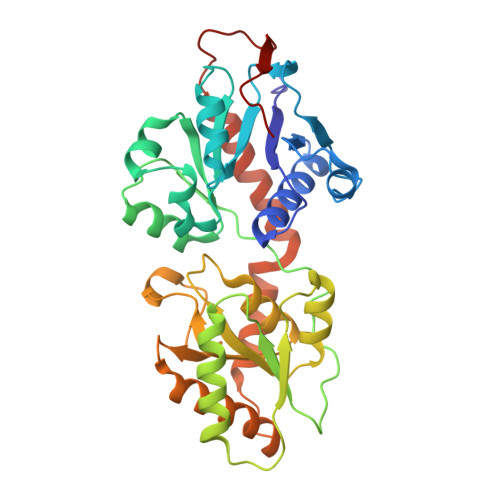
Elucidating the functions of glycosyltransferases is a necessary step toward understanding their biological roles and producing drug leads, cosmetics, and foods that utilize glycans as functional molecules. We found a previously uncharacterized protein classified as a glycosyltransferase encoded in the Actinobacillus minor NM305 genome and named the gene product A. minor glucoside-glucosyltransferase (AmGGT). To clarify the biochemical properties of the AmGGT protein, we determined its substrate specificity and crystal structure. AmGGT exhibited processive glycosyltransferase activity when UDP-Glc was used as the donor substrate and, unexpectedly, showed different acceptor substrate specificity from that of the homologous Agt proteins of other Actinobacillus species. While the homologous proteins transfer glucose residues to the nonreducing end of oligosaccharide chains linked to peptides, AmGGT cannot use glycopeptides as acceptors and requires the nonreducing end of oligosaccharides. The crystal structure provided clues to identify a sequence motif consisting of two pairs of two amino acid residues that defines the acceptor specificity, oligosaccharide, or glycopeptide. Based on this discovery, the acceptor substrate of AmGGT was changed from an oligosaccharide to a glycopeptide by transplanting the sequence motif from the homologous proteins. Furthermore, the AmGGT protein could utilize eukaryotic high-mannose type N-glycans as acceptors, as a model for branched oligosaccharides. The sequential glycosyltransfer activity and controllable substrate specificity of AmGGT will make it a useful tool in glycosyltransferase engineering to synthesize functional glycans and glycoconjugates.
- Glyco-Biochemistry Laboratory, Institute for Glyco-core Research (iGCORE), Gifu University, Gifu, Japan. Electronic address: yamasaki.takahiro.u2@f.gifu-u.ac.jp.
Organizational Affiliation: