Download Mendeley
Identification of potential C1-binding sites in the immunoglobulin CL domains.
Yanaka, S., Kodama, A., Nishiguchi, S., Fujita, R., Shen, J., Boonsri, P., Sung, D., Isono, Y., Yagi, H., Miyanoiri, Y., Uchihashi, T., Kato, K.(2024) Int Immunol 36: 405-412
- PubMed: 38564192 Search on PubMedSearch on PubMed Central
- DOI: https://doi.org/10.1093/intimm/dxae017
- Primary Citation Related Structures:
8XKJ, 8XKK, 8XLB, 8XLC - PubMed Abstract:
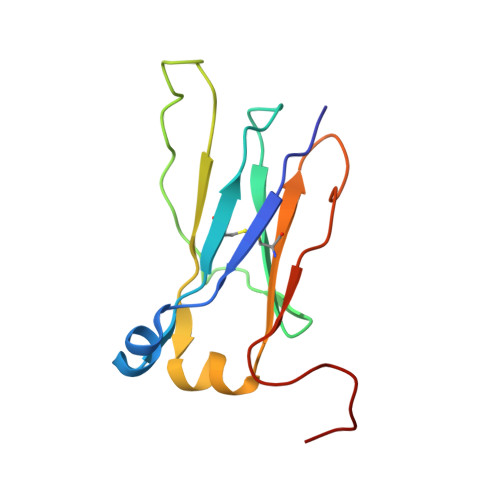
Immunoglobulin G (IgG) molecules that bind antigens on the membrane of target cells spontaneously form hexameric rings, thus recruiting C1 to initiate the complement pathway. However, our previous report indicated that a mouse IgG mutant lacking the Cγ1 domain activates the pathway independently of antigen presence through its monomeric interaction with C1q via the CL domain, as well as Fc. In this study, we investigated the potential interaction between C1q and human CL isoforms. Quantitative single-molecule observations using high-speed atomic force microscopy revealed that human Cκ exhibited comparable C1q binding capabilities with its mouse counterpart, surpassing the Cλ types, which have a higher isoelectric point than the Cκ domains. Nuclear magnetic resonance and mutation experiments indicated that the human and mouse Cκ domains share a common primary binding site for C1q, centred on Glu194, a residue conserved in the Cκ domains but absent in the Cλ domains. Additionally, the Cγ1 domain, with its high isoelectric point, can cause electrostatic repulsion to the C1q head and impede the C1q-interaction adjustability of the Cκ domain in Fab. The removal of the Cγ1 domain is considered to eliminate these factors and thus promote Cκ interaction with C1q with the potential risk of uncontrolled activation of the complement pathway in vivo in the absence of antigen. However, this research underscores the presence of potential subsites in Fab for C1q binding, offering promising targets for antibody engineering to refine therapeutic antibody design.
- Department of Creative Research, Exploratory Research Center on Life and Living Systems (ExCELLS), Department of Life and Coordination-Complex Molecular Science, Institute for Molecular Science (IMS), National Institutes of Natural Sciences, 5-1 Higashiyama, Myodaiji, Okazaki 444-8787, Japan.
Organizational Affiliation: