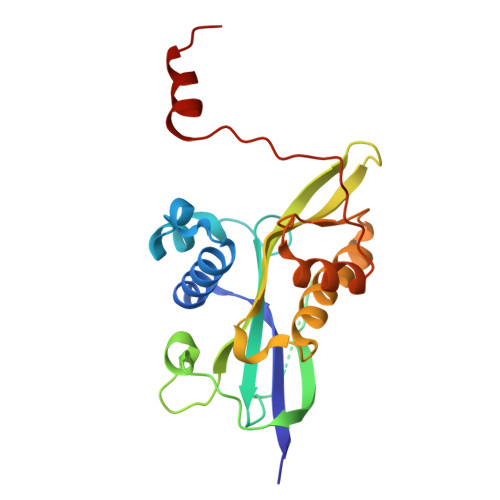
8XJF | pdb_00008xjf

Crystal structure of Arabidopsis N-amino acetyltransferase 2 bound to HEPES, Acetyl CoA, GABA, and glycerol


Experimental Data Snapshot

  • Method: X-RAY DIFFRACTION
  • Resolution: 2.00 Å
  • R-Value Free: 
    0.223 (Depositor), 0.233 (DCC) 
  • R-Value Work: 
    0.180 (Depositor), 0.193 (DCC) 

Starting Model: experimental
View more details

wwPDB Validation 3D Report Full Report

Validation slider image for 8XJF

Ligand Structure Quality Assessment 


This is version 2.1 of the entry. See complete history. 

Literature

Mechanism and regulation of Arabidopsis polyamine acetylation by NATA1 and NATA2.

Shahul Hameed, U.F., Lou, Y.R., Young, A., Yan, J., Guzman-Vega, F.J., Aleksenko, E., Ma, H., Briozzo, P., Morera, S., Jander, G., Arold, S.T.

(2026) Protein Sci 35

  • DOI: https://doi.org/10.1002/pro.70828
  • Primary Citation Related Structures: 
    8XBN, 8XBP, 8XJ5, 8XJ9, 8XJB, 8XJF, 8XJH

  • PubMed Abstract: 

    Polyamines are crucial for sustaining plant growth and stress resilience. Spermine/spermidine N1-acetyl transferases (SSATs) regulate polyamine abundance by catalyzing their N-acetylation, thereby reducing the pool of polyamines and producing other bioactive components. Arabidopsis encodes two SSAT paralogues, N-acetyltransferase activity (NATA) 1 and 2, whose physiological differences and regulatory mechanisms remain poorly understood. Here, we report eight crystal structures of NATA1 and NATA2, providing a detailed view of substrate recognition and conformational dynamics during catalysis. Biophysical analyses reveal that NATA2 is markedly more thermostable than NATA1, suggesting a compensatory role for NATA2 under heat stress. Combining structural and biochemical approaches, we further show that stress-induced acidic metabolites, including glutamate and γ-aminobutyric acid, competitively occupy the NATA active site and collectively attenuate polyamine acetylation. Based on these findings, we propose an autoregulatory mechanism in which stress-associated metabolites jointly inhibit SSAT activity to preserve polyamine pools under adverse conditions, while maintaining basal acetylation capacity. This work clarifies SSAT activity and regulation in Arabidopsis and suggests a previously unrecognized link between stress metabolism and polyamine homeostasis in plants.


  • Organizational Affiliation: 
    • KAUST Center of Excellence for Smart Health, Division of Biomedical Sciences, King Abdullah University of Science and Technology (KAUST), Thuwal, Kingdom of Saudi Arabia.

Macromolecule Content 

  • Total Structure Weight: 25.32 kDa 
  • Atom Count: 1,771 
  • Modeled Residue Count: 205 
  • Deposited Residue Count: 212 
  • Unique protein chains: 1

Macromolecules

Find similar proteins by:|  3D Structure
Entity ID: 1
MoleculeChains  Sequence LengthOrganismDetailsImage
GCN5-related N-acetyltransferase 8212Arabidopsis thalianaMutation(s): 0 
Gene Names: GNAT8, At2g39020, T7F6.19
EC: 2.3.1.48
UniProt
Find proteins for Q9ZV06 (Arabidopsis thaliana)
Explore Q9ZV06 
Go to UniProtKB:  Q9ZV06
Entity Groups
Sequence Clusters30% Identity50% Identity70% Identity90% Identity95% Identity100% Identity
UniProt GroupQ9ZV06
Sequence Annotations
Expand
Reference Sequence

Small Molecules

Experimental Data & Validation

Experimental Data

  • Method: X-RAY DIFFRACTION
  • Resolution: 2.00 Å
  • R-Value Free:  0.223 (Depositor), 0.233 (DCC) 
  • R-Value Work:  0.180 (Depositor), 0.193 (DCC) 
Space Group: C 2 2 21
Unit Cell:
Length ( Å )Angle ( ˚ )
a = 60.06α = 90
b = 69.74β = 90
c = 104.32γ = 90
Software Package:
Software NamePurpose
REFMACrefinement
PDB-REDOrefinement
XDSdata reduction
XDSdata scaling
PHASERphasing

Structure Validation

View Full Validation Report


Ligand Structure Quality Assessment 


Entry History 

& Funding Information

Deposition Data


Funding OrganizationLocationGrant Number
Other privateSaudi ArabiaKing Abdullah University of Science and Technology

Revision History  (Full details and data files)

  • Version 1.0: 2024-12-25
    Type: Initial release
  • Version 2.0: 2026-11-04
    Type: Coordinate replacement
    Reason: Missing anisotropic B-factor
    Changes: Advisory, Atomic model, Data collection, Database references, Derived calculations, Other, Refinement description, Source and taxonomy, Structure summary, Version format compliance
  • Version 2.1: 2026-11-18
    Changes: Database references